
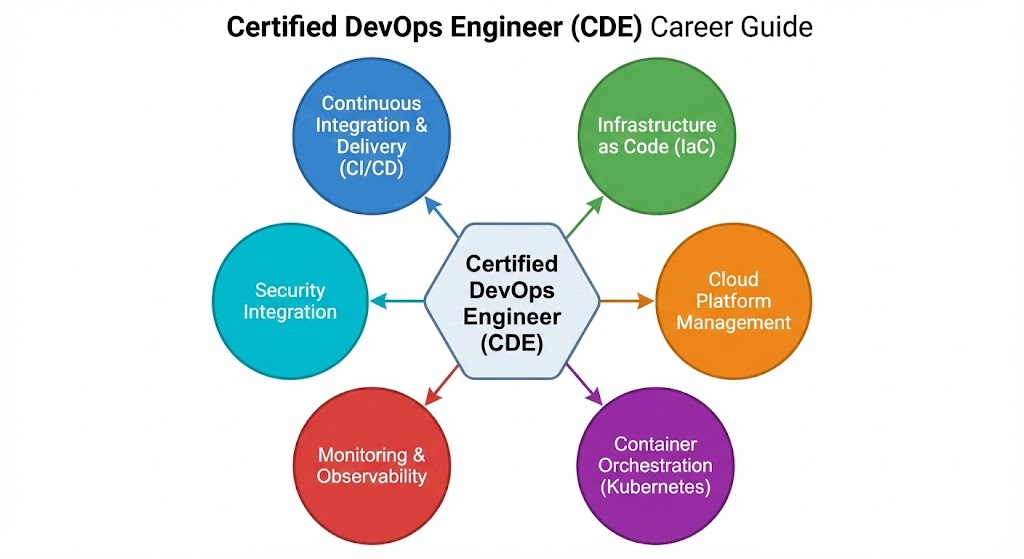
Introduction
The Certified DevOps Engineer (CDE) designation has become a cornerstone for professionals navigating the complex intersection of software development and IT operations. In an era where “ship fast or fail” is the industry standard, this guide is designed to help you understand how the CDE certification serves as a roadmap for mastering the tools, cultures, and methodologies that define modern engineering. Whether you are a developer looking to understand infrastructure or a sysadmin moving toward automation, this guide provides the clarity needed to make informed career decisions.
As we move deeper into 2026, the boundaries between DevOps, cloud-native architecture, and platform engineering continue to blur. The CDE program is structured to address this evolution, ensuring that professionals are not just learning tools in isolation but are understanding how they integrate into a cohesive delivery pipeline. This guide will break down the certification levels, the skills acquired at each stage, and how this investment translates into real-world career growth within the global tech ecosystem.
What is the Certified DevOps Engineer (CDE)?
The Certified DevOps Engineer (CDE) is a comprehensive professional validation that signifies an individual’s ability to design, implement, and manage continuous integration and continuous delivery pipelines. It exists to bridge the gap between theoretical knowledge and the high-pressure environment of production systems. Unlike certifications that focus purely on a single cloud provider, the CDE emphasizes the fundamental principles of automation, monitoring, and collaboration that apply across any environment.
In today’s enterprise landscape, organizations are moving away from “siloed” automation and toward integrated platform engineering. The CDE represents a practitioner’s commitment to these modern engineering workflows, focusing heavily on infrastructure as code, container orchestration, and automated testing. It is designed to prove that an engineer can handle the complexities of scaling applications while maintaining stability and security in a fast-paced deployment cycle.
Who Should Pursue Certified DevOps Engineer (CDE)?
This certification is built for a wide spectrum of technical professionals, ranging from software engineers who want to take ownership of their deployments to systems administrators who are transitioning into automation-heavy roles. Site Reliability Engineers (SREs) and Cloud Architects also find immense value here, as the curriculum reinforces the core tenets of scalability and reliability that are critical for large-scale distributed systems.
Furthermore, the CDE is increasingly relevant for security professionals and data engineers who need to integrate their workflows into a broader DevOps culture. In the Indian market, where the demand for “Full Stack” DevOps professionals is at an all-time high, this certification provides a competitive edge. Even technical managers and leads benefit from pursuing the CDE, as it provides them with the technical vocabulary and strategic understanding required to lead modern engineering teams effectively.
Why Certified DevOps Engineer (CDE) is Valuable in 2026 and Beyond
The demand for DevOps expertise is no longer a trend; it is a permanent shift in how software is built. As we look toward the future, the longevity of the CDE certification lies in its focus on core principles rather than just fleeting toolsets. While specific tools may evolve, the need for automated delivery, observability, and infrastructure management remains constant, ensuring that CDE-certified professionals remain relevant regardless of market shifts.
Enterprise adoption of cloud-native technologies continues to accelerate, creating a massive vacuum for skilled practitioners who can manage complex Kubernetes clusters and serverless architectures. By earning the CDE, professionals demonstrate a high return on investment for their employers through reduced deployment lead times and improved system uptime. For the individual, it acts as a catalyst for salary growth and provides a clear pathway to senior roles like Principal Engineer or Head of Platform.
Certified DevOps Engineer (CDE) Certification Overview
The Certified DevOps Engineer (CDE) program is a structured learning journey delivered via the official platform and is hosted by the reputable organization DevOpsSchool. This program is designed to be rigorous and practical, moving beyond simple multiple-choice exams to focus on competency-based assessments that mirror actual industry challenges.
The certification is owned and maintained by industry experts who regularly update the curriculum to reflect current enterprise practices. It is structured into distinct levels—Foundation, Professional, and Advanced—to accommodate different stages of an engineer’s career. Each level requires a combination of self-paced learning, hands-on labs, and a final assessment that validates both technical proficiency and a strategic understanding of DevOps culture.
Certified DevOps Engineer (CDE) Certification Tracks & Levels
The CDE program is organized into three primary levels to ensure a logical progression of skills. The Foundation level focuses on the “What” and “Why” of DevOps, introducing the core concepts of CI/CD, version control, and team collaboration. It is the entry point for those new to the field or for managers who need a high-level technical overview of the ecosystem.
The Professional level is where the “How” happens, diving deep into the specific toolchains and workflows used in production, such as Docker, Jenkins, and Terraform. For those seeking mastery, the Advanced level covers complex topics like SRE practices, FinOps, and architectural scaling. These levels allow professionals to specialize in tracks like DevSecOps or MLOps, ensuring their certification aligns perfectly with their specific career aspirations and the needs of their current organization.
Complete Certified DevOps Engineer (CDE) Certification Table
| Track | Level | Who it’s for | Prerequisites | Skills Covered | Recommended Order | Official Link |
| Core DevOps | Foundation | Beginners, Managers | Basic IT knowledge | DevOps Culture, CI/CD Basics, Git | 1st | Link |
| Engineering | Professional | Working Engineers | Foundation Level | Docker, Kubernetes, Ansible, Jenkins | 2nd | Link |
| Architecture | Advanced | Senior Engineers, SREs | Professional Level | Scaling, Observability, IaC Architecture | 3rd | Link |
Detailed Guide for Each Certified DevOps Engineer (CDE) Certification
Certified DevOps Engineer (CDE) – Foundation
What it is The Foundation level validates your understanding of the core DevOps philosophy and the basic building blocks of a delivery pipeline. It ensures you speak the language of modern engineering teams.
Who should take it This is ideal for junior developers, traditional IT operations staff, or project managers who need to understand how DevOps impacts the software development lifecycle.
Skills you’ll gain
- Understanding the CALMS framework (Culture, Automation, Lean, Measurement, Sharing).
- Basic proficiency with Git and version control strategies.
- Knowledge of Continuous Integration and Continuous Deployment (CI/CD) concepts.
- Familiarity with the software development lifecycle (SDLC) in a DevOps context.
Real-world projects you should be able to do
- Set up a basic version control workflow for a small team.
- Document a manual deployment process and identify automation opportunities.
- Participate effectively in Scrum or Kanban-based DevOps teams.
Preparation plan
- 7-14 Days: Focus on reading core DevOps whitepapers and understanding the terminology.
- 30 Days: Complete the basic hands-on labs for Git and introductory CI tools.
- 60 Days: Not typically required for this level unless you are entirely new to IT.
Common mistakes
- Focusing too much on specific tools rather than the underlying culture and philosophy.
- Skipping the fundamentals of version control.
Best next certification after this
- Same-track option: CDE Professional.
- Cross-track option: Certified DevSecOps Professional.
- Leadership option: Certified DevOps Manager.
Certified DevOps Engineer (CDE) – Professional
What it is The Professional certification validates your ability to build and maintain production-grade DevOps toolchains. It is the industry benchmark for a “hands-on” DevOps Engineer.
Who should take it This is for engineers with 1-3 years of experience who are responsible for maintaining build servers, container environments, and deployment scripts.
Skills you’ll gain
- Mastering containerization with Docker and basic orchestration with Kubernetes.
- Advanced CI/CD pipeline construction using tools like Jenkins or GitLab CI.
- Infrastructure as Code (IaC) implementation using Terraform or Ansible.
- Basic monitoring and logging setup for distributed applications.
Real-world projects you should be able to do
- Containerize a multi-tier application and deploy it to a cluster.
- Build a fully automated “Commit to Deploy” pipeline with integrated testing.
- Use configuration management to provision and update multiple server environments.
Preparation plan
- 7-14 Days: Reviewing specific tool syntax (YAML, HCL) and pipeline logic.
- 30 Days: Daily hands-on lab practice focusing on integration between different tools.
- 60 Days: Deep dive into troubleshooting complex deployment failures and networking.
Common mistakes
- Memorizing commands without understanding the logic of why a tool is used.
- Ignoring the “security” aspect of the pipeline (e.g., hardcoding secrets).
Best next certification after this
- Same-track option: CDE Advanced.
- Cross-track option: Certified SRE Professional.
- Leadership option: Technical Program Manager (TPM) in DevOps.
Certified DevOps Engineer (CDE) – Advanced
What it is The Advanced level validates your capacity to architect resilient, scalable systems and lead organizational change. It focuses on high-level strategy and complex problem-solving.
Who should take it Senior engineers, Architects, and aspiring SREs who have at least 5 years of experience and deal with large-scale, high-availability environments.
Skills you’ll gain
- Advanced Kubernetes patterns, Service Mesh (Istio), and GitOps.
- Designing for high availability, disaster recovery, and multi-region deployments.
- Advanced observability, tracing, and AIOps integration.
- Cost optimization and FinOps principles within the cloud-native ecosystem.
Real-world projects you should be able to do
- Design a self-healing infrastructure that can survive a regional cloud outage.
- Implement a GitOps workflow for managing dozens of microservices across clusters.
- Conduct a thorough post-mortem and implement preventative observability measures.
Preparation plan
- 7-14 Days: Studying case studies of large-scale system failures and architectural patterns.
- 30 Days: Building complex multi-cloud or hybrid-cloud lab environments.
- 60 Days: Refining leadership skills and learning how to measure DevOps success via DORA metrics.
Common mistakes
- Over-engineering solutions for simple problems.
- Neglecting the financial impact (FinOps) of architectural decisions.
Best next certification after this
- Same-track option: CDE Expert / Specialist Tracks.
- Cross-track option: Certified MLOps Engineer.
- Leadership option: CTO or Head of Platform Engineering.
Choose Your Learning Path
DevOps Path
The traditional DevOps path focuses on the core cycle of Plan, Code, Build, Test, Release, Deploy, Operate, and Monitor. This path is ideal for those who want to be the “glue” between development and production. You will spend most of your time refining CI/CD pipelines and ensuring that code reaches the user as quickly and safely as possible. It requires a balanced knowledge of both software development practices and system operations.
DevSecOps Path
The DevSecOps path is for those who believe security should be “shifted left” and integrated into every stage of the pipeline. In this path, you will learn how to automate security scanning, manage secrets securely, and implement compliance as code. It is an increasingly critical role as cyber threats become more sophisticated. Professionals on this path often act as the bridge between the security team and the engineering organization.
SRE Path
Site Reliability Engineering (SRE) is a specific implementation of DevOps that focuses on using software engineering disciplines to solve operations problems. On this path, you will focus on service level objectives (SLOs), error budgets, and building automated systems to manage other systems. It is highly analytical and requires a deep understanding of system internals and distributed computing. SREs are the guardians of uptime and performance.
AIOps / MLOps Path
This path is at the bleeding edge of the industry, focusing on applying DevOps principles to machine learning models and using AI to manage IT operations. In MLOps, you handle the unique challenges of data versioning and model retraining pipelines. In AIOps, you use machine learning to analyze vast amounts of log data to predict and prevent outages. This is perfect for engineers with an interest in data science and advanced automation.
DataOps Path
DataOps is a collaborative data management practice focused on improving the communication, integration, and automation of data flows between data managers and data consumers. This path applies the agility of DevOps to the world of big data and analytics. You will learn how to build automated data pipelines that are resilient, scalable, and high-quality. It is an essential path for organizations that rely heavily on real-time data for decision-making.
FinOps Path
FinOps is an evolving cloud financial management discipline and cultural practice that enables organizations to get maximum business value by helping engineering, finance, and technology teams to collaborate on data-driven spending decisions. On this path, you learn how to balance performance with cost-efficiency. It involves heavy use of tagging, automated rightsizing, and cloud cost forecasting. This path is highly valued by executives who want to control cloud “sticker shock.”
Role → Recommended Certified DevOps Engineer (CDE) Certifications
| Role | Recommended Certifications |
| DevOps Engineer | CDE Foundation, Professional, Advanced |
| SRE | CDE Professional, Certified SRE Professional |
| Platform Engineer | CDE Advanced, Certified Kubernetes Specialist |
| Cloud Engineer | CDE Professional, Cloud-Specific Architect Certs |
| Security Engineer | CDE Foundation, Certified DevSecOps Professional |
| Data Engineer | CDE Professional, Certified DataOps Professional |
| FinOps Practitioner | CDE Foundation, Certified FinOps Specialist |
| Engineering Manager | CDE Foundation, Certified DevOps Manager |
Next Certifications to Take After Certified DevOps Engineer (CDE)
Same Track Progression
Once you have mastered the core CDE levels, the natural next step is to look toward “Expert” status or specialized niche certifications within the same ecosystem. This might include deep-diving into specific tools like advanced Kubernetes security or specialized service mesh configurations. Staying within the same track allows you to become a Subject Matter Expert (SME) that organizations rely on for their most complex infrastructure challenges.
Cross-Track Expansion
If you feel your core DevOps skills are solid, expanding cross-track is the best way to become a versatile lead. For example, a CDE Professional might move into the DevSecOps track to add a security lens to their work, or into the MLOps track to support the growing demand for AI-driven products. This “T-shaped” skill set makes you incredibly valuable in a market that prizes flexibility and broad technical understanding.
Leadership & Management Track
For those who wish to move away from daily coding and terminal work, the leadership track is the logical progression. This involves taking certifications that focus on the people and process side of DevOps. You will learn about organizational change management, how to build and scale high-performing teams, and how to align technical strategy with business goals. This path leads to roles like DevOps Director or VP of Engineering.
Training & Certification Support Providers for Certified DevOps Engineer (CDE)
DevOpsSchool
DevOpsSchool is a primary resource for CDE aspirants, offering a vast array of hands-on labs and instructor-led sessions. They focus on real-world scenarios and provide deep technical insights that go beyond the exam syllabus. Their community support is robust, making it a top choice for those in India and abroad.
Cotocus
Cotocus provides highly specialized training focused on the practical implementation of DevOps tools in enterprise environments. They are known for their “project-first” approach, ensuring that students can actually build the systems they are being certified on. Their curriculum is strictly aligned with current industry standards.
Scmgalaxy
Scmgalaxy is one of the oldest and most trusted names in the DevOps community, offering a wealth of free resources alongside their formal training programs. They focus heavily on the “Source Code Management” aspect of the pipeline, which is a critical foundation for any CDE professional.
BestDevOps
BestDevOps offers a curated learning experience designed to get engineers “job-ready” in the shortest time possible. Their training modules are concise and focused on the most high-demand tools in the current market, making them ideal for busy professionals.
devsecopsschool.com
This provider is the go-to source for those looking to specialize in the security aspect of the CDE journey. They provide specialized modules on automated security testing and compliance that integrate perfectly with the core CDE curriculum.
sreschool.com
Sreschool.com focuses specifically on the reliability and scalability aspects of the DevOps ecosystem. Their training is highly technical and aimed at engineers who want to master the art of keeping massive, complex systems running smoothly.
aiopsschool.com
As the name suggests, this provider focuses on the intersection of AI and Operations. They offer unique training on using machine learning to enhance the DevOps cycle, providing CDE holders with a futuristic edge in their careers.
dataopsschool.com
Dataopsschool.com is dedicated to the world of automated data pipelines. They help CDE professionals transition their automation skills to the data domain, covering everything from ETL automation to data quality monitoring.
finopsschool.com
Finopsschool.com addresses the critical need for cloud cost management. They provide training that helps engineers understand the financial impact of their technical decisions, a skill that is increasingly required for senior CDE roles.
Frequently Asked Questions (General)
How difficult is the CDE certification compared to others? The CDE certification is considered moderately to highly difficult because it prioritizes practical application over rote memorization. While entry-level cloud certifications might only require understanding what a service does, the CDE requires you to know how to integrate that service into a complex, automated pipeline. It tests your ability to troubleshoot real-world scenarios, which requires a deeper level of cognitive engagement than simple multiple-choice exams. For a prepared engineer with some hands-on experience, it is a manageable but rewarding challenge that commands respect in the industry.
What is the average time required to prepare for the CDE? Preparation time varies significantly based on your starting point. A seasoned engineer might only need 30 days of focused study to bridge their knowledge gaps, while a beginner might require 3 to 6 months to master the underlying concepts of Linux, networking, and coding before tackling the CDE curriculum. On average, most professionals find that a consistent 10-12 hours of study per week over two months provides enough depth to pass the Professional level comfortably. It is not a certification you should rush, as the value lies in the skills you build.
Are there any prerequisites for the CDE Foundation level? Technically, there are no hard prerequisites for the Foundation level, as it is designed to be an entry point. However, having a basic understanding of how software is developed and a general familiarity with IT infrastructure will make the learning process much smoother. If you have never used a command-line interface or don’t know what a server is, you might want to take a basic “IT Fundamentals” course first. The Foundation level is the perfect place for career switchers to start their journey into the world of modern engineering.
Does the CDE certification cover specific cloud providers like AWS or Azure? The CDE is designed to be “cloud-agnostic,” meaning it focuses on principles and tools that work across any environment. While you might use AWS, Azure, or Google Cloud in your labs, the certification teaches you how to use tools like Terraform, Kubernetes, and Jenkins to manage resources regardless of where they live. This approach is highly valuable because it ensures you aren’t locked into a single ecosystem. It makes you a more versatile engineer who can move between different companies that use different cloud providers without losing your edge.
Is the CDE certification recognized globally? Yes, the CDE is recognized by major technology hubs around the world, including the United States, Europe, and India. Because the curriculum is based on the standard tools used by global giants like Netflix, Amazon, and Google, the skills you prove by earning the CDE are universally applicable. Many multinational corporations (MNCs) specifically look for CDE or equivalent validations when hiring for their platform and SRE teams. It acts as a standardized “technical passport” that validates your expertise to recruiters and hiring managers globally.
What is the validity period of the CDE certification? The CDE certification typically remains valid for two to three years. This is standard for technical certifications in fields that change as rapidly as DevOps. To maintain your certification, you are usually required to either pass a higher-level exam or participate in continuing education credits. This ensures that your skills remain fresh and that you are up to date with the latest versions of tools and industry best practices. It prevents the certification from becoming a “legacy” badge that no longer reflects current market realities.
How does CDE help in salary negotiation? Earning a CDE often leads to a significant bump in salary, as it moves you into a “specialist” category. In many markets, DevOps engineers earn 20-30% more than standard software developers with the same years of experience. Having the certification provides you with objective proof of your skills, which gives you more leverage during annual reviews or when interviewing for new roles. It signals to the employer that you are a high-value asset who can reduce their operational risks and increase their deployment frequency, which has a direct impact on their bottom line.
Can I take the CDE exam online? Yes, the CDE exams are generally available through online proctoring services, allowing you to take the test from the comfort of your home or office. This makes it highly accessible for professionals worldwide. You will need a stable internet connection, a webcam, and a quiet environment. The online format includes the same practical, lab-based challenges as an in-person exam, ensuring that the integrity of the certification is maintained. This flexibility is a major advantage for busy engineers who cannot afford to travel to testing centers.
What tools are most important for the CDE Professional level? The most critical tools for the Professional level include Git for version control, Docker for containerization, Kubernetes for orchestration, Jenkins for CI/CD, and Terraform or Ansible for Infrastructure as Code. You don’t need to be a world-class expert in every single one, but you must understand how they interact. For instance, you should know how a code change in Git triggers a Jenkins build, which creates a Docker image and then deploys it to a Kubernetes cluster via a Terraform script. Understanding this “flow” is the key to success.
Is there a community for CDE certified professionals? Yes, there is a vibrant community of CDE professionals who connect through forums, Slack channels, and LinkedIn groups. Many of the training providers like DevOpsSchool also host exclusive alumni groups where members share job leads, troubleshooting tips, and advice on the latest industry trends. Being part of this community is often just as valuable as the certification itself, as it provides a network of peers who are working on similar challenges. It is a great way to stay motivated and keep your knowledge current through peer-to-peer learning.
Does CDE focus more on coding or operations? The CDE is a true hybrid. It requires you to have enough coding knowledge to write scripts (usually in Python, Bash, or Go) and manage configuration files (in YAML or JSON). On the other hand, it also requires a deep understanding of operations, such as Linux internals, networking, and security. The goal of the CDE is to make you proficient in both areas so that you can facilitate the “merging” of these two worlds. If you are a dev, it will push you toward ops; if you are ops, it will push you toward dev.
What is the ROI of the CDE certification? The Return on Investment (ROI) for the CDE is generally very high. The cost of the training and exam is usually recovered within the first few months of a new role or a promotion. Beyond the financial aspect, the ROI includes the time saved through better workflows and the reduced stress that comes with having a deep, confident understanding of your production environment. For many, the greatest ROI is the career longevity it provides, ensuring they are not left behind as the industry moves further into the cloud-native era.
FAQs on Certified DevOps Engineer (CDE)
What specifically makes the CDE curriculum “production-focused”? The CDE curriculum is built around “Day 2” operations—what happens after the code is deployed. While many courses stop at “Hello World,” the CDE requires you to manage stateful sets in Kubernetes, handle database migrations in a CI/CD pipeline, and set up complex monitoring alerts that filter out noise. This focus ensures that when you arrive on the job, you aren’t surprised by the messy realities of enterprise software. It focuses on resilience, security, and scalability—the three pillars that determine whether a production system succeeds or fails under load.
How does CDE address the “Culture” aspect of DevOps? Unlike purely technical tool-based certifications, the CDE places a strong emphasis on the “Soft Skills” and cultural shifts required for DevOps to work. This includes learning how to conduct blameless post-mortems, how to break down communication silos between teams, and how to implement a “You Build It, You Run It” mentality. The certification recognizes that even the best tools will fail if the organization’s culture is still stuck in a traditional, finger-pointing mindset. It teaches you how to be a change agent within your company, not just a script-writer.
Is Python a requirement for the CDE? While you don’t need to be a senior Python developer, having a working knowledge of Python (or a similar language like Go or Ruby) is highly recommended for the CDE Professional and Advanced levels. DevOps is fundamentally about “software defined” everything, and that requires some level of programming. You should be able to write scripts to interact with APIs, automate repetitive tasks, and understand the logic in the deployment scripts you will be managing. If you are new to coding, the CDE journey is the perfect excuse to finally learn these essential modern engineering skills.
How does CDE differ from a Cloud Provider certification like AWS Certified DevOps Engineer? The primary difference is scope and portability. An AWS-specific certification focuses deeply on AWS services like CodePipeline, CloudFormation, and OpsWorks. While valuable, those skills are less transferable if your next company uses Azure or an on-premise OpenStack cloud. The CDE focuses on “Best-of-Breed” open-source tools that are the industry standard across all clouds. By learning the CDE way, you gain a foundation that makes it very easy to pick up any cloud-provider-specific tools later. It makes you a more flexible and platform-independent professional.
Can I skip the Foundation level if I have experience? Yes, if you are already working in a technical role and understand the basics of Git and the SDLC, you can often jump straight to the CDE Professional level. However, many experienced engineers still find value in the Foundation level as it helps standardize their terminology and fills in any “theoretical gaps” they might have picked up during their hands-on work. It is worth reviewing the Foundation syllabus; if you find that you can explain all the concepts clearly to a non-technical person, you are likely ready to move directly to the Professional track.
How are the lab portions of the CDE exam graded? The labs are usually graded based on the “End State.” The automated grading system checks if the requested infrastructure is running, if the pipeline successfully deploys the app, and if the security constraints are met. It doesn’t usually care how you got there, as long as the solution is efficient and follows best practices. This mirrors real life, where your manager cares about the result and the reliability of the system. This practical approach prevents “brain-dumping” and ensures that only those who can actually do the work receive the certification.
What is the role of Kubernetes in the CDE? Kubernetes is a central pillar of the CDE Professional and Advanced levels. As the industry standard for container orchestration, it is impossible to be a modern DevOps engineer without a deep understanding of K8s. The CDE covers everything from basic pod deployments and services to advanced topics like Ingress controllers, Helm charts, and Persistent Volumes. By the time you reach the Advanced level, you are expected to be able to architect and troubleshoot clusters, not just run basic commands. It is one of the most career-transforming skills in the entire program.
Will the CDE help me move into a Platform Engineering role? Absolutely. Platform Engineering is essentially “DevOps at Scale,” and the CDE provides the exact technical foundation needed for it. A Platform Engineer’s job is to create an “Internal Developer Platform” (IDP) that allows developers to self-serve their infrastructure. The skills you learn in the CDE—like Infrastructure as Code, CI/CD, and Kubernetes—are the exact building blocks you will use to create those platforms. The CDE Advanced level, in particular, focuses on the architectural thinking required to build these scalable, multi-tenant environments that define the modern platform engineering landscape.
Final Thoughts: Is Certified DevOps Engineer (CDE) Worth It?
From the perspective of a mentor who has seen the industry transition from physical racks to serverless functions, the answer is a resounding yes—but with a caveat. The CDE is worth it if you approach it as a way to build a deep, functional understanding of engineering systems, rather than just a badge to put on your LinkedIn profile. The industry has plenty of “certified” people who can’t troubleshoot a simple network latency issue; don’t be one of them. Use this certification as a rigorous training program to harden your skills.
The real value of the CDE is that it forces you to step out of your comfort zone. If you are a developer, it forces you to think about the network and the disk; if you are an admin, it forces you to think about code quality and test coverage. In 2026, the most successful engineers are those who can navigate the entire stack. The CDE is one of the few programs that provides a structured, unbiased path to achieving that versatility. Invest the time, do the labs, and the career growth will follow naturally.
Helpful and informative article! It explains the Certified DevOps Engineer certification clearly, highlighting key skills, career opportunities, and the value it brings to DevOps professionals.