
Introduction
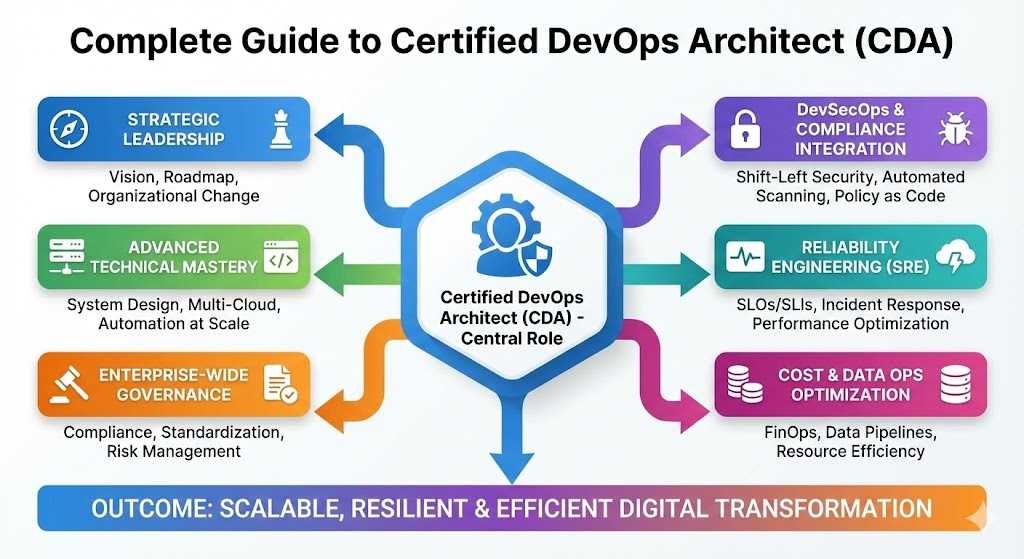
The Certified DevOps Architect (CDA) represents the pinnacle of technical leadership in the modern software delivery lifecycle. This guide serves as a comprehensive roadmap for engineers, architects, and technical managers who aim to master the art of designing scalable, resilient, and automated systems. As organizations move toward cloud-native architectures and platform engineering, the ability to bridge the gap between development and operations becomes critical. This guide helps you navigate the complexities of this certification to ensure your career decisions align with global industry standards and enterprise demands.
What is the Certified DevOps Architect (CDA)?
The Certified DevOps Architect (CDA) is a professional designation that validates your ability to design and implement complex DevOps frameworks within an enterprise environment. Unlike foundational certifications that focus on single tools, this program emphasizes high-level architectural patterns, infrastructure as code, and continuous delivery strategies. It exists to bridge the gap between knowing how to use a tool and knowing how to build a production-grade ecosystem. It aligns perfectly with modern engineering workflows by focusing on security, scalability, and observability from the initial design phase.
Who Should Pursue Certified DevOps Architect (CDA)?
This certification targets a wide range of professionals, from senior software engineers to site reliability engineers (SREs) and cloud architects. It is particularly beneficial for experienced engineers who want to transition into leadership roles or design-heavy positions. Managers who lead technical teams will find the strategic insights invaluable for making informed architectural decisions. Whether you are based in India’s booming tech hubs or working in a global distributed team, this credential signals a high level of expertise in managing complex enterprise digital transformations.
Why Certified DevOps Architect (CDA) is Valuable and Beyond
The demand for skilled architects continues to rise as companies adopt microservices and multi-cloud strategies. Achieving the Certified DevOps Architect (CDA) ensures you remain relevant even as specific tools evolve or disappear, because it teaches the underlying principles of automation and resilience. It offers a significant return on time by focusing on architectural endurance rather than just syntax. Furthermore, enterprise adoption of DevOps practices ensures that architects with this certification have long-term job security and high growth potential in the global market.
Certified DevOps Architect (CDA) Certification Overview
The program is delivered via Certified DevOps Architect (CDA) and hosted on DevOpsSchool. This certification uses a rigorous assessment approach that combines theoretical knowledge with practical, scenario-based evaluations. It covers various levels of expertise, ensuring that professionals can demonstrate their skills in a structured and verifiable manner. The ownership of the program rests with industry veterans who update the curriculum frequently to match current enterprise practices and emerging technologies.
Certified DevOps Architect (CDA) Certification Tracks & Levels
The certification structure follows a logical progression from foundation to advanced mastery. The foundation level introduces core concepts of architectural thinking, while the professional level dives deep into implementation strategies for CI/CD and monitoring. The advanced level focuses on enterprise-scale design, including governance, compliance, and multi-region deployments. These tracks allow professionals to specialize in areas like SRE or DevSecOps while maintaining a strong architectural core. This alignment ensures that your learning path mirrors your actual career progression in the industry.
Complete Certified DevOps Architect (CDA) Certification Table
| Track | Level | Who it’s for | Prerequisites | Skills Covered | Recommended Order | Official Link |
| Core Architecture | Foundation | Aspiring Architects | 2+ years experience | DevOps Basics, IAC | 1st | Link |
| System Design | Professional | Senior Engineers | Foundation Level | Microservices, CI/CD | 2nd | Link |
| Enterprise Strategy | Advanced | Lead Architects | Professional Level | Governance, Security | 3rd | Link |
Detailed Guide for Each Certified DevOps Architect (CDA) Certification
Certified DevOps Architect (CDA) – Foundation
What it is This certification validates the candidate’s understanding of basic DevOps architectural principles and the ability to contribute to automated delivery pipelines. It ensures you understand the fundamental shift from traditional silos to integrated engineering cultures.
Who should take it Software developers, junior system administrators, and quality assurance engineers should take this exam to establish a strong theoretical and practical baseline. It suits those with at least two years of experience in IT environments.
Skills you’ll gain
- Mastery of Version Control Systems (Git) architectural patterns.
- Understanding of Containerization basics using Docker.
- Ability to design basic Continuous Integration (CI) workflows.
- Knowledge of Infrastructure as Code (IaC) fundamentals.
Real-world projects you should be able to do
- Create a multi-stage Dockerfile for a web application.
- Set up a basic Jenkins or GitLab CI pipeline for automated testing.
- Automate local environment provisioning using Vagrant or Terraform.
Preparation plan
- 7–14 days: Review core DevOps terminology and basic tool syntax.
- 30 days: Complete hands-on labs for Docker and Jenkins integrations.
- 60 days: Deep dive into networking basics and Linux administration.
Common mistakes
- Ignoring the cultural aspects of DevOps in favor of tool-only learning.
- Neglecting basic Linux command-line proficiency.
Best next certification after this
- Same-track: CDA Professional
- Cross-track: Certified SRE Practitioner
- Leadership: DevOps Team Lead
Certified DevOps Architect (CDA) – Professional
What it is This level confirms your expertise in designing and managing scalable, production-grade environments. It focuses on the integration of various tools into a cohesive, self-healing system that supports high-frequency deployments.
Who should take it Experienced DevOps engineers and senior developers who are responsible for maintaining production uptime and deployment automation. It requires a solid grasp of container orchestration and cloud services.
Skills you’ll gain
- Advanced Kubernetes cluster architecture and management.
- Implementation of Service Meshes for microservices communication.
- Designing automated rollback and canary deployment strategies.
- Configuration management at scale using Ansible or Chef.
Real-world projects you should be able to do
- Deploy a highly available Kubernetes cluster on a public cloud provider.
- Implement a GitOps workflow using ArgoCD or Flux.
- Build a centralized logging and monitoring system using ELK or Prometheus.
Preparation plan
- 7–14 days: Study Kubernetes objects and networking deep dives.
- 30 days: Build a complete end-to-end pipeline with security scanning.
- 60 days: Perform disaster recovery drills and architectural reviews.
Common mistakes
- Over-complicating the architecture with unnecessary tools.
- Failing to account for stateful application requirements in containers.
Best next certification after this
- Same-track: CDA Advanced
- Cross-track: DevSecOps Expert
- Leadership: Engineering Manager
Certified DevOps Architect (CDA) – Advanced
What it is The Advanced level validates your capability to lead enterprise-wide DevOps transformations. It covers the strategic side of engineering, focusing on compliance, cost optimization, and large-scale organizational structure.
Who should take it Principal engineers, Chief Architects, and Technical Directors who make high-stakes decisions regarding technology stacks and organizational workflows. Candidates should have extensive experience in multiple domains.
Skills you’ll gain
- Designing multi-cloud and hybrid-cloud architectures.
- Implementing enterprise-wide security and compliance gates.
- Financial operations (FinOps) for cloud cost management.
- Strategic planning for legacy migration to cloud-native platforms.
Real-world projects you should be able to do
- Design a disaster recovery plan for a global, multi-region application.
- Create a governance framework for cloud resource provisioning.
- Lead a migration of a monolith to microservices for a large enterprise.
Preparation plan
- 7–14 days: Study cloud governance and compliance frameworks (SOC2, GDPR).
- 30 days: Focus on FinOps strategies and cost-saving architectural patterns.
- 60 days: Review case studies of large-scale DevOps transformations.
Common mistakes
- Focusing too much on technical details while ignoring business ROI.
- Failing to build consensus across different engineering departments.
Best next certification after this
- Same-track: CTO Mentorship Program
- Cross-track: AI/MLOps Architect
- Leadership: Certified IT Director
Choose Your Learning Path
DevOps Path
Engineers follow this path to master the core loop of plan, code, build, test, release, deploy, operate, and monitor. You start with foundation skills and move toward automating everything in the lifecycle. This path creates a generalist who can handle any part of the delivery pipeline with ease. It remains the most popular choice for those entering the field from a development background.
DevSecOps Path
The security path integrates protection into every stage of the DevOps cycle rather than treating it as an afterthought. You will learn to automate security scanning, manage secrets effectively, and implement “security as code.” This path is essential for professionals working in regulated industries like finance or healthcare. It transforms a standard architect into a guardian of the production environment.
SRE Path
Site Reliability Engineering focuses specifically on the “operate” and “monitor” aspects of the lifecycle. This path teaches you how to use software engineering principles to solve operations problems. You will focus on service level objectives (SLOs), error budgets, and incident management. It is the ideal route for those who enjoy making systems highly available and performant.
AIOps / MLOps Path
This modern path applies DevOps principles to the world of machine learning and artificial intelligence. You will learn how to automate the training, deployment, and monitoring of ML models. As AI becomes integrated into every product, the need for architects who understand model versioning and data drift increases. This path bridges the gap between data science and traditional engineering.
DataOps Path
DataOps focuses on the automated, policy-based management of data to improve quality and reduce cycle time. You will learn how to build resilient data pipelines and manage large-scale data warehouses. This path is perfect for data engineers who want to apply architectural rigor to their data workflows. It ensures that data remains accessible, clean, and secure across the organization.
FinOps Path
The FinOps path teaches architects how to balance speed, cost, and quality in the cloud. You will learn to design systems that are not only performant but also cost-effective. By understanding cloud billing and resource optimization, you help the organization maximize its return on cloud investment. This is a critical skill set for architects working in large-scale enterprise environments.
Role → Recommended Certified DevOps Architect (CDA) Certifications
| Role | Recommended Certifications |
| DevOps Engineer | CDA Foundation, CDA Professional |
| SRE | CDA Professional, SRE Practitioner |
| Platform Engineer | CDA Advanced, Kubernetes Specialist |
| Cloud Engineer | CDA Professional, Cloud Provider Certs |
| Security Engineer | CDA Foundation, DevSecOps Expert |
| Data Engineer | CDA Professional, DataOps Specialist |
| FinOps Practitioner | CDA Advanced, FinOps Certified |
| Engineering Manager | CDA Foundation, Leadership Track |
Next Certifications to Take After Certified DevOps Architect (CDA)
Same Track Progression
Once you complete the advanced level, focus on deep specialization within specific toolsets or cloud providers. For instance, obtaining expert-level AWS or Azure certifications complements your architectural knowledge with provider-specific depth. You may also look into specialized certifications for service meshes or advanced container security. Continuous learning in the same track ensures you remain the go-to expert for architectural design.
Cross-Track Expansion
Broadening your skills into AIOps or FinOps after completing the CDA makes you a “T-shaped” professional. This means you have deep knowledge in DevOps architecture but can also speak the language of data scientists or financial controllers. Cross-track expansion is the best way to move into high-level consulting or principal engineering roles where multi-disciplinary knowledge is required.
Leadership & Management Track
If you wish to move away from hands-on keyboard work, use the CDA as a springboard into management. Combine your technical architectural skills with certifications in ITIL, PMP, or dedicated Engineering Management programs. Your background as a Certified DevOps Architect will give you the technical credibility needed to lead high-performing engineering teams effectively.
Training & Certification Support Providers for Certified DevOps Architect (CDA)
DevOpsSchool
DevOpsSchool provides a comprehensive learning ecosystem specifically tailored for the CDA program. They offer instructor-led sessions and a massive library of practical labs to ensure hands-on mastery. Their curriculum is updated frequently to reflect the latest changes in the DevOps landscape.
Cotocus
Cotocus focuses on enterprise-level training and consulting, helping professionals master the complexities of the CDA curriculum. They emphasize real-world scenarios and provide deep insights into how large organizations implement DevOps at scale. Their trainers are often active practitioners in the industry.
Scmgalaxy
Scmgalaxy is a well-known community and training hub that offers extensive resources for CDA candidates. They provide a wealth of tutorials, blog posts, and community support to help engineers troubleshoot common architectural challenges. Their approach is very practical and grounded in community-driven knowledge.
BestDevOps
BestDevOps specializes in streamlined certification paths for busy professionals. They offer focused boot camps and exam preparation materials that help candidates clear the CDA assessments with confidence. Their training style is direct and efficiency-oriented, making it popular for working engineers.
devsecopsschool.com
This provider focuses specifically on the intersection of security and DevOps within the CDA framework. They offer specialized modules that teach you how to bake security into your architectural designs. This is a vital resource for anyone pursuing the DevSecOps specialization track.
sreschool.com
Sreschool.com provides dedicated training for the reliability and operations aspects of the CDA program. They focus on observability, incident response, and the software engineering side of operations. Their labs are designed to simulate high-pressure production environments.
aiopsschool.com
Aiopsschool.com caters to the emerging field of AI-driven operations. They help CDA candidates understand how to integrate machine learning into their monitoring and automation stacks. This provider is excellent for those looking to future-proof their architectural skills.
dataopsschool.com
Dataopsschool.com offers specialized training in managing data pipelines and big data architecture within a DevOps context. They provide the necessary tools and methodologies to apply CDA principles to complex data environments. This is a key resource for modern data engineers.
finopsschool.com
Finopsschool.com focuses on the financial management side of cloud architecture. They provide CDA candidates with the skills needed to optimize costs and justify cloud spending to stakeholders. Their training is essential for architects working on large-scale budget-conscious projects.
Frequently Asked Questions (General)
- How difficult is the Certified DevOps Architect (CDA) exam? The difficulty of the CDA exam is moderate to high, depending on your practical experience. It is not a simple multiple-choice test that you can pass by memorizing definitions. The exam requires a deep understanding of how different tools and processes interact within a system. You will face scenario-based questions that test your ability to design solutions for real-world problems. Preparation involves significant hands-on practice and a solid grasp of architectural patterns. For those with a strong background in engineering, the challenge is rewarding and manageable with consistent study.
- How much time does it take to get certified? The time required varies based on your starting point and the level of certification you seek. For the foundation level, a dedicated professional might spend 4 to 6 weeks preparing. The professional and advanced levels usually require 3 to 6 months of study and hands-on implementation. This timeline includes attending training sessions, completing labs, and reviewing theoretical concepts. It is best to treat the certification as a marathon rather than a sprint to ensure you truly absorb the architectural principles being taught.
- What are the prerequisites for the CDA? The primary prerequisite is a solid foundation in software development or system operations. While there are no strict mandatory certifications required before taking the CDA, having 2 to 5 years of industry experience is highly recommended. You should be comfortable with Linux environments, basic networking, and at least one programming or scripting language. Understanding the basics of cloud computing will also give you a significant advantage. The program is designed to build upon your existing professional knowledge rather than starting from zero.
- Is there a high ROI for this certification? The return on investment for the CDA is quite significant in the current job market. Certified architects often command higher salaries and have access to more senior roles compared to their non-certified peers. Beyond the financial aspect, the ROI manifests in the efficiency you bring to your organization. You will be able to design systems that reduce downtime, speed up deployments, and lower operational costs. This makes you an invaluable asset to any technical team, ensuring long-term career stability and growth.
- In what sequence should I take the certifications? The recommended sequence is to start with the Foundation level to align your terminology and basic concepts. Once you have a strong grasp of the fundamentals, move to the Professional level to master implementation and orchestration. Finally, pursue the Advanced level when you are ready to take on enterprise-wide strategic responsibilities. If you have a specific interest like security or data, you can take a cross-track specialization after the Professional level. This logical progression ensures you don’t skip critical architectural steps.
- Can I take the exam online? Yes, the certification program offers flexible testing options, including online proctored exams. This allows professionals from around the world to participate without the need for travel. You will need a stable internet connection, a webcam, and a quiet environment to take the test. The online format maintains the same level of rigor and integrity as in-person testing. This accessibility is a key feature of the program, making it easier for global candidates to enhance their professional credentials.
- How long is the certification valid? The certification is typically valid for two to three years. Given the rapid pace of technological change in the DevOps field, periodic recertification ensures that your skills remain current. To maintain your status, you may need to pass a recertification exam or demonstrate ongoing professional development through advanced courses or industry contributions. This requirement protects the value of the credential by ensuring that all “Certified” architects are up-to-date with the latest industry standards and tools.
- What tools are covered in the CDA? The CDA is largely tool-agnostic, focusing on principles rather than specific software. However, you will gain exposure to industry-standard tools like Docker, Kubernetes, Jenkins, Terraform, Ansible, and Prometheus. The goal is to teach you how to select and integrate the right tools for a given architectural challenge. You will learn the “why” behind the tools, which allows you to adapt to new technologies as they emerge. This approach makes the certification much more valuable than a simple tool-specific training program.
- Does the CDA cover cloud-specific architectures? While the CDA focuses on general DevOps architectural principles, it heavily incorporates cloud-native concepts. You will learn how to design for major providers like AWS, Azure, and Google Cloud Platform. The curriculum covers hybrid-cloud and multi-cloud strategies, which are essential for modern enterprise architects. You will understand how to leverage cloud-specific services while avoiding vendor lock-in where possible. This balanced approach ensures you can work effectively in any cloud environment or a traditional on-premises data center.
- How does this certification help in India? In India, the tech industry is shifting rapidly toward high-end product engineering and global service delivery. Having a CDA credential sets you apart in a competitive job market where “DevOps” is often a misunderstood term. It proves to employers that you have the architectural depth required for complex global projects. Many top-tier Indian IT firms and product startups prioritize certified architects for their leadership roles. It also provides a clear pathway for engineers in India to move into global roles or work for international clients.
- Are there any community resources for study? There is a vibrant community surrounding the CDA certification. Providers like Scmgalaxy and DevOpsSchool offer forums, Slack channels, and local meetups where you can connect with other candidates. These communities are excellent for sharing study tips, discussing complex architectural problems, and networking with industry experts. Engaging with the community can provide practical insights that you won’t find in textbooks alone. It also helps you stay motivated throughout your certification journey by connecting you with like-minded professionals.
- Is the CDA recognized globally? Yes, the Certified DevOps Architect (CDA) is recognized as a standard for architectural excellence worldwide. Organizations across North America, Europe, Asia, and the Middle East value the structured approach to DevOps that this program provides. Because it focuses on universal architectural patterns and enterprise-scale challenges, the skills you gain are transferable across borders and industries. This global recognition makes it an ideal credential for professionals who aspire to work in international environments or for multinational corporations.
FAQs on Certified DevOps Architect (CDA)
- What is the core focus of the CDA curriculum? The core focus of the CDA curriculum is the design and governance of automated delivery systems. It moves beyond simple task automation to focus on the high-level orchestration of people, processes, and technology. You will learn how to build systems that are inherently secure, observable, and scalable. The curriculum emphasizes the architectural trade-offs involved in different design choices, such as consistency versus availability. Ultimately, it prepares you to be the technical visionary who can steer a project toward long-term success through sound engineering practices.
- How does CDA differ from a standard DevOps Engineer certification? A standard DevOps Engineer certification usually focuses on the implementation of tools and the execution of specific tasks, such as writing a CI script or configuring a server. In contrast, the CDA focuses on the “why” and the “how” of the entire ecosystem. An architect decides which CI tool to use, how the networking should be structured between clusters, and how to ensure data integrity during a deployment. The CDA is about high-level design and strategic decision-making, whereas an engineer certification is about tactical execution and maintenance.
- Does the CDA include hands-on lab work? Yes, hands-on lab work is a critical component of the CDA program. You cannot become an architect solely through reading; you must experience the challenges of building and breaking systems. The labs involve setting up complex environments, simulating failures, and implementing automated recovery. These practical exercises ensure that you can translate theoretical architectural patterns into working production systems. Most training providers for the CDA include access to cloud-based lab environments where you can practice without risking your own infrastructure.
- Is the CDA suitable for a traditional Project Manager? The CDA is highly technical, so a traditional Project Manager might find it challenging without a background in software engineering. However, for a Technical Project Manager or an Engineering Manager, it is an excellent investment. It provides the technical vocabulary and understanding required to manage high-performing DevOps teams. It helps managers understand the realistic timelines and complexities involved in architectural changes. While they may not be the ones writing the code, the knowledge allows them to make much better strategic decisions.
- How does the CDA address security? Security is not a separate module but is integrated into every part of the CDA curriculum. You will learn about “Shift Left” security, which means moving security considerations to the earliest stages of the design process. The program covers automated vulnerability scanning, secure container images, and the management of secrets and identities. By the end of the program, you will know how to build a “Secure by Design” architecture that meets modern compliance standards without slowing down the development team.
- What is the passing score for the CDA exam? The passing score generally hovers around 70% to 75%, depending on the specific level and version of the exam. The scoring is designed to ensure that only those with a comprehensive understanding of the subject matter receive the credential. Questions are weighted based on their complexity and importance to the role of an architect. If you do not pass on your first attempt, you will usually receive a breakdown of your performance, allowing you to focus your studies on your weaker areas before retaking the test.
- Does the CDA cover microservices architecture? Microservices are a central theme of the CDA program because they are the primary driver of modern DevOps practices. You will learn how to design, deploy, and monitor microservices at scale. This includes understanding service discovery, load balancing, and inter-service communication patterns like REST and gRPC. The curriculum also addresses the challenges of microservices, such as distributed tracing and data consistency. Understanding how to manage the complexity of microservices is essential for any modern DevOps architect.
- Can I skip the Foundation level if I am experienced? While some highly experienced engineers may feel they can skip the Foundation level, it is generally not recommended. The Foundation level ensures that you are aligned with the specific terminology and architectural framework used throughout the CDA program. It serves as a vital “sanity check” to ensure there are no gaps in your basic knowledge. Starting from the beginning provides a more cohesive learning experience and ensures that you are fully prepared for the more rigorous challenges of the Professional and Advanced levels.
Final Thoughts: Is Certified DevOps Architect (CDA) Worth It?
If you want to move beyond the role of a tool-operator and become a true technical leader, the Certified DevOps Architect (CDA) is worth the investment. It provides the structure and credibility needed to design enterprise-scale systems that survive the test of time. In an industry where everyone claims to “do DevOps,” this certification proves that you actually understand the architectural soul of the movement. It is a challenging journey, but the clarity you gain and the career doors it opens make it a premier choice for any serious engineering professional.
Excellent guide! The article clearly explains the Certified DevOps Architect path, key responsibilities, and essential skills, making it a valuable resource for aspiring DevOps architects.