
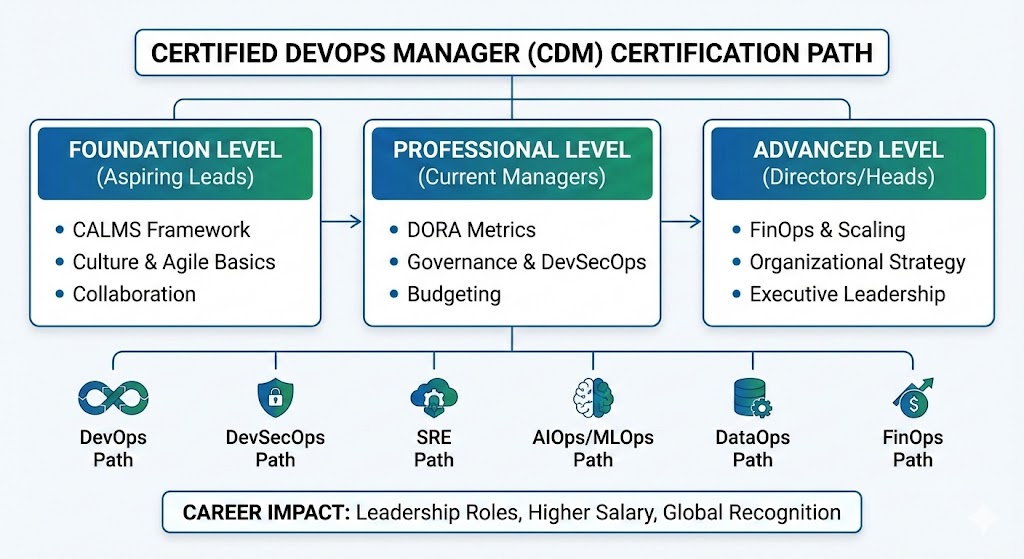
Introduction
The modern software landscape demands leaders who can bridge the gap between complex engineering workflows and business objectives. This guide explores the Certified DevOps Manager (CDM) program, which serves as a blueprint for professionals aiming to lead high-performing technical teams. Furthermore, it addresses the critical need for management strategies that support automation, continuous integration, and cultural transformation. Consequently, readers will understand how this certification helps them navigate the complexities of platform engineering and cloud-native environments while making informed career decisions.
What is the Certified DevOps Manager (CDM)?
The Certified DevOps Manager (CDM) represents a standard of excellence for those who oversee technical delivery and organizational change. It exists to move beyond theoretical management and focus on production-ready leadership strategies. Specifically, this program teaches how to align modern engineering workflows with enterprise goals like reliability and speed. Moreover, it emphasizes the practical application of the CALMS framework—Culture, Automation, Lean, Measurement, and Sharing. As a result, practitioners learn to manage not just the tools, but the people and processes that drive digital transformation.
Who Should Pursue Certified DevOps Manager (CDM)?
Senior software engineers and technical leads who want to transition into formal management roles find this certification particularly beneficial. Additionally, Site Reliability Engineers (SREs) and cloud architects use this program to gain the managerial oversight required for large-scale infrastructure projects. Engineering managers and technical leaders in India and global markets also pursue this to stay updated with modern platform governance. Furthermore, professionals in security and data roles benefit from learning how to integrate their specialized domains into a broader DevOps management framework. Consequently, this certification caters to anyone responsible for the health and performance of the modern software delivery lifecycle.
Why Certified DevOps Manager (CDM) is Valuable Today and Beyond
Enterprises continue to adopt cloud-native technologies at a rapid pace, which creates a massive demand for managers who understand these complex systems. The CDM certification ensures longevity in a career because it focuses on leadership principles that remain relevant despite frequent tool changes. In addition, it teaches managers how to calculate the return on investment for automation projects, making them indispensable to executive leadership. Professionals who hold this certification often see a significant return on their time investment through faster promotions and higher salary brackets. Therefore, mastering these management skills ensures that you remain a vital asset in an increasingly automated industry.
Certified DevOps Manager (CDM) Certification Overview
The program delivers its curriculum through Certified DevOps Manager (CDM) and maintains its primary presence on DevOpsSchool. This certification uses a practical, assessment-based approach to validate a candidate’s ability to lead DevOps initiatives. Specifically, the ownership of the program lies with industry experts who ensure the content reflects current enterprise challenges. The structure includes various modules covering budgeting, team topology, and performance metrics. Consequently, participants finish the program with a deep understanding of how to own and operate a successful DevOps department.
Certified DevOps Manager (CDM) Certification Tracks & Levels
The certification offers a clear progression from foundational management concepts to executive-level strategic planning. The foundation level introduces the core principles of DevOps culture and team structures. Meanwhile, the professional level dives into technical governance, compliance, and multi-team synchronization. Finally, the advanced level focuses on organizational-wide transformation and FinOps strategies for cost optimization. These levels align perfectly with career milestones, allowing a professional to grow from a team lead to a Director of Engineering or VP of Infrastructure.
Complete Certified DevOps Manager (CDM) Certification Table
| Track | Level | Who it’s for | Prerequisites | Skills Covered | Recommended Order | Official Link |
| Management | Foundation | Aspiring Leads | Basic DevOps Knowledge | CALMS, Agile Basics | 1 | Link |
| Management | Professional | Current Managers | 3+ Years Experience | Metrics, Governance | 2 | Link |
| Management | Advanced | Directors/Heads | 5+ Years Management | FinOps, Scaling | 3 | Link |
Detailed Guide for Each Certified DevOps Manager (CDM) Certification
Certified DevOps Manager (CDM) – Foundation
What it is
This level validates a candidate’s understanding of the basic cultural and structural shifts required for DevOps. It confirms that the individual can speak the language of both developers and operations staff.
Who should take it
Technical leads, project managers, and senior engineers who are beginning their journey into leadership roles should pursue this. It provides the necessary mental model for modern team management.
Skills you’ll gain
- Understanding the CALMS framework for DevOps.
- Implementing Lean management principles.
- Facilitating collaboration between siloed teams.
- Basic knowledge of automation pipelines.
Real-world projects you should be able to do
- Conduct a DevOps maturity assessment for a small team.
- Design a basic communication protocol for incident response.
- Create a value stream map for a single product line.
Preparation plan
- 7–14 days: Review the core definitions of DevOps and the history of Agile.
- 30 days: Study case studies of successful cultural transformations in large enterprises.
- 60 days: Deep dive into specific team topologies and organizational structures.
Common mistakes
- Focusing too much on specific tools rather than management principles.
- Ignoring the cultural aspect of DevOps in favor of technical automation.
Best next certification after this
- Same-track option: Certified DevOps Manager – Professional.
- Cross-track option: Certified SRE Professional.
- Leadership option: Agile Leadership Certification.
Certified DevOps Manager (CDM) – Professional
What it is
This certification validates the ability to manage complex delivery pipelines and diverse engineering teams. It focuses heavily on data-driven management and the implementation of DORA metrics.
Who should take it
Current DevOps managers, Engineering managers, and Delivery heads who have several years of experience will benefit most. It helps them refine their existing processes for better efficiency.
Skills you’ll gain
- Designing and monitoring DORA metrics.
- Managing technical debt in large-scale projects.
- Implementing security governance (DevSecOps).
- Budgeting for cloud infrastructure and tools.
Real-world projects you should be able to do
- Implement a centralized dashboard for tracking deployment frequency and lead time.
- Develop a cross-departmental security compliance checklist.
- Optimize cloud spend across multiple development environments.
Preparation plan
- 7–14 days: Study advanced metrics and reporting frameworks.
- 30 days: Analyze governance and compliance requirements for various industries.
- 60 days: Practice designing full-scale technical strategies for multi-team organizations.
Common mistakes
- Over-complicating metrics that do not provide actionable insights.
- Failing to align DevOps goals with broader business KPIs.
Best next certification after this
- Same-track option: Certified DevOps Manager – Expert/Advanced.
- Cross-track option: Certified Cloud Security Professional.
- Leadership option: Chief Technology Officer (CTO) Program.
Choose Your Learning Path
DevOps Path
A dedicated DevOps management path focuses on the lifecycle of software delivery from ideation to production. Managers on this path learn to eliminate bottlenecks and foster a culture of continuous improvement. Furthermore, they study how to integrate automated testing and deployment into every stage of the process. Consequently, this path creates leaders who can deliver high-quality software at high velocity.
DevSecOps Path
The DevSecOps management path prioritizes the integration of security into the DevOps pipeline. Leaders learn to manage security audits, compliance, and vulnerability scanning without slowing down the development team. Moreover, they focus on the “shift-left” philosophy where security becomes a shared responsibility. As a result, this path is essential for managers in highly regulated industries like finance or healthcare.
SRE Path
The Site Reliability Engineering (SRE) management path focuses on the balance between feature delivery and system stability. Managers learn to define and monitor Service Level Objectives (SLOs) and Error Budgets. Additionally, they study how to manage “toil” and ensure that engineers spend time on high-value automation tasks. Consequently, this path is ideal for those managing production environments where uptime is critical.
AIOps / MLOps Path
This path addresses the unique challenges of managing machine learning and artificial intelligence workflows. Managers learn to handle data versioning, model monitoring, and the collaboration between data scientists and engineers. Furthermore, they explore how to use AI to automate operational tasks through AIOps. Therefore, this path prepares leaders for the next generation of data-driven infrastructure.
DataOps Path
DataOps managers focus on the orchestration of data delivery across the enterprise. This path emphasizes the importance of data quality, privacy, and accessibility in the DevOps ecosystem. Moreover, leaders learn to apply DevOps principles like version control and CI/CD to data pipelines. Consequently, this path creates managers who can treat data as a high-velocity product.
FinOps Path
The FinOps path focuses on the financial management of cloud resources. Managers learn how to bring accountability to cloud spending and optimize costs through technical and organizational changes. Furthermore, they study how to bridge the gap between finance, engineering, and business teams. As a result, this path is vital for managing the bottom line in cloud-native organizations.
Role → Recommended Certified DevOps Manager (CDM) Certifications
| Role | Recommended Certifications |
| DevOps Engineer | CDM Foundation, Certified Kubernetes Professional |
| SRE | CDM Professional, Certified SRE Practitioner |
| Platform Engineer | CDM Professional, Certified Infrastructure Architect |
| Cloud Engineer | CDM Foundation, Cloud Provider Specific Certs |
| Security Engineer | CDM (DevSecOps Track), Certified Security Manager |
| Data Engineer | CDM (DataOps Track), Big Data Certification |
| FinOps Practitioner | CDM (FinOps Track), Cloud Economics Cert |
| Engineering Manager | CDM Expert, Agile/Scrum Master |
Next Certifications to Take After Certified DevOps Manager (CDM)
Same Track Progression
Once you master the CDM curriculum, you should look toward executive leadership certifications. These programs often focus on the business of technology, covering topics like organizational psychology and global market strategy. Furthermore, continuing in this track allows you to move into roles such as Head of Infrastructure or Director of Engineering. Consequently, deep specialization in management ensures you can handle the largest and most complex organizational structures.
Cross-Track Expansion
Expanding into technical specializations like Cloud Security or Artificial Intelligence Operations provides a well-rounded profile. For instance, a manager with a CDM background and an MLOps certification can lead specialized data science teams more effectively. Additionally, cross-training helps you understand the technical hurdles your teams face daily. Therefore, broadening your skills makes you a more empathetic and effective leader.
Leadership & Management Track
Transitioning into broader leadership tracks like an MBA or a Chief Technology Officer (CTO) program is a logical next step. These certifications focus on the intersection of technology, finance, and human resources at the highest corporate levels. Moreover, they prepare you to participate in boardroom discussions and influence long-term company direction. As a result, this track helps you move from managing technical teams to managing entire business units.
Training & Certification Support Providers for Certified DevOps Manager (CDM)
DevOpsSchool
This provider offers comprehensive training for CDM with a focus on real-world scenarios and hands-on labs. Their instructors bring years of industry experience to the classroom, ensuring that the training remains practical and relevant. Furthermore, they provide extensive resources and community support for all students.
Cotocus
Cotocus specializes in high-end consulting and training for DevOps and cloud-native technologies. They provide tailored CDM programs that meet the specific needs of enterprise clients. Consequently, they are a preferred choice for corporate teams looking to upskill their management layer.
Scmgalaxy
As a long-standing community hub, Scmgalaxy offers a wealth of knowledge and training options for CDM candidates. They focus on the technical aspects of configuration management and delivery pipelines. Moreover, their platform provides a space for professionals to share insights and best practices.
BestDevOps
BestDevOps focuses on providing streamlined and efficient training paths for busy professionals. Their CDM courses emphasize core concepts and exam readiness, making them ideal for those on a tight schedule. Additionally, they offer flexible learning options including self-paced and instructor-led sessions.
devsecopsschool.com
This platform focuses exclusively on the security aspect of the DevOps lifecycle. They provide CDM modules that are specifically tailored for security managers and compliance officers. As a result, they are the go-to resource for those looking to specialize in secure delivery.
sreschool.com
Sreschool.com offers training focused on reliability and production excellence within the CDM framework. They teach managers how to handle incident response, error budgets, and system monitoring. Consequently, their curriculum is essential for leaders of high-availability systems.
aiopsschool.com
This provider explores the intersection of AI and operations management. Their CDM offerings help managers understand how to implement machine learning within their operational workflows. Furthermore, they provide training on the latest AIOps tools and methodologies.
dataopsschool.com
Dataopsschool.com addresses the management of data as a core part of the DevOps lifecycle. They offer CDM tracks that focus on data pipeline automation and governance. Therefore, they are the best choice for managers overseeing data-intensive projects.
finopsschool.com
Finopsschool.com provides specialized training in cloud financial management for DevOps leaders. Their CDM modules cover cloud cost optimization and financial accountability. As a result, they help managers prove the value of their cloud initiatives to the business.
Frequently Asked Questions (General)
- How difficult is the Certified DevOps Manager (CDM) exam for beginners?The exam presents a moderate challenge because it requires a blend of technical and managerial understanding. Beginners might find the cultural and organizational concepts intuitive, but they often struggle with the technical governance and metrics sections. However, a consistent study plan that covers the CALMS framework and basic CI/CD concepts will significantly increase the chances of success. It is important to remember that this certification focuses on “how” to manage rather than “how” to code, which changes the preparation strategy. Most candidates find that practical experience in any team lead role helps immensely during the exam.
- What is the typical time commitment required to pass the CDM?Most professionals spend between 30 and 60 days preparing for the certification, depending on their existing experience. For someone already in a management role, 30 days of focused study is usually sufficient to grasp the specific CDM methodologies. However, individuals moving from a purely technical role might need 60 days to fully understand organizational transformation and budgeting. You should aim to spend at least five to ten hours per week reviewing the course material and participating in labs. Consistency is more important than cramming, as the concepts require time to sink in and reflect in your leadership style.
- Are there any specific prerequisites before I can enroll in the CDM program?While there are no strict mandatory prerequisites, having a basic understanding of the software development lifecycle (SDLC) is highly recommended. Familiarity with Agile or Scrum methodologies will also provide a solid foundation for the management concepts taught in the CDM program. Furthermore, having at least two years of experience in a technical team helps you relate to the real-world scenarios discussed in the curriculum. If you are a complete novice, you might consider taking a basic DevOps Foundation course before attempting the manager certification. This ensures you are not overwhelmed by the technical terminology used throughout the management modules.
- What is the return on investment (ROI) for getting the CDM certification?The ROI for the CDM certification is often seen in both salary increases and improved team performance. Professionally, many candidates report salary hikes of 20% to 40% after obtaining the certification and moving into management roles. Organizationally, the skills you learn help reduce deployment failures and improve lead times, which saves the company money and resources. Moreover, the certification provides a global standard that makes you a competitive candidate in international job markets. Therefore, the investment in time and exam fees usually pays for itself within the first few months of a new role or promotion.
- In what sequence should I take the different CDM levels?You should always start with the Foundation level to ensure you have a solid grasp of the core vocabulary and concepts. Even if you are an experienced manager, the Foundation level aligns your knowledge with the specific CDM framework used in higher levels. After completing the Foundation, you should move to the Professional level to dive into metrics, governance, and scaling. Only after you have mastered these areas should you attempt the Advanced or Expert levels, which focus on strategic organizational change. Following this logical sequence ensures that you build a comprehensive skill set without missing critical foundational knowledge.
- How does the CDM certification compare to a general PMP or Scrum Master cert?The PMP and Scrum Master certifications focus on project management and process facilitation, whereas the CDM focuses on the management of a specific technical culture. While a PMP might teach you how to manage a schedule, the CDM teaches you how to manage a high-velocity automation team and infrastructure. Specifically, the CDM addresses technical topics like CI/CD, cloud governance, and SRE which are not covered in general management certs. Consequently, for those working in software and cloud, the CDM is much more relevant and practical. It bridges the gap between high-level management and low-level technical execution.
- Does the CDM certification require any coding knowledge?You do not need to be a professional coder to pass the CDM, but you must understand the coding process. The certification requires you to understand how code moves through a pipeline and what challenges developers face during that journey. You should be familiar with concepts like Git, pull requests, and automated testing scripts. However, you will not be asked to write complex algorithms or build applications during the assessment. The focus remains on your ability to manage the people who write the code and the systems that deploy it. Understanding the “dev” in DevOps is essential, but being a developer is not.
- Is the CDM certification recognized globally?Yes, the CDM certification is recognized by enterprises and technology firms across the globe, including major hubs in India, the US, and Europe. Because it is based on industry-standard frameworks like DORA and CALMS, the skills are universally applicable. Many global recruiters specifically look for DevOps management certifications when hiring for leadership roles in cloud-native companies. Furthermore, the standardized nature of the exam ensures that a CDM holder in one country has the same base knowledge as one in another. This global portability is one of the key benefits for professionals looking to work in international tech markets.
- What kind of support is available during the CDM preparation?Candidates have access to a variety of support systems, including instructor-led training, community forums, and comprehensive study guides. Most training providers, such as DevOpsSchool, offer dedicated Slack or Discord channels where students can ask questions and share insights. Additionally, there are numerous webinars and whitepapers available that dive deep into specific CDM modules. Many candidates also form study groups to practice scenario-based questions and discuss real-world management challenges. This multi-layered support system ensures that you are never alone in your preparation journey and can get help whenever you encounter a difficult concept.
- How often does the CDM curriculum get updated?The CDM curriculum is reviewed and updated regularly to reflect the latest trends in the DevOps and cloud-native industry. As new methodologies like FinOps or AIOps become mainstream, they are integrated into the management tracks. This ensures that the certification remains relevant and that the skills you learn are not outdated. The governing body for the certification monitors industry reports and feedback from practitioners to keep the content fresh. Consequently, holding a CDM indicates that you are aware of modern management practices and are not relying on obsolete waterfall-era strategies. This commitment to updates maintains the high value of the credential.
- Can the CDM certification help me transition from a non-technical role?The CDM is an excellent bridge for project managers or business analysts who want to enter the technical management space. While it requires you to learn technical concepts, it focuses on the managerial application of those concepts which is familiar to non-technical leaders. However, you will need to put in extra effort to understand the infrastructure and development lifecycle. By mastering the CDM, you prove that you can lead technical teams despite not having a traditional engineering background. This opens up new career paths in technical project management and delivery leadership that were previously difficult to access.
- What is the format of the CDM assessment?The assessment typically consists of a combination of multiple-choice questions and scenario-based case studies. This format tests both your knowledge of DevOps theory and your ability to apply that theory to real-world management problems. Some advanced levels may also include a practical project where you must design a DevOps strategy for a hypothetical company. This comprehensive approach ensures that certified individuals are not just “paper certified” but can actually perform the duties of a manager. Preparing for this format involves studying the core materials and practicing with mock exams that simulate the scenario-based nature of the actual test.
FAQs on Certified DevOps Manager (CDM)
- What is the core focus of the CDM program?The core focus of the CDM program is the strategic management of the DevOps lifecycle within an enterprise. It prioritizes the cultural transformation necessary for teams to adopt automation and continuous delivery effectively. Furthermore, it emphasizes the use of data and metrics to drive decision-making and improve system reliability. Unlike purely technical certifications, the CDM looks at the “big picture” of how technology serves the business. Consequently, it produces leaders who can align technical effort with organizational goals.
- How does CDM handle the concept of “Culture”?CDM treats culture as a measurable and manageable asset rather than an abstract idea. It provides managers with specific tools to break down silos and foster psychological safety within their teams. Moreover, the program teaches how to implement a blameless culture, which is essential for effective incident response and learning. By focusing on the Westrum organizational model, CDM helps managers identify and fix cultural bottlenecks. As a result, the culture becomes a catalyst for technical speed rather than a barrier.
- Does the CDM cover financial aspects like budgeting?Yes, the CDM program includes significant modules on financial management and the FinOps framework. Managers learn how to forecast cloud costs, allocate budgets for automation tools, and justify technical spending to stakeholders. Additionally, it covers the concept of “Total Cost of Ownership” (TCO) for internal platforms and tools. This financial literacy is what sets a CDM apart from a standard team lead. Therefore, practitioners can speak the language of the CFO while still leading an engineering organization.
- Is the CDM certification suitable for government or highly regulated sectors?The CDM is highly suitable for regulated sectors because it places a strong emphasis on governance, risk management, and compliance (GRC). It teaches managers how to build “compliance as code” into the delivery pipeline, ensuring that security audits are automated. Furthermore, it addresses the challenges of managing DevOps in environments where air-gapped systems or strict data residency rules apply. Consequently, managers in government, finance, and healthcare find the CDM framework extremely helpful for navigating their unique constraints.
- How does the CDM approach the scaling of DevOps?Scaling DevOps across multiple teams is a primary topic in the CDM Professional and Expert levels. The program explores various team topologies and explains when to use a centralized platform team versus decentralized DevOps advocates. Moreover, it addresses the complexities of maintaining consistency across hundreds of microservices and dozens of delivery pipelines. Managers learn how to build internal developer platforms (IDPs) that provide “paved paths” for engineering teams. As a result, the organization can grow without sacrificing deployment speed or system stability.
- What role does automation play in the CDM curriculum?While the CDM is a management certification, it views automation as the foundation of modern delivery. The curriculum teaches managers how to prioritize automation tasks based on their impact on the value stream. Furthermore, it covers the management of automated testing, infrastructure as code (IaC), and continuous deployment systems. Managers learn to identify “toil” and empower their teams to automate it away. Consequently, the focus is on managing the automation strategy rather than configuring the specific tools themselves.
- How does CDM prepare you for incident management?The CDM program provides a structured approach to incident management that focuses on reliability and learning. It teaches managers how to design an incident response process that includes clear roles, communication channels, and post-mortem procedures. Moreover, it emphasizes the importance of Service Level Indicators (SLIs) and Service Level Objectives (SLOs) in managing production health. By learning these SRE-based principles, managers can ensure that their teams respond to outages effectively and prevent them from recurring. This results in more stable systems and more confident teams.
- Can the CDM help with vendor management and tool selection?Yes, the CDM provides a framework for evaluating and selecting the right tools for a DevOps ecosystem. Managers learn how to avoid “vendor lock-in” and how to build a toolchain that is both flexible and scalable. Furthermore, it covers the negotiation and management of service level agreements (SLAs) with third-party cloud and SaaS providers. This ensures that the tools you choose actually solve business problems rather than creating new technical debt. As a result, the CDM holder becomes a savvy buyer and manager of technical infrastructure.
Final Thoughts: Is Certified DevOps Manager (CDM) Worth It?
Choosing to pursue the CDM certification is a strategic decision that signals your commitment to high-level technical leadership. In an industry often obsessed with the latest “shiny” tool, the CDM focuses on the enduring principles of people, process, and performance. This certification does not just add a line to your resume; it changes how you perceive and solve organizational problems. It provides the framework you need to lead your team through the complexities of modern cloud-native development with confidence.
If you find yourself stuck in a purely technical role or struggling to prove the value of DevOps to your stakeholders, this program offers the solution. It equips you with the metrics, the language, and the strategy to lead from the front. Furthermore, the global recognition and community support ensure that your skills remain relevant in any market. Ultimately, the CDM is an investment in your future as a leader who can deliver real business value in an automated world.
Informative and well-written article! It clearly explains the responsibilities of a Certified DevOps Manager and offers valuable insights for professionals looking to develop leadership and DevOps management skills.