
Introduction
The current landscape of software delivery demands a profound shift from traditional siloed operations to a more integrated, automated approach. Consequently, the Master in DevOps Engineering (MDE) has emerged as a critical framework for professionals who seek to lead this transformation within their organizations. This guide serves as a comprehensive resource for engineers and technical leaders who want to navigate the complexities of cloud-native ecosystems and platform engineering. By understanding the core tenets of this certification, you can make strategic decisions that propel your career forward while delivering tangible value to your enterprise.
What is the Master in DevOps Engineering (MDE)?
The Master in DevOps Engineering (MDE) represents a sophisticated blend of cultural philosophy and technical mastery focused on the entire application lifecycle. It exists to provide a structured path for engineers to move beyond basic automation into the realm of production excellence. Unlike traditional certifications that focus on a single tool, MDE emphasizes the integration of various technologies to create a seamless, resilient delivery pipeline. Therefore, it aligns with modern enterprise practices by prioritizing scalability, security, and developer productivity in high-stakes environments.
Who Should Pursue Master in DevOps Engineering (MDE)?
This program is specifically designed for individuals who are responsible for the reliability and speed of software deployments. Systems administrators, backend developers, and quality assurance specialists will find this path essential for transitioning into specialized roles like Site Reliability Engineer (SRE) or Platform Engineer. Furthermore, technical managers who oversee engineering departments gain the necessary insight to foster a culture of automation and high performance. Whether you are operating in the rapidly growing tech sector in India or working for a global multinational, this certification provides a universally recognized standard of expertise.
Why Master in DevOps Engineering (MDE) is Valuable in 2026 and Beyond
As organizations increasingly adopt complex microservices and distributed systems, the need for deep engineering knowledge becomes undeniable. The Master in DevOps Engineering (MDE) remains highly valuable because it focuses on principles that are immune to the frequent changes in the tool ecosystem. By mastering the underlying logic of orchestration and observability, you ensure your long-term relevance in a market that is constantly evolving. Additionally, the program offers a high return on investment by enabling you to reduce operational debt and accelerate the time-to-market for critical business applications.
Master in DevOps Engineering (MDE) Certification Overview
The program is formally delivered through the Master in DevOps Engineering (MDE) curriculum and is hosted on the DevOpsSchool website. It utilizes a progressive learning model that challenges candidates through various certification levels and rigorous assessments. The certification ownership resides with industry practitioners who ensure that every module reflects the current challenges faced in production environments. Furthermore, the structure is designed to be practical, requiring you to demonstrate proficiency through hands-on labs and real-world architectural design scenarios.
Master in DevOps Engineering (MDE) Certification Tracks & Levels
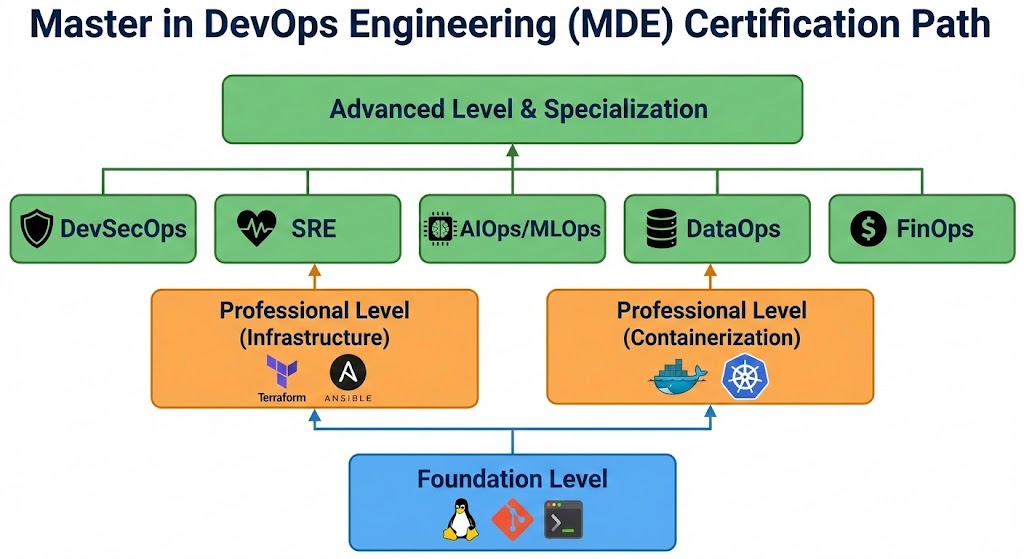
The MDE framework is organized into three distinct levels: Foundation, Professional, and Advanced. The Foundation level establishes the groundwork in Linux, version control, and basic scripting. Moving forward, the Professional level dives into container orchestration, configuration management, and the construction of complex CI/CD pipelines. Finally, the Advanced level allows for specialization in niche but critical fields like DevSecOps, SRE, and FinOps. This tiered approach ensures that you can align your learning journey with your current career stage and professional aspirations.
Complete Master in DevOps Engineering (MDE) Certification Table
| Track | Level | Who it’s for | Prerequisites | Skills Covered | Recommended Order |
| Core Engineering | Foundation | Entry-level Engineers | General IT awareness | Linux, Git, Shell | 1 |
| Infrastructure | Professional | Cloud/SysAdmins | Core Foundation | Terraform, Ansible | 2 |
| Containerization | Professional | Developers/SREs | Linux Scripting | Docker, Kubernetes | 3 |
| Delivery Pipeline | Advanced | DevOps Engineers | CI/CD Basics | Jenkins, GitLab CI | 4 |
| Security/Compliance | Advanced | Security Analysts | Professional Level | Vault, Scan Tools | 5 |
| Reliability Ops | Advanced | SRE / Architects | Multi-Cloud Exp | Prometheus, ELK | 6 |
Detailed Guide for Each Master in DevOps Engineering (MDE) Certification
Master in DevOps Engineering (MDE) – Foundation Level
What it is
The Foundation Level validates your command of the essential tools and philosophies that underpin the entire DevOps movement. It ensures you have a solid grasp of the command line and collaborative workflows.
Who should take it
This certification is ideal for junior engineers, IT support staff, or manual testers who want to build a career in automation. It serves as a necessary first step for anyone entering the DevOps domain.
Skills you’ll gain
- Advanced Linux file system management and permissions.
- Collaborative coding practices using Git and GitHub.
- Automation of repetitive tasks using Bash and Python.
- Understanding the principles of the CAMS (Culture, Automation, Measurement, Sharing) model.
Real-world projects you should be able to do
- Develop a script to automate the configuration of a local development environment.
- Manage complex code merges and resolve conflicts in a shared repository.
- Set up a basic automated monitoring alert for a server’s health.
Preparation plan
- 7 Days: Master the Linux command line and basic networking concepts.
- 30 Days: Practice Git branching strategies and write multiple shell scripts.
- 60 Days: Complete a project that integrates script-based automation with a version-controlled repository.
Common mistakes
- Underestimating the depth of Linux knowledge required for production systems.
- Neglecting the cultural aspects of DevOps in favor of purely technical tools.
Best next certification after this
- Same-track: Master in DevOps Engineering (MDE) – Professional.
- Cross-track: AWS Certified Cloud Practitioner.
- Leadership: Certified Agile Professional.
Master in DevOps Engineering (MDE) – Professional Level
What it is
The Professional Level focuses on the “as-code” movement, validating your ability to treat infrastructure and configurations as programmable software. It bridges the gap between manual setup and scalable automation.
Who should take it
Working DevOps engineers or systems architects who need to manage large-scale cloud environments should pursue this. It requires a working knowledge of the Foundation level concepts.
Skills you’ll gain
- Infrastructure as Code (IaC) using tools like Terraform and CloudFormation.
- Configuration management at scale using Ansible or Chef.
- Designing and implementing robust CI/CD pipelines.
- Mastering containerization and local orchestration.
Real-world projects you should be able to do
- Provision a complete multi-tier cloud infrastructure using a single command.
- Automate the deployment of a microservices application into a containerized environment.
- Build a Jenkins pipeline that includes automated unit and integration testing.
Preparation plan
- 7 Days: Deep dive into Terraform providers and state management.
- 30 Days: Build and optimize Docker images for various application stacks.
- 60 Days: Architect an end-to-end deployment pipeline that targets a cloud environment.
Common mistakes
- Failing to modularize IaC code, leading to unmanageable monolithic scripts.
- Overlooking the importance of state file security in Terraform.
Best next certification after this
- Same-track: Master in DevOps Engineering (MDE) – Advanced.
- Cross-track: Certified Kubernetes Administrator (CKA).
- Leadership: Professional Scrum Master.
Master in DevOps Engineering (MDE) – Advanced Level
What it is
This level is the ultimate validation of your ability to architect high-availability, secure, and observable systems at an enterprise scale. It represents the highest technical tier within the MDE program.
Who should take it
Senior engineers, Principal SREs, and technical architects who are responsible for organizational infrastructure strategy should take this level. It demands deep prior experience.
Skills you’ll gain
- Advanced Kubernetes administration, including networking and security.
- Implementing comprehensive observability with Prometheus, Grafana, and Jaeger.
- Designing “Shift-Left” security protocols within the delivery lifecycle.
- Service mesh implementation for complex microservices communication.
Real-world projects you should be able to do
- Deploy a production-grade, highly available Kubernetes cluster with auto-scaling.
- Integrate automated security scanning for secrets and vulnerabilities in the pipeline.
- Create a centralized logging and monitoring dashboard for a multi-cloud deployment.
Preparation plan
- 7 Days: Study Kubernetes security policies and network configurations.
- 30 Days: Implement a service mesh like Istio to manage traffic and encryption.
- 60 Days: Design a disaster recovery strategy that includes automated failover across regions.
Common mistakes
- Implementing advanced tools like service meshes when a simpler solution would suffice.
- Neglecting the cost optimization aspect of high-scale cloud architectures.
Best next certification after this
- Same-track: Specialized vendor certifications (e.g., AWS DevOps Engineer Professional).
- Cross-track: FinOps Certified Practitioner.
- Leadership: VP of Engineering or CTO tracks.
Choose Your Learning Path
DevOps Path
The DevOps path focuses on maximizing the speed and quality of software delivery. You will master the integration of development and operations teams through shared tools and automated workflows. This track is perfect for those who want to be the primary facilitators of business agility. Consequently, you will become an expert in CI/CD, release management, and feedback loops.
DevSecOps Path
In the DevSecOps path, security becomes a shared responsibility that is integrated into every stage of the pipeline. You will learn how to automate compliance and security checks so they do not slow down the development process. This path is vital for professionals in regulated industries. Therefore, you will focus on vulnerability management, identity access, and runtime security.
SRE Path
The Site Reliability Engineering (SRE) path applies a software engineering mindset to the challenges of system operations. You will learn to manage systems through code and prioritize reliability via Service Level Objectives (SLOs). This path is designed for engineers who thrive on solving complex stability and performance issues. Additionally, you will master incident response and post-mortem analysis.
AIOps / MLOps Path
The AIOps and MLOps path addresses the unique challenges of deploying and maintaining artificial intelligence models. You will learn how to automate the data pipeline and the model training process to ensure consistency in production. This specialization bridges the gap between data science and traditional engineering. Consequently, you ensure that AI applications are as reliable as traditional software.
DataOps Path
DataOps focuses on the automated, policy-based management of data to improve the quality of analytics. You will learn to treat data pipelines as code, ensuring that data flows smoothly from source to insight. This path is essential for organizations that rely on real-time data for decision-making. Furthermore, you will work with big data technologies and automated testing for data integrity.
FinOps Path
The FinOps path introduces financial accountability to the variable spending world of the cloud. You will learn how to collaborate across engineering, finance, and business teams to optimize cloud costs. This track is becoming increasingly important as cloud budgets grow larger and more complex. Therefore, you will focus on cost allocation, forecasting, and architectural efficiency.
Role → Recommended Master in DevOps Engineering (MDE) Certifications
| Role | Recommended Certifications |
| DevOps Engineer | MDE Foundation + MDE Professional (Delivery Focus) |
| SRE | MDE Professional + MDE Advanced (Reliability Focus) |
| Platform Engineer | MDE Professional + MDE Advanced (Infrastructure Focus) |
| Cloud Engineer | MDE Foundation + MDE Professional (Cloud Focus) |
| Security Engineer | MDE Foundation + MDE DevSecOps Track |
| Data Engineer | MDE Foundation + MDE DataOps Track |
| FinOps Practitioner | MDE Foundation + MDE FinOps Track |
| Engineering Manager | MDE Foundation + Leadership & Culture Modules |
Next Certifications to Take After Master in DevOps Engineering (MDE)
Same Track Progression
Once you have completed the MDE, the next logical step is to gain deep specialization in the specific tools used by your organization. For example, obtaining an AWS Certified DevOps Engineer – Professional or an Azure DevOps Engineer Expert certification will allow you to apply MDE principles to specific cloud ecosystems. This ensures that your broad architectural knowledge is complemented by deep, vendor-specific technical skills. Furthermore, pursuing advanced Kubernetes certifications can solidify your standing as a container expert.
Cross-Track Expansion
To become a truly versatile professional, you should explore certifications in adjacent fields like Cybersecurity or Data Science. Understanding the challenges faced by the teams you support will make you a more effective DevOps practitioner. For instance, a certification in ethical hacking can provide you with a new perspective on why certain security measures are necessary in your pipelines. This cross-training allows you to solve multifaceted problems that impact the entire business.
Leadership & Management Track
If you aspire to move into leadership, you should seek certifications that focus on strategy and people management. Options like the PMP (Project Management Professional) or ITIL (Information Technology Infrastructure Library) can provide the framework needed to manage large-scale digital transformations. These certifications help you transition from solving technical problems to solving organizational ones. Consequently, you will be better equipped to lead teams, manage budgets, and align technology with business goals.
Training & Certification Support Providers for Master in DevOps Engineering (MDE)
DevOpsSchool
DevOpsSchool provides an extensive array of training modules specifically designed for the MDE curriculum. They focus on instructor-led, hands-on labs that simulate real-world production environments. Their trainers are industry experts who bring years of practical experience to the classroom.
Cotocus
Cotocus offers specialized consulting and training for organizations and individuals looking to master high-end DevOps practices. They emphasize advanced orchestration and cloud-native architectures in their training delivery. Their approach is highly customized to meet the needs of senior-level professionals.
Scmgalaxy
Scmgalaxy is a premier resource for software configuration management and DevOps tutorials. They offer a vast library of content that supports the MDE certification tracks with practical, tool-focused guides. It is a go-to platform for engineers looking to troubleshoot specific automation challenges.
BestDevOps
BestDevOps focuses on delivering high-quality, curated learning paths that guide students from foundational concepts to advanced mastery. They emphasize industry best practices and ensure that their curriculum is always up to date. Their training is designed to be accessible yet technically rigorous.
devsecopsschool.com
This provider specializes in the critical intersection of security and DevOps. They offer focused certifications and training on how to secure the modern software supply chain. Their curriculum is essential for anyone pursuing a DevSecOps specialization within the MDE framework.
sreschool.com
Sreschool.com is dedicated to teaching the principles and practices of Site Reliability Engineering. They offer deep dives into observability, error budgets, and incident management. Their training helps engineers adopt the mindset required to manage web-scale systems reliably.
aiopsschool.com
Aiopsschool.com provides training on the use of artificial intelligence and machine learning in IT operations. They help professionals understand how to automate complex monitoring and remediation tasks using AI. This is an ideal resource for engineers looking toward the future of operations.
dataopsschool.com
Dataopsschool.com offers specialized training in managing the lifecycle of data within a DevOps framework. They focus on the automation of data pipelines and the integration of data science into production workflows. Their courses are vital for modern data-driven enterprises.
finopsschool.com
Finopsschool.com focuses on the practice of cloud financial management. They provide the training necessary to balance performance, quality, and cost in a cloud-first environment. Their curriculum is designed to help professionals maximize the business value of their cloud spend.
Frequently Asked Questions (General)
- How much prior coding experience do I need for MDE? You do not need to be a professional software developer to start the MDE program. However, a basic understanding of programming logic and familiarity with at least one scripting language like Python or Bash is highly beneficial. The Foundation level will help you build these skills if you are starting from scratch. As you progress to the Professional and Advanced levels, you will find that a programmatic mindset is essential for managing infrastructure as code and building automated pipelines.
- Is the MDE certification exam more theoretical or practical? The MDE certification process is heavily weighted toward practical application. While you must understand the underlying theories and philosophies, the primary assessment involves solving real-world problems in a simulated production environment. You will be expected to write scripts, configure tools, and architect solutions that meet specific business requirements. This ensures that a certified professional is not just someone who can pass a test, but someone who can actually perform the job in a high-pressure corporate setting.
- How does MDE compare to vendor-specific certifications? The MDE is vendor-neutral, meaning it teaches you the core principles and tools that apply across all cloud providers and environments. While a vendor-specific certification like AWS DevOps Engineer focuses on one ecosystem, the MDE prepares you to work in the multi-cloud environments common in modern enterprises. Consequently, the MDE offers more flexibility in your career. Many professionals find that the MDE provides the foundational architectural knowledge that makes vendor-specific certifications much easier to obtain later.
- What is the typical salary increase after becoming MDE certified? While salary depends on various factors like location and experience, many professionals report a significant increase in compensation after achieving MDE certification. In the Indian market, for instance, certified DevOps engineers often see salary hikes ranging from 25% to 50% when moving into specialized roles. Globally, the demand for these skills remains high, leading to competitive salary packages and better benefits. More importantly, the certification opens doors to senior-level positions that were previously out of reach.
- How long does it take to prepare for the Professional Level? For most working professionals, preparing for the Professional Level takes approximately two to three months of consistent study. This assumes you are spending about 10 hours a week practicing with tools like Terraform, Ansible, and Docker. If you are already using these tools in your daily job, you might be able to complete the preparation in a shorter timeframe. The key is to ensure you can not only use the tools but also understand how to integrate them into a larger delivery ecosystem.
- Can I take the Advanced Level exams without passing the Foundation Level? While it is technically possible to skip levels depending on your experience, we strongly recommend completing the program in the intended order. The Foundation and Professional levels build the necessary technical and philosophical groundwork that the Advanced level assumes you already possess. Skipping these can lead to gaps in your knowledge that may become apparent during the practical assessments. Following the recommended order ensures a comprehensive and cohesive learning experience that prepares you for long-term success.
- Does the MDE program cover soft skills? Yes, the MDE program recognizes that DevOps is as much about culture as it is about tools. Therefore, the curriculum includes modules on communication, collaboration, and how to lead organizational change. You will learn how to break down silos between departments and how to foster a culture of shared responsibility. These “soft” skills are often what separate a good engineer from a great one, especially when you are tasked with implementing DevOps practices in a large, traditional organization.
- Is the MDE certification recognized by large tech companies? The MDE is highly regarded by major tech companies and enterprises globally because of its focus on practical, production-ready skills. Many organizations use the MDE curriculum as a benchmark for their internal training and hiring processes. When a hiring manager sees an MDE certification on a resume, they know the candidate has been through a rigorous, hands-on validation process. This recognition is particularly strong in sectors like finance, e-commerce, and cloud services where reliability and speed are paramount.
- What tools are covered in the MDE curriculum? The curriculum covers a wide range of industry-standard tools, including but not limited to Linux, Git, Jenkins, Docker, Kubernetes, Terraform, Ansible, Prometheus, and Grafana. The focus is on teaching you how these tools work together rather than just how to use them individually. We frequently update the tool list to reflect the current market leaders and the CNCF landscape. This ensures that you are always learning technologies that are in high demand by employers.
- Do I get access to a lab environment during my training? Most training providers for the MDE program offer access to cloud-based lab environments where you can practice without worrying about infrastructure costs. These labs are often pre-configured with the tools and scenarios you will encounter in the certification exams. This hands-on practice is a critical part of the learning process, allowing you to experiment and make mistakes in a safe environment. Having access to these labs significantly increases your chances of passing the practical assessments on your first attempt.
- Is there a community for MDE certified professionals? Yes, when you pursue the MDE, you gain access to a global community of like-minded professionals and mentors. This network is an invaluable resource for sharing knowledge, troubleshooting technical issues, and finding new career opportunities. Many providers host exclusive webinars, forums, and local meetups for their students and alumni. Being part of this community ensures that your learning does not stop once you receive your certificate, as you can continue to learn from the experiences of your peers.
- What happens if I fail an assessment? If you do not pass an assessment on your first try, most providers offer the opportunity to retake the exam after a certain period. Use the detailed feedback from your first attempt to identify the specific areas where you need more practice. Many students find that they need a bit more time with the hands-on labs before they are ready for the final practical exam. The goal is mastery, so we encourage you to treat a failed attempt as a learning opportunity rather than a final judgment.
FAQs on Master in DevOps Engineering (MDE)
- How does the MDE address the security “Shift-Left” concept? The Master in DevOps Engineering (MDE) integrates security directly into the pipeline modules rather than treating it as a separate phase. You will learn to implement automated security scanning for both code (SAST) and dependencies early in the development cycle. Furthermore, the Advanced level teaches you how to manage infrastructure security through policy-as-code. This ensures that security is a continuous process that supports speed rather than a manual gate that slows down the release cycle.
- Why is Kubernetes such a large part of the Professional and Advanced tracks? Kubernetes has become the de facto standard for container orchestration in the modern enterprise. Therefore, the MDE devotes significant time to mastering cluster management, networking, and scaling. Understanding Kubernetes is essential for anyone who wants to work with microservices at scale. The MDE teaches you not just how to deploy applications on Kubernetes, but how to manage the cluster itself, including its security, observability, and resilience in a production environment.
- Does the MDE cover serverless architectures? Yes, the MDE curriculum includes modules on serverless computing and how to integrate it into your DevOps workflows. You will learn how to manage functions-as-a-service (FaaS) and how to handle the unique deployment and monitoring challenges they present. This ensures that you are prepared for modern cloud-native designs that often mix containers and serverless components. Consequently, you will be able to choose the best compute model for your specific application requirements while maintaining a consistent automation strategy.
- How does MDE handle multi-cloud strategies? The MDE program emphasizes vendor-neutral tools like Terraform and Kubernetes specifically to support multi-cloud environments. You will learn how to architect systems that can run across AWS, Azure, and GCP without being locked into a single provider’s proprietary tools. This is a critical skill for modern enterprises that want to avoid vendor lock-in and optimize their costs. Additionally, you will learn about the challenges of data synchronization and networking in a multi-cloud or hybrid-cloud setup.
- What role does observability play in the MDE? Observability is a core component of the Advanced track, focusing on the three pillars: metrics, logs, and traces. You will learn how to implement comprehensive monitoring using Prometheus and Grafana, as well as centralized logging with the ELK stack. The MDE teaches you how to move beyond simple monitoring to true observability, where you can understand the internal state of your system based on its outputs. This is essential for maintaining reliability and quickly troubleshooting issues in complex distributed systems.
- How does MDE prepare me for an SRE role? The MDE provides the technical foundation required for SRE, including automation, monitoring, and infrastructure management. Specifically, the SRE track within the MDE focuses on Service Level Objectives (SLOs), error budgets, and incident management protocols. You will learn how to balance the need for new features with the need for system stability. This specialized training ensures that you can apply software engineering principles to operations, which is the core definition of the SRE role.
- Are there any industry-specific modules in the MDE? While the core principles are universal, the MDE includes case studies and labs based on various industries like finance, healthcare, and e-commerce. These examples show how DevOps can be tailored to meet specific regulatory or performance requirements. For instance, a healthcare lab might focus more on data privacy and compliance, while an e-commerce lab might focus on high-traffic scaling and performance optimization. This practical exposure helps you understand how to apply your skills in different business contexts.
- How do I keep my MDE skills current after certification? The DevOps field moves incredibly fast, so the MDE program encourages a mindset of continuous learning. Most providers offer alumni access to updated course materials and new modules as they are released. We recommend participating in community forums, attending industry conferences, and following major open-source projects. Many MDE professionals also pursue specialized “micro-certs” in emerging areas like AI-driven operations or green coding to stay at the absolute forefront of the technology landscape.
Final Thoughts: Is Master in DevOps Engineering (MDE) Worth It?
From the perspective of a senior mentor, the Master in DevOps Engineering (MDE) is more than just a credential; it is a transformative educational journey. It provides the structured discipline needed to master a field that can often feel overwhelming due to the sheer number of tools available. By focusing on the engineering foundations and the “as-code” philosophy, it empowers you to build systems that are truly scalable and resilient. If you are committed to reaching the highest levels of your profession and want to lead the future of software delivery, this certification is undeniably worth the effort. It is an investment in your technical authority that will pay dividends for years to come.