
Introduction
The modern software landscape demands a shift from traditional silos toward integrated, automated, and scalable workflows. This guide explores the DevOps Certified Professional (DCP) as a cornerstone for engineers aiming to master the intersection of development and operations. Whether you are a system administrator looking to modernize your skill set or a developer aiming to take control of the deployment pipeline, understanding this certification path is essential. Consequently, this comprehensive breakdown helps professionals navigate the complex ecosystem of cloud-native technologies and platform engineering. By the end of this guide, you will possess the clarity needed to make informed career decisions that align with the high-velocity demands of the current global tech market.
What is the DevOps Certified Professional (DCP)?
The DevOps Certified Professional (DCP) serves as a rigorous validation of an engineer’s ability to design, implement, and manage automated software delivery pipelines. Unlike certifications that focus purely on theoretical definitions, the DCP emphasizes real-world, production-focused learning. It forces practitioners to move beyond simple automation scripts and instead adopt a holistic view of the software development lifecycle. Therefore, the program aligns closely with modern enterprise practices where reliability, security, and speed are non-negotiable. It bridges the gap between manual infrastructure management and the highly orchestrated, cloud-native environments that dominate the industry today.
Who Should Pursue DevOps Certified Professional (DCP)?
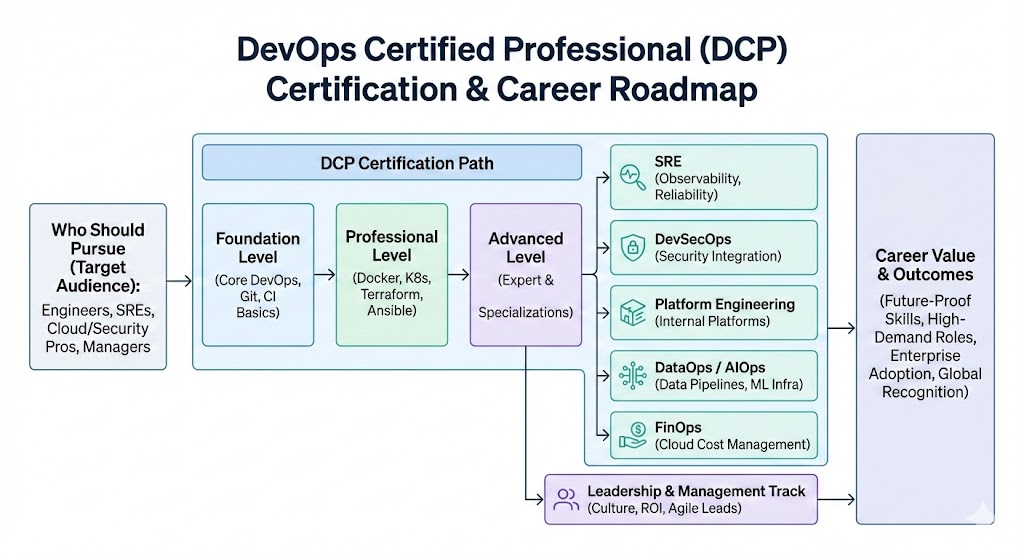
Software engineers and system administrators who wish to transition into specialized roles like Site Reliability Engineering (SRE) or Platform Engineering find immense value in this certification. Furthermore, cloud professionals, security analysts, and data engineers benefit from the standardized methodologies taught within the curriculum. Even technical managers and leaders find the program useful for understanding the cultural and technical shifts required to lead high-performing teams. Given the rapid digital transformation across India and the global market, this certification provides a competitive edge for anyone involved in building or maintaining enterprise-scale applications. It caters to beginners seeking a solid foundation and experienced veterans looking to formalize their industry knowledge.
Why DevOps Certified Professional (DCP) is Valuable in the Modern Era and Beyond
As organizations increasingly adopt microservices and distributed architectures, the demand for skilled DevOps practitioners continues to outpace the supply. This certification ensures longevity in a career by teaching core principles that remain relevant despite the constant churn of specific tools and technologies. Consequently, professionals who hold the DCP designation demonstrate a commitment to continuous improvement and operational excellence. Enterprise adoption of DevOps practices is no longer optional for businesses that want to stay competitive; thus, the return on time investment for this certification is substantial. It empowers engineers to stay relevant by focusing on the underlying patterns of automation and orchestration that define successful tech organizations.
DevOps Certified Professional (DCP) Certification Overview
The program is delivered via the DevOps Certified Professional (DCP) portal and is primarily hosted on DevOpsSchool. This certification utilizes a structured assessment approach that combines theoretical knowledge with practical, hands-on labs. Ownership of the curriculum remains with industry experts who update the content to reflect the latest shifts in the DevOps landscape. In practical terms, the certification structure moves from foundational concepts to complex architectural patterns. This ensures that every candidate undergoes a comprehensive evaluation of their technical capabilities before they receive the professional designation.
DevOps Certified Professional (DCP) Certification Tracks & Levels
The certification framework categorizes learning into three distinct levels: foundation, professional, and advanced. The foundation level introduces core concepts such as Version Control Systems (VCS) and basic Continuous Integration (CI). Moving forward, the professional level (DCP) dives deep into containerization, orchestration, and Infrastructure as Code (IaC). Finally, the advanced level focuses on specialization tracks such as DevSecOps, FinOps, and SRE. These levels align perfectly with career progression, allowing a junior engineer to eventually evolve into a principal-level architect. By following these tracks, professionals can broaden their expertise while maintaining a clear focus on their specific career goals.
Complete DevOps Certified Professional (DCP) Certification Table
| Track | Level | Who it’s for | Prerequisites | Skills Covered | Recommended Order |
| Core DevOps | Foundation | Beginners, Freshers | Basic IT knowledge | Git, Maven, Jenkins basics | 1st |
| Core DevOps | Professional | Engineers (2+ yrs) | Foundation level | Docker, K8s, Terraform, Ansible | 2nd |
| SRE | Advanced | SREs, Ops Leads | DCP Professional | Monitoring, Logging, SLOs/SLIs | 3rd |
| Security | Advanced | Security Engineers | DCP Professional | SAST/DAST, Vault, Compliance | 3rd |
| Management | Leadership | Leads, Managers | Any Technical Cert | ROI, Culture, Agile, Metrics | 4th |
Detailed Guide for Each DevOps Certified Professional (DCP) Certification
DevOps Certified Professional (DCP) – Foundation Level
What it is
This certification validates a candidate’s understanding of the basic DevOps philosophy and the essential tools required for early-stage automation. It serves as the entry point into the wider DevOps ecosystem.
Who should take it
Aspiring engineers, fresh graduates, or traditional system administrators who need to understand how the development and operations worlds intersect should start here. It requires minimal prior experience in automation.
Skills you’ll gain
- Proficiency in Git-based version control workflows.
- Understanding of the Continuous Integration (CI) lifecycle.
- Knowledge of basic Linux administration and shell scripting.
- Familiarity with Agile and Scrum methodologies within a DevOps context.
Real-world projects you should be able to do
- Set up a basic CI pipeline for a static website.
- Manage source code repositories using branching strategies.
- Automate simple repetitive tasks using Bash or Python.
Preparation plan
- 7–14 days: Focus on learning the DevOps culture and basic Git commands.
- 30 days: Build a simple pipeline using Jenkins and integrate it with GitHub.
- 60 days: Review all foundational concepts and take practice exams to ensure high marks.
Common mistakes
- Ignoring the cultural aspect of DevOps in favor of tool-only learning.
- Neglecting the importance of Linux command-line proficiency.
Best next certification after this
- Same-track option: DevOps Certified Professional (DCP).
- Cross-track option: Cloud Practitioner Certification.
- Leadership option: Agile Scrum Master.
DevOps Certified Professional (DCP) – Professional Level
What it is
This is the core certification that confirms your ability to manage production-grade environments using modern orchestration and configuration management tools. It is the industry standard for intermediate DevOps roles.
Who should take it
Intermediate engineers with at least two years of experience who want to master containerization and Infrastructure as Code (IaC) should pursue this. It is ideal for those responsible for environment stability.
Skills you’ll gain
- Mastering Docker containerization and image management.
- Orchestrating microservices using Kubernetes.
- Implementing Infrastructure as Code with Terraform and Ansible.
- Designing multi-stage CI/CD pipelines with integrated testing.
Real-world projects you should be able to do
- Deploy a highly available microservices application on a Kubernetes cluster.
- Provisions entire cloud environments using modular Terraform code.
- Automate configuration management for a fleet of servers using Ansible.
Preparation plan
- 7–14 days: Intensive study of containerization and Dockerfile optimization.
- 30 days: Practical implementation of Kubernetes clusters and Helm charts.
- 60 days: Complete a full end-to-end project incorporating IaC and CI/CD.
Common mistakes
- Hardcoding values in configuration files instead of using variables.
- Failing to understand the networking and storage layers of Kubernetes.
Best next certification after this
- Same-track option: DevOps Certified Expert (DCE).
- Cross-track option: Certified Kubernetes Administrator (CKA).
- Leadership option: DevOps Engineering Manager.
DevOps Certified Professional (DCP) – Expert Level
What it is
The expert level focuses on advanced architectural patterns, observability, and the integration of specialized domains like security and finance into the DevOps workflow.
Who should take it
Senior engineers and architects who are responsible for the entire engineering platform’s health and security should take this. It requires a deep understanding of the professional-level tools.
Skills you’ll gain
- Designing advanced observability stacks using Prometheus and Grafana.
- Implementing Zero Trust security models within pipelines.
- Optimizing cloud costs through FinOps principles.
- Managing large-scale distributed systems and service meshes.
Real-world projects you should be able to do
- Implement a full service mesh architecture using Istio.
- Build an automated incident response system using AIOps tools.
- Design a multi-cloud disaster recovery strategy for mission-critical apps.
Preparation plan
- 7–14 days: Study advanced networking and security protocols.
- 30 days: Implement observability and automated scaling policies.
- 60 days: Refine architectural designs and prepare for high-level scenario-based questions.
Common mistakes
- Over-engineering solutions for simple problems.
- Neglecting the financial impact of architectural decisions.
Best next certification after this
- Same-track option: SRE Certified Professional.
- Cross-track option: Cloud Architect (AWS/Azure/GCP).
- Leadership option: Chief Technology Officer (CTO) path.
Choose Your Learning Path
DevOps Path
Engineers following the DevOps path prioritize the seamless flow of code from a developer’s machine to the production environment. This involves mastering CI/CD tools, version control, and basic automation. Consequently, practitioners focus on breaking down silos and ensuring that software delivery is predictable and repeatable. This path is ideal for those who enjoy improving developer productivity and streamlining operational tasks. By choosing this route, you become the glue that holds the engineering organization together through automated processes.
DevSecOps Path
The DevSecOps path emphasizes the integration of security at every stage of the software development lifecycle rather than treating it as an afterthought. Professionals in this track learn to automate security scanning, manage secrets, and ensure compliance within the pipeline. Furthermore, they work closely with security teams to implement guardrails that prevent vulnerabilities from reaching production. This path is increasingly critical as cyber threats become more sophisticated and regulatory requirements tighten. Consequently, DevSecOps specialists are in high demand across financial and healthcare sectors globally.
SRE Path
Site Reliability Engineering (SRE) applies software engineering principles to operations problems to create highly scalable and reliable systems. Those on this path focus heavily on observability, incident management, and error budgets to balance reliability with the speed of innovation. Similarly, SREs spend a significant portion of their time writing code to automate operational tasks and improve system performance. This path is perfect for engineers who enjoy deep-diving into system internals and managing large-scale distributed architectures. It requires a strong analytical mindset and a passion for data-driven decision-making.
AIOps / MLOps Path
As artificial intelligence becomes central to modern applications, the AIOps and MLOps path focuses on the specialized infrastructure needed to support machine learning models. Practitioners learn to automate the training, deployment, and monitoring of ML models at scale. In addition, they use AI-driven tools to analyze vast amounts of operational data to predict and prevent system failures before they occur. This track bridges the gap between data science and traditional DevOps. It is a forward-looking path for engineers who want to stay at the cutting edge of technological innovation.
DataOps Path
The DataOps path applies DevOps principles to data management and analytics to improve the quality and cycle time of data insights. Professionals in this field focus on automating data pipelines, ensuring data integrity, and facilitating collaboration between data scientists and engineers. Furthermore, they implement version control for data schemas and manage complex ETL processes with the same rigor as application code. This path is essential for organizations that rely on big data to drive their business strategies. Consequently, DataOps engineers ensure that data flows smoothly and accurately throughout the enterprise.
FinOps Path
FinOps focuses on the financial management of cloud environments to ensure that organizations get the most value out of their cloud spend. Practitioners on this path learn to monitor cloud usage, identify waste, and implement cost-saving measures through automated policies. In addition, they facilitate communication between finance, engineering, and business teams to align cloud costs with business value. This role is becoming vital as cloud bills grow and organizations seek to optimize their infrastructure investments. By mastering FinOps, you help ensure the long-term economic sustainability of the company’s technology stack.
Role → Recommended (Topic name) Certifications
| Role | Recommended Certifications |
| DevOps Engineer | DCP Professional, Jenkins Certified, Terraform Associate |
| SRE | DCP Expert, Prometheus Certified, SRE Foundation |
| Platform Engineer | DCP Professional, Kubernetes Administrator (CKA), Helm Specialist |
| Cloud Engineer | DCP Professional, AWS/Azure Solutions Architect |
| Security Engineer | DevSecOps Certified, DCP Foundation, Vault Certified |
| Data Engineer | DataOps Certified, DCP Foundation, Snowflake/BigQuery Cert |
| FinOps Practitioner | FinOps Certified, DCP Foundation, Cloud Cost Management |
| Engineering Manager | DCP Foundation, DevOps Leader (DOL), Agile Leadership |
Next Certifications to Take After DevOps Certified Professional (DCP)
Same Track Progression
Once you master the professional level, the logical progression involves moving toward expert-level certifications that focus on high-level architecture. These advanced programs often require you to design complex systems that can handle millions of users while maintaining five-nines of availability. Furthermore, deep specialization in specific toolchains, such as advanced Kubernetes or advanced Terraform, can establish you as a subject matter expert. This path ensures that your technical skills remain at the absolute top tier of the industry. Consequently, staying on this track leads to roles like Principal DevOps Engineer or Infrastructure Architect.
Cross-Track Expansion
Expanding your skills across different domains like security or data management makes you a more versatile and valuable asset to any organization. For instance, a DevOps professional who understands the nuances of DevSecOps can lead comprehensive security transformations. Similarly, learning the basics of DataOps allows you to support data-heavy applications more effectively. This cross-pollination of skills prevents you from becoming a “one-trick pony” and opens doors to a wider variety of career opportunities. In addition, it allows you to solve complex problems that span multiple technical disciplines.
Leadership & Management Track
For those who wish to move away from day-to-day coding and into strategic roles, the leadership track offers certifications focused on culture and organizational change. These programs teach you how to measure the ROI of DevOps initiatives and how to lead large-scale digital transformations. Furthermore, you learn how to build and mentor high-performing engineering teams that embrace the DevOps philosophy. This transition is ideal for professionals who enjoy high-level decision-making and business alignment. Consequently, this path leads to roles such as Engineering Manager, Director of Platform Engineering, or even CTO.
Training & Certification Support Providers for DevOps Certified Professional (DCP)
- DevOpsSchool: This organization provides comprehensive training programs that cover the entire DCP curriculum with a strong emphasis on hands-on labs. They offer both instructor-led and self-paced options to suit different learning styles and schedules.
- Cotocus: Cotocus specializes in high-end consulting and training for DevOps and SRE roles, ensuring that students learn from real-world scenarios. Their trainers are active practitioners who bring current industry challenges into the classroom environment.
- Scmgalaxy: This platform serves as a massive knowledge base and training hub for software configuration management and DevOps tools. They provide extensive resources and community support for candidates preparing for the DCP exam.
- BestDevOps: Focusing on premium quality content, BestDevOps offers structured courses that guide engineers through the complexities of modern cloud-native architectures. Their curriculum is updated frequently to reflect the latest changes in the tech landscape.
- devsecopsschool.com: This provider focuses exclusively on the intersection of security and DevOps, offering specialized tracks for those looking to master DevSecOps. They provide deep-dive sessions on vulnerability management and automated compliance.
- sreschool.com: Dedicated to the principles of Site Reliability Engineering, this site offers targeted training for those who want to master system reliability and observability. Their courses cover everything from error budgets to incident response automation.
- aiopsschool.com: This school addresses the growing need for AI in operations by offering courses on machine learning integration and automated data analysis. They help engineers prepare for the future of intelligent, self-healing systems.
- dataopsschool.com: DataOpsSchool provides specialized training for managing data pipelines and big data infrastructure using DevOps methodologies. Their curriculum is essential for anyone working in modern data engineering roles.
- finopsschool.com: This provider teaches the art of cloud financial management, helping professionals balance technical performance with cost efficiency. Their courses are vital for anyone looking to optimize enterprise cloud expenditures.
Frequently Asked Questions (General)
- How difficult is the DevOps Certified Professional (DCP) exam?The difficulty of the exam is moderate to high, as it requires both theoretical knowledge and practical application. Candidates must demonstrate a deep understanding of how various tools interact within a pipeline. Furthermore, the exam includes scenario-based questions that test your ability to solve real-world architectural problems. If you have hands-on experience with Docker, Jenkins, and Kubernetes, you will find the technical portions manageable. However, if you are new to these technologies, you must invest significant time in lab exercises to pass. Consequently, preparation is the key to successfully navigating the exam’s challenges.
- How much time does it take to prepare for the certification?Preparation time varies based on your existing experience, but most candidates spend between 30 to 60 days of focused study. For a working professional, dedicating 10 to 15 hours per week is usually sufficient to cover the entire curriculum. Furthermore, you should spend at least half of that time in hands-on labs to build practical familiarity with the tools. In addition, reviewing case studies and practice exams during the final two weeks helps solidify your understanding. Consequently, a structured approach ensures that you are fully ready by the time you sit for the actual assessment.
- Are there any prerequisites for taking the DCP exam?While there are no strict mandatory prerequisites, having a basic understanding of Linux administration and at least one programming language is highly recommended. Familiarity with cloud concepts and version control systems like Git will also give you a significant head start. Furthermore, completing a foundation-level DevOps course can help bridge any knowledge gaps before you tackle the professional-level material. In addition, some candidates find that having a year or two of experience in a software-related role makes the concepts much easier to grasp. Consequently, a solid technical baseline is the best foundation for success.
- What is the return on investment (ROI) for this certification?The ROI for the DCP is substantial, often leading to significant salary increases and better job opportunities in high-growth companies. Many organizations prioritize certified professionals because it guarantees a baseline of technical competence and a shared vocabulary. Furthermore, the skills you gain allow you to work more efficiently, reducing the time spent on manual, error-prone tasks. In addition, the certification provides long-term career stability by focusing on core principles that remain relevant despite tool changes. Consequently, the investment in time and money pays for itself through accelerated career progression.
- In what sequence should I take the certifications?The recommended sequence begins with the Foundation level to establish core concepts, followed by the Professional (DCP) level to master the primary toolset. After achieving the DCP, you should choose a specialization track such as SRE, DevSecOps, or Expert level based on your career interests. Furthermore, this step-by-step progression ensures that you build a deep and broad understanding of the field without feeling overwhelmed. In addition, it allows you to gain practical experience at each level before moving to the next complexity tier. Consequently, a logical sequence maximizes your learning and certification success.
- How does this certification help with career growth?This certification acts as a powerful signal to recruiters and hiring managers that you possess the skills necessary for modern engineering roles. It qualifies you for specialized positions like DevOps Engineer, SRE, and Platform Engineer, which are among the highest-paying roles in tech. Furthermore, the networking opportunities within the certified community can lead to referrals and collaborations on high-impact projects. In addition, the certification gives you the confidence to lead technical initiatives within your current organization. Consequently, it serves as a catalyst for both horizontal and vertical career movement.
- Is the DCP certification recognized globally?Yes, the DCP is recognized by major tech hubs around the world, including those in North America, Europe, and Asia. Since it focuses on industry-standard tools like Kubernetes and Terraform, the skills are universally applicable across different regions and industries. Furthermore, global enterprises often use these certifications as a benchmark during their international hiring processes. In addition, the digital nature of the certification allows you to easily share your credentials on professional platforms like LinkedIn. Consequently, holding a DCP makes you a competitive candidate in the global labor market.
- How often should I renew my certification?The tech landscape evolves rapidly, so it is recommended to refresh your knowledge or pursue an advanced level every two to three years. While the core principles of DevOps remain stable, the specific tools and best practices are constantly updated. Furthermore, staying active in the community and earning “delta” certifications for new tool versions can keep your profile current. In addition, some professionals choose to pivot to a different track (like DevSecOps) to broaden their expertise instead of just renewing. Consequently, continuous learning is essential for maintaining your professional edge.
- Can I pass the exam using only self-study?While self-study is possible for highly motivated individuals, many candidates benefit from structured training programs offered by support providers. These programs provide curated content, expert guidance, and access to lab environments that are difficult to set up on your own. Furthermore, instructor-led sessions allow you to ask specific questions and clarify complex architectural patterns. In addition, peer interaction in training cohorts can provide different perspectives on problem-solving. Consequently, while self-study builds discipline, a formal training program often results in a deeper and more comprehensive understanding.
- What tools are covered in the DCP curriculum?The curriculum covers a wide array of industry-standard tools including Git for version control, Jenkins for CI/CD, and Docker for containerization. Furthermore, it delves into Kubernetes for orchestration, Ansible for configuration management, and Terraform for Infrastructure as Code. In addition, candidates learn about monitoring tools like Prometheus and Grafana, as well as cloud-native services from providers like AWS and Azure. This broad toolset ensures that you can work in almost any modern engineering environment. Consequently, you become a versatile engineer capable of handling multiple aspects of the delivery pipeline.
- Does the certification focus on a specific cloud provider?The DCP is designed to be cloud-agnostic, meaning the principles and tools you learn are applicable across AWS, Azure, Google Cloud, and on-premises environments. While some labs may use a specific provider for demonstration, the focus remains on tools like Kubernetes and Terraform that work everywhere. Furthermore, this approach prevents you from being locked into a single ecosystem, making you more valuable to multi-cloud organizations. In addition, it allows you to adapt to whatever infrastructure your future employers might use. Consequently, the certification offers the broadest possible career flexibility.
- What kind of support is available for certified professionals?Certified professionals often gain access to exclusive forums, job boards, and community events where they can connect with other experts. Furthermore, many training providers offer lifetime access to updated course materials and webinars on emerging technologies. In addition, the recognition from the certification body provides a level of professional credibility that can be useful during salary negotiations or promotions. Consequently, the support extends far beyond the exam day, providing ongoing value throughout your professional journey. This community aspect is a significant advantage for long-term career growth.
FAQs on DevOps Certified Professional (DCP)
- What specifically distinguishes DCP from other general DevOps certifications?The DCP stands out due to its heavy emphasis on production-grade environments and real-world orchestration challenges rather than just tool definitions. While other certifications might only ask how to write a Dockerfile, the DCP expects you to understand how to secure and scale that container in a cluster. Furthermore, it integrates cross-functional knowledge from SRE and Security domains to provide a more holistic view of engineering. This depth makes the DCP a preferred choice for companies looking for engineers who can hit the ground running. Consequently, it bridges the gap between basic automation and enterprise-scale platform engineering.
- How does DCP address the shift toward Platform Engineering?The DCP curriculum has evolved to include the core tenets of Platform Engineering, such as creating internal developer platforms and self-service infrastructure. It teaches engineers how to build guardrails and abstractions that allow developers to deploy code without needing to be infrastructure experts. Furthermore, it covers the automation of environment provisioning, which is a cornerstone of modern platform teams. In addition, the certification emphasizes the “platform as a product” mindset, focusing on user experience for internal developers. Consequently, DCP holders are well-positioned to transition into high-demand Platform Engineering roles.
- Does the DCP exam include hands-on coding or lab-based assessments?Yes, the assessment process involves practical components where candidates must demonstrate their ability to configure tools and troubleshoot failing pipelines. This ensures that the certification represents actual technical capability rather than just the ability to memorize facts. Furthermore, these labs simulate real-world scenarios, such as fixing a broken Kubernetes deployment or optimizing a CI/CD process. In addition, the hands-on nature of the exam builds confidence, as you know you have successfully performed the tasks required in a professional setting. Consequently, the DCP is highly respected by technical interviewers.
- How relevant is DCP for professionals working in legacy or on-premises environments?Even if you are not yet in the cloud, the DCP is highly relevant as it teaches the principles of automation and configuration management that improve any environment. Tools like Ansible and Jenkins are just as effective on-premises as they are in the cloud. Furthermore, the containerization skills you gain allow you to begin modernizing legacy applications for eventual cloud migration. In addition, the cultural shift toward DevOps helps break down silos in traditional IT organizations, leading to better collaboration. Consequently, the DCP provides a roadmap for bringing modern practices to any infrastructure.
- How does the DCP certification handle the integration of Security (DevSecOps)?Security is not treated as a separate module but is integrated throughout the DCP curriculum to promote the “shifting left” philosophy. Candidates learn how to integrate automated security scanning, secrets management, and compliance checks directly into their CI/CD pipelines. Furthermore, the course covers container security best practices and secure infrastructure provisioning with IaC. In addition, it emphasizes the importance of audit trails and observability for maintaining a secure production environment. Consequently, DCP professionals enter the workforce with a security-first mindset that is essential for modern enterprise software development.
- What role does Kubernetes play in the DevOps Certified Professional (DCP) path?Kubernetes is a central pillar of the DCP certification, reflecting its status as the industry standard for container orchestration. The program covers everything from basic pod management to complex deployment strategies like Blue-Green and Canary releases. Furthermore, candidates learn about service discovery, ingress controllers, and persistent storage within a Kubernetes context. In addition, the certification explores how to manage stateful applications and scale clusters based on real-time traffic demands. Consequently, mastering Kubernetes through the DCP path is essential for anyone aiming to work on modern, distributed, cloud-native systems.
- How does DCP help engineers manage “tool sprawl” within an organization?The DCP focuses on the underlying principles of the DevOps lifecycle, helping engineers choose the right tools for the right tasks rather than just following trends. It teaches you how to evaluate tools based on their integration capabilities, community support, and alignment with business goals. Furthermore, by mastering standardized tools like Terraform and Jenkins, you can help consolidate fragmented processes into a cohesive platform. In addition, the certification emphasizes interoperability and the use of APIs to link different parts of the toolchain. Consequently, you gain the strategic insight needed to simplify and optimize complex technical ecosystems.
- Can the DCP certification help in transitioning from a developer role to SRE?Absolutely, the DCP provides the operational foundation that developers often lack, such as deep knowledge of networking, storage, and system reliability. It teaches developers how to think about their code in a production environment and how to build in observability from the start. Furthermore, the focus on automation and Infrastructure as Code aligns perfectly with the SRE goal of “eliminating toil” through software engineering. In addition, the certification covers the incident management and monitoring skills required for high-stakes SRE roles. Consequently, it serves as a perfect bridge for developers looking to specialize in reliability and operations.
Final Thoughts: Is DevOps Certified Professional (DCP) Worth It?
In my two decades of experience across DevOps and SRE, I have seen many certifications come and go, but the core principles remain the same. The DevOps Certified Professional (DCP) is worth the investment because it focuses on those enduring principles while utilizing the most relevant modern tools. It provides a structured path for engineers to move from manual, fragmented work to highly automated, scalable systems.
Furthermore, the certification forces you to step out of your comfort zone and master areas of the stack you might otherwise ignore. Consequently, you emerge as a more complete, confident engineer capable of leading significant technical changes. If you are looking to future-proof your career and join the ranks of high-performing engineering teams, pursuing the DCP is a logical and highly rewarding next step.
Excellent article! It provides a clear roadmap to DevOps certification, covering essential skills, best practices, and practical guidance for professionals aiming to advance their careers.