
Introduction
In the high-stakes arena of modern software engineering, the boundary between building a masterpiece and inviting a catastrophe often rests on a single line of code. Therefore, the DevSecOps Certified Professional (DSOCP) serves as the definitive bridge between rapid innovation and ironclad security. This guide exists for those engineers who refuse to accept that speed and safety are mutually exclusive. Furthermore, it illuminates a path for professionals to transition from traditional deployment models to a proactive, security-first paradigm. By mastering these principles, you ensure that your career remains resilient against the shifting tides of the global tech landscape while making informed, strategic career decisions.
What is the DevSecOps Certified Professional (DSOCP)?
The DevSecOps Certified Professional (DSOCP) represents a fundamental evolution in how enterprises perceive the software delivery lifecycle. Instead of treating security as an isolated, final hurdle, this program embeds protection into the very DNA of the development process. Specifically, it shifts the focus from theoretical compliance toward production-focused, automated learning that mirrors actual engineering workflows. Consequently, professionals learn to orchestrate complex security gates that function at the speed of cloud-native development. Ultimately, it aligns with modern enterprise practices by ensuring that every automated deployment is inherently secure and compliant.
Who Should Pursue DevSecOps Certified Professional (DSOCP)?
Software engineers and DevOps practitioners who seek to elevate their technical authority should prioritize this certification. Additionally, Site Reliability Engineers (SREs) and platform specialists can use these skills to harden infrastructure-as-code and containerized workloads. Even security analysts who wish to enter the world of automated CI/CD pipelines will find the curriculum indispensable. For managers in India and across the globe, this credential provides the technical vocabulary needed to lead secure digital transformations. Whether you are a beginner or a veteran engineer, this path offers the tools to master the intersection of security and engineering.
Why DevSecOps Certified Professional (DSOCP) is Valuable and Beyond
The modern digital economy operates on trust, and a single vulnerability can erase years of brand value overnight. As a result, the DevSecOps Certified Professional (DSOCP) remains a high-value asset for anyone navigating the cloud-native ecosystem. This certification helps professionals stay relevant despite the rapid arrival of new tools because it emphasizes core architectural principles. Moreover, it provides a massive return on investment by positioning you for roles that demand both agility and rigorous risk management. By investing in this skill set, you solidify your career longevity in an industry that increasingly prioritizes “secure by design” methodologies.
DevSecOps Certified Professional (DSOCP) Certification Overview
The program delivers its curriculum through the official DevSecOps Certified Professional (DSOCP) training modules and is hosted on the DevOpsSchool platform. It utilizes a practical, hands-on assessment approach that evaluates a candidate’s ability to implement security in real-world scenarios. Students engage with various ownership models and organizational structures, learning how to foster collaboration between siloed teams. Furthermore, the program structure ensures that you master the practical application of security tools within a standard delivery pipeline. Consequently, you graduate with the confidence to lead security initiatives in high-pressure production environments.
DevSecOps Certified Professional (DSOCP) Certification Tracks & Levels
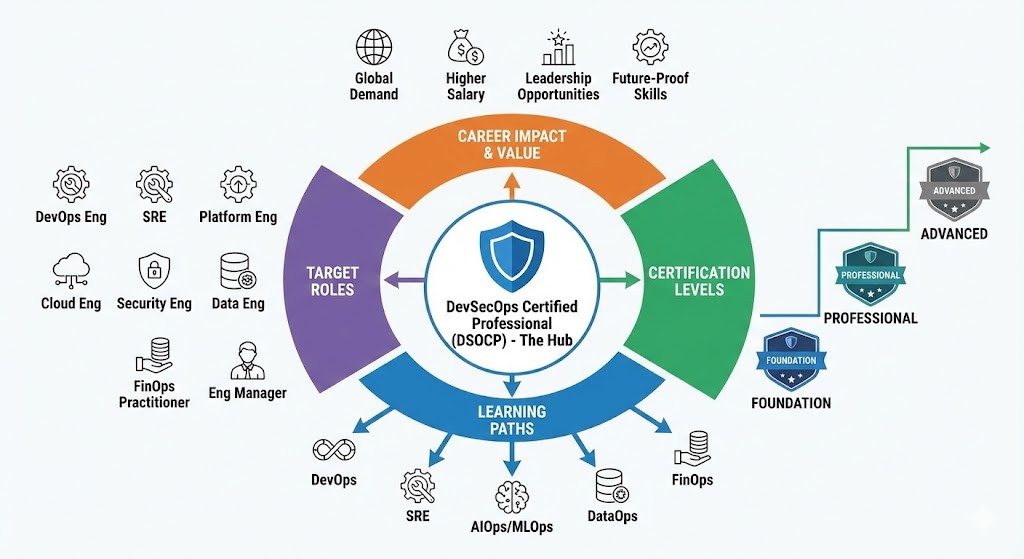
The certification framework offers a progressive journey through foundation, professional, and advanced levels to suit different career stages. Initially, the foundation level introduces the core mindset of shifting security left and basic automated scanning. Following this, the professional level dives into deep technical implementations such as secret management and container hardening. Finally, the advanced level focuses on the governance, risk, and compliance (GRC) aspects of automated systems at scale. These levels align perfectly with career progression, moving from individual technical execution to high-level strategic leadership. Specialized tracks also allow for deep dives into specific domains like SRE or data security.
Complete DevSecOps Certified Professional (DSOCP) Certification Table
| Track | Level | Who it’s for | Prerequisites | Skills Covered | Recommended Order |
| Security Ops | Foundation | Junior Engineers | Basic Linux | SCA, SAST, DAST | 1st |
| Core Engineering | Professional | DevOps / SRE | DSOCP Foundation | Vault, Image Scanning | 2nd |
| Strategy | Advanced | Tech Leads | DSOCP Professional | Governance, SaC | 3rd |
| Orchestration | Expert | Architects | 5+ Years Exp | K8s Security, Mesh | 4th |
Detailed Guide for Each DevSecOps Certified Professional (DSOCP) Certification
DevSecOps Certified Professional (DSOCP) – Foundation
What it is
This certification validates a professional’s understanding of the shift-left philosophy and the basics of security automation. It confirms that the candidate can identify common web vulnerabilities and understands the DevSecOps lifecycle.
Who should take it
Entry-level developers, aspiring DevOps engineers, and technical project managers should pursue this level. It serves as the perfect entry point for anyone new to the intersection of security and operations.
Skills you’ll gain
- Mastery of the “Shift Left” mindset and cultural requirements.
- Ability to identify OWASP Top 10 vulnerabilities in code.
- Knowledge of basic Static Application Security Testing (SAST).
- Understanding of how security fits into a standard CI/CD pipeline.
Real-world projects you should be able to do
- Integrate a simple linting and security scanner into a Git repository.
- Document a basic threat model for a small web application.
- Configure an automated alert system for failed security checks.
Preparation plan
- 7–14 days: Study the core definitions of DevSecOps and the OWASP framework.
- 30 days: Practice setting up basic pipelines with integrated SAST tools.
- 60 days: Perform full audits on small-scale projects to solidify your knowledge.
Common mistakes
- Candidates often focus solely on the tools while ignoring the cultural shift.
- Many beginners neglect the importance of manual code review alongside automation.
- Ignoring basic networking fundamentals often leads to confusion during the exam.
Best next certification after this
- Same-track option: DSOCP Professional level.
- Cross-track option: Certified SRE Foundation.
- Leadership option: DevOps Leader (DOL) certification.
DevSecOps Certified Professional (DSOCP) – Professional
What it is
This level focuses on the heavy-duty technical implementation of security within automated environments. It proves your ability to secure the entire infrastructure and the application runtime effectively.
Who should take it
Active DevOps engineers, SREs, and cloud architects with several years of experience should take this. It is designed for those who manage production-grade systems and require deep automation expertise.
Skills you’ll gain
- Advanced implementation of Secret Management using tools like Vault.
- Mastery of Container Security and Kubernetes admission controllers.
- Ability to automate compliance as code using specialized frameworks.
- Deep knowledge of Software Composition Analysis (SCA) for dependencies.
Real-world projects you should be able to do
- Design a zero-trust architecture for a microservices-based deployment.
- Implement automated image signing and verification in a container registry.
- Build a self-healing pipeline that blocks insecure dependencies automatically.
Preparation plan
- 7–14 days: Refresh your knowledge of Docker, Kubernetes, and API security.
- 30 days: Build a comprehensive pipeline that includes Vault and SCA.
- 60 days: Practice remediating complex, multi-layered security vulnerabilities in a lab.
Common mistakes
- Over-engineering security gates so they block legitimate development speed.
- Failing to rotate secrets regularly despite having the tools in place.
- Neglecting the feedback loop that informs developers of their security errors.
Best next certification after this
- Same-track option: DSOCP Advanced level.
- Cross-track option: FinOps Certified Professional.
- Leadership option: Principal Engineer Certification.
DevSecOps Certified Professional (DSOCP) – Advanced
What it is
The Advanced certification validates your ability to lead entire organizations through a DevSecOps transformation. It covers high-level governance, strategic tool selection, and building a security-first culture at scale.
Who should take it
Senior architects, technical directors, and aspiring CISOs should aim for this credential. It targets professionals who make the final decisions on security policy and architectural standards.
Skills you’ll gain
- Designing enterprise-level security governance frameworks.
- Implementing Security as Code (SaC) across multi-cloud environments.
- Leading incident response and forensic analysis for automated systems.
- Developing strategic KPIs to measure security posture and velocity.
Real-world projects you should be able to do
- Draft a global security policy for an organization with hundreds of teams.
- Conduct a full-scale security audit of a complex multi-cloud infrastructure.
- Create a custom security automation framework for a specific industry niche.
Preparation plan
- 7–14 days: Study global compliance standards such as GDPR, HIPAA, and SOC2.
- 30 days: Analyze and document the failure points of major historical security breaches.
- 60 days: Create a mock transformation plan for a legacy enterprise.
Common mistakes
- Creating policies that are technically sound but practically impossible to follow.
- Losing touch with the technical realities of the engineering teams.
- Failing to align security goals with the overarching business objectives.
Best next certification after this
- Same-track option: Specialized Expert tracks.
- Cross-track option: Advanced AIOps/MLOps certification.
- Leadership option: CTO/CISO Leadership program.
Choose Your Learning Path
DevOps Path
The DevOps path focuses on the seamless flow of code from development to production without friction. Consequently, you will learn to treat security tools just like any other automated test in the pipeline. By doing so, you ensure that every deployment remains secure without slowing down the release cycle. Furthermore, you will focus on integrating security alerts directly into developer workflows. This path ultimately produces engineers who can maintain high velocity while keeping systems safe.
DevSecOps Path
This specialized path dives deep into the technical heart of automated security and vulnerability management. Initially, you will master the art of building “security gates” that automatically reject insecure code or infrastructure. Additionally, you will focus on hardening the very platforms that host your applications, such as Kubernetes or Serverless environments. This path is ideal for those who want to be the primary defenders of their organization’s digital assets. Consequently, you will become a vital link between the security office and the engineering floor.
SRE Path
Site Reliability Engineers use this path to ensure that security threats do not compromise system availability or performance. Therefore, you will treat security incidents as reliability failures and apply standard SRE practices like post-mortems and error budgets. In addition, you will focus on the security of the underlying infrastructure and network layers. This path highlights the fact that an insecure system can never be a truly reliable one. Ultimately, you will build systems that are both resilient to failure and resistant to attack.
AIOps / MLOps Path
As machine learning becomes central to modern business, securing these models and their data pipelines is paramount. Specifically, this path teaches you how to protect training data from poisoning and secure the deployment of AI models. You will also learn to use AI-driven tools to detect security anomalies faster than any human could. Consequently, you will stay ahead of sophisticated threats that target automated decision-making systems. This path ensures that your AI initiatives remain both innovative and trustworthy for the business.
DataOps Path
Data security and privacy are the core focuses of this learning path for modern professionals. You will learn to automate the encryption of data at rest and in transit throughout its entire lifecycle. Moreover, you will implement automated data masking and access controls to comply with international privacy laws. This path ensures that the “data oil” of the company does not become a toxic liability through leaks or breaches. Consequently, you provide a safe foundation for data-driven insights and business intelligence.
FinOps Path
The FinOps path explores the often-overlooked connection between security posture and cloud costs. Specifically, you will learn that insecure configurations often lead to wasted resources and unexpected cloud bills from compromised accounts. Additionally, you will focus on the cost-efficiency of security tools, ensuring you get the best protection for every dollar spent. This ensures that the organization remains safe without ballooning the cloud budget unnecessarily. Consequently, you help the business achieve a secure and financially sustainable cloud presence.
Role → Recommended DevSecOps Certified Professional (DSOCP) Certifications
| Role | Recommended Certifications |
| DevOps Engineer | DSOCP Foundation & Professional |
| SRE | DSOCP Professional & SRE Professional |
| Platform Engineer | DSOCP Professional & Advanced |
| Cloud Engineer | DSOCP Foundation & Cloud Security |
| Security Engineer | DSOCP Foundation, Professional & Advanced |
| Data Engineer | DSOCP Foundation & DataOps Specialty |
| FinOps Practitioner | DSOCP Foundation & FinOps Professional |
| Engineering Manager | DSOCP Foundation & DevOps Leader |
Next Certifications to Take After DevSecOps Certified Professional (DSOCP)
Same Track Progression
Once you master the DSOCP levels, you should pursue deep technical specializations in cloud-specific security. For example, getting an AWS Security Specialty or Azure Security Engineer certification will complement your vendor-neutral DSOCP knowledge. Furthermore, you can look into certifications for specific security tools that are standard in your organization. This deep dive ensures that you remain the undisputed expert in your specific technical stack. Ultimately, staying on this track leads to high-level architectural roles with significant influence.
Cross-Track Expansion
Broadening your expertise into fields like SRE or FinOps will make you a much more versatile and valuable asset. By understanding how security impacts reliability and cost, you can provide more holistic and strategic advice to your organization. Additionally, exploring DataOps will help you handle the massive data workloads that define modern enterprise systems. This “T-shaped” skill set is highly coveted by recruiters who need engineers capable of wearing multiple hats. Consequently, you will find yourself better equipped for senior roles that require a broad technical perspective.
Leadership & Management Track
For those who want to move away from day-to-day coding, the leadership track offers a path to strategic management. You should focus on certifications that teach risk management, team building, and organizational change. These credentials help you communicate the value of DevSecOps to non-technical stakeholders and executives. Moreover, you will learn how to manage budgets and choose security vendors that align with the company’s long-term goals. This track eventually leads to roles like Director of Engineering or even Chief Information Security Officer (CISO).
Training & Certification Support Providers for DevSecOps Certified Professional (DSOCP)
DevOpsSchool
This provider offers an industry-leading training program that combines deep theoretical knowledge with extensive practical lab work. Their instructors bring decades of real-world experience to the classroom, ensuring that students learn what actually works in production. Furthermore, they provide continuous support to help candidates navigate the complexities of the certification process successfully.
Cotocus
Cotocus focuses on delivering high-impact technical training that is specifically designed for modern engineering teams and individuals. They emphasize the mastery of cutting-edge tools and the implementation of best practices in cloud-native security. Additionally, their mentorship programs provide personalized guidance to help students reach their career goals in the DevSecOps space.
Scmgalaxy
As a major community hub, Scmgalaxy provides a wealth of educational resources, tutorials, and community support for aspiring engineers. They focus on the entire software configuration management lifecycle, with a heavy emphasis on security and automation. Moreover, their platform allows professionals to stay updated on the latest industry trends and tool updates.
BestDevOps
BestDevOps is known for its practical, hands-on approach to learning that prioritizes skill acquisition over simple exam preparation. They offer a range of training formats, including live sessions and self-paced modules, to accommodate different learning styles. Consequently, they are a preferred choice for professionals who want to build real-world competence quickly.
devsecopsschool.com
This platform focuses exclusively on the DevSecOps domain, offering specialized courses that cover everything from basic security to advanced architecture. They provide a structured learning path that aligns perfectly with the requirements of the DSOCP certification. Furthermore, their content is developed by experts who are currently working at the forefront of the security industry.
sreschool.com
SRESchool teaches professionals how to build and maintain highly reliable systems while integrating security as a core component. They provide deep dives into how security impacts system availability and how to handle incidents using SRE principles. Additionally, their training helps engineers bridge the gap between infrastructure stability and automated security.
aiopsschool.com
This provider explores the intersection of artificial intelligence and operations, showing how AI can revolutionize security monitoring. They offer specialized training on using machine learning to detect threats and automate remediation in complex environments. Consequently, it is a great resource for engineers looking to master the next generation of operations.
dataopsschool.com
DataOpsSchool addresses the critical need for secure and compliant data pipelines in today’s data-driven world. They provide comprehensive training on data governance, encryption, and the technical challenges of managing data at scale. Moreover, their courses help professionals ensure that their data initiatives remain safe and legally compliant.
finopsschool.com
FinOpsSchool focuses on the financial management of cloud resources, including the significant impact of security on the bottom line. They teach students how to optimize cloud costs while maintaining a robust and secure architectural posture. Ultimately, they provide the financial literacy needed to justify security investments to the business leaders.
Frequently Asked Questions
- How much time should I dedicate to the DSOCP Foundation exam?Most professionals find that spending 3 to 4 weeks of consistent daily study is sufficient for the foundation level. You should focus on understanding the core concepts of shift-left and basic automated tools. Furthermore, completing at least 10-15 hours of hands-on lab work will ensure you are comfortable with the practical questions.
- Is the DSOCP certification recognized in the global market?Yes, the certification is highly respected globally because it addresses the universal need for secure software delivery pipelines. Companies in the US, Europe, and India specifically look for these skills when hiring for DevOps and SRE roles. Consequently, earning this credential will make your profile stand out to recruiters in major tech hubs worldwide.
- What is the primary difference between DevOps and DevSecOps?DevOps focuses on the collaboration between development and operations to increase the speed and reliability of releases. In contrast, DevSecOps introduces security as a shared responsibility throughout that entire process from the very beginning. Therefore, it ensures that speed does not come at the expense of the organization’s safety.
- Do I need to know how to code to pass the DSOCP exam?While you don’t need to be a professional developer, you should have a basic understanding of code structure and scripting. You will need to read scripts, understand configuration files, and interpret the results of automated security scans. Consequently, a basic familiarity with languages like Python, Bash, or YAML is highly beneficial for candidates.
- Are the exams for DSOCP practical or multiple-choice?The assessment usually consists of a combination of multiple-choice questions and scenario-based problems that test your practical application. You will often be asked how you would solve a specific security challenge within a pipeline or infrastructure. This ensures that the certification validates actual technical competence rather than just rote memorization.
- How long does the DSOCP certification remain valid for a professional?The certification typically remains valid for two to three years before you need to renew or upgrade to a higher level. This cycle ensures that your skills stay current with the rapidly evolving security landscape and new tool releases. Furthermore, it encourages lifelong learning, which is a key trait of successful senior engineers.
- Does the DSOCP curriculum cover specific cloud providers like AWS?The curriculum is designed to be vendor-neutral, focusing on principles and tools that work across any cloud environment. However, many of the hands-on labs use popular providers like AWS or Azure to demonstrate these concepts in action. This approach ensures that your skills are transferable across different companies and technical stacks.
- What kind of salary can a DSOCP professional expect in India?In the Indian market, a professional with DevSecOps skills can expect a significant premium compared to traditional IT roles. Salaries for certified professionals often range from 15 to 35 lakhs per annum, depending on experience and the specific company. Furthermore, senior architects with this certification can command even higher compensation packages in major cities.
- Can this certification help me move from a manual testing role?Absolutely, this is an excellent path for manual testers who want to transition into the more lucrative world of automation. You will learn how to automate security testing, which is a highly specialized and valuable skill set. Consequently, it provides a clear roadmap for moving into modern engineering and operations roles.
- Is there any prerequisite for the DSOCP Professional level?It is generally recommended that you pass the Foundation level or have equivalent industry experience before attempting the Professional exam. This ensures that you have the necessary background knowledge to handle the more complex technical scenarios presented at this level. Furthermore, it helps you build a solid foundation for your long-term career growth.
- How does DevSecOps impact the overall speed of deployment?Initially, integrating security might seem to slow things down, but it actually prevents major delays caused by late-stage security failures. By catching bugs early, you avoid the “emergency fixes” that often derail release schedules in traditional models. Ultimately, DevSecOps leads to a more predictable and faster delivery cycle over the long term.
- Are there any community forums for DSOCP students?Yes, many training providers host dedicated forums and Slack channels where students can collaborate and share their learning experiences. Engaging with these communities allows you to get answers to tough questions and stay motivated throughout your study journey. Moreover, it provides excellent networking opportunities with other professionals who share your career interests.
FAQs on DevSecOps Certified Professional (DSOCP)
What specific tools are covered in the DSOCP training?
The training covers a broad range of industry-standard tools for every stage of the pipeline, including SonarQube, Snyk, and Vault. You will also get hands-on experience with container scanning tools like Trivy and infrastructure-as-code scanners like Checkov. This ensures that you are familiar with the actual toolsets used by leading engineering teams today.
How does DSOCP address the “culture” aspect of engineering?
The certification emphasizes that DevSecOps is as much about people and processes as it is about technical tools and automation. You will learn strategies for breaking down silos and fostering a culture where every engineer takes ownership of security. Consequently, you will be able to lead the cultural shifts necessary for a successful transformation.
Is container security a major part of the curriculum?
Yes, container and Kubernetes security are core pillars of the Professional and Advanced tracks within the DSOCP program. You will learn how to secure the container build process, the registry, and the actual runtime environment in production. This is essential because most modern DevSecOps initiatives revolve around microservices and containerized workloads.
What is the “Security as Code” concept taught here?
Security as Code involves defining your security policies, compliance checks, and infrastructure hardening steps in version-controlled scripts. This allows you to automate the enforcement of security standards across your entire environment without manual intervention. Consequently, it ensures that your security posture remains consistent and audit-ready at all times during the delivery.
Can I take the training and exam remotely?
Most providers offer fully remote training options, including live virtual classrooms and proctored online exams for your convenience. This allows you to gain world-class certification regardless of your physical location or time zone. Furthermore, it makes it easier for working professionals to balance their certification goals with their existing job responsibilities.
Does DSOCP cover compliance with standards like GDPR?
Yes, the curriculum includes modules on how to automate the compliance checks required for international standards like GDPR and SOC2. You will learn to use automated tools to ensure that your infrastructure and applications always meet these legal requirements. This significantly reduces the stress and manual effort involved in passing corporate security audits.
How often is the DSOCP curriculum updated?
The curriculum is reviewed and updated regularly to reflect the latest security threats and advancements in automation technology. This ensures that the skills you learn are always relevant to the current state of the industry. Consequently, you can be confident that your certification represents the cutting edge of DevSecOps knowledge and practice.
Is there a focus on API security in this certification?
Absolutely, since modern applications rely heavily on APIs, the certification covers the best practices for securing these critical interfaces. You will learn how to implement automated API testing, authentication, and authorization within your delivery pipeline. This ensures that your microservices can communicate safely without exposing the organization to unnecessary risks or data leaks.
Final Thoughts: Is DevSecOps Certified Professional (DSOCP) Worth It?
When you look at the current trajectory of the tech industry, it becomes clear that security is no longer an optional add-on. Therefore, the DevSecOps Certified Professional (DSOCP) is not just another badge; it is a vital survival kit for the modern engineer. This certification proves that you have the skills to build the fast, secure, and reliable systems that the world now depends on. Instead of being just another person in the deployment chain, you become a strategic architect of trust and resilience.
Furthermore, the investment you make in your education today will pay dividends throughout your entire career as you climb the professional ladder. The shift toward automated, secure engineering is permanent, and those who lead this change will always be in high demand. Focus on the practical skills, embrace the cultural shift, and use this certification as a springboard to your next major career milestone. Ultimately, the peace of mind that comes from knowing how to build truly secure systems is worth the effort alone.
Excellent article! It explains DevSecOps concepts clearly, highlights the value of certification, and provides practical insights for professionals looking to strengthen their engineering and security skills.