
Introduction
The modern tech landscape is moving faster than ever. As organizations race to integrate artificial intelligence, secure their software supply chains, and scale multi-cloud infrastructures, the lines between development, operations, security, and data science continue to blur. For IT professionals, staying ahead requires more than just knowing how to write code or configure a server; it demands a validated, comprehensive understanding of automation, cloud native architectures, and continuous delivery pipelines. Choosing the right path from the dozens of available credentials can feel overwhelming. This ultimate guide breaks down the ecosystem to help you find the best DevOps certification to advance your career.
What is a DevOps Certification?
A DevOps certification is a formal, industry-recognized credential that validates your technical expertise in bridging the gap between software development and IT operations. Unlike broad academic degrees, these certifications focus heavily on practical skills, structured learning, and hands-on validation of tools and methodologies.
They prove to employers that you understand how to automate workflows, manage cloud infrastructure at scale, implement robust security protocols, and maintain highly available systems. Preparing for these exams forces you to move past casual, tutorial-based knowledge and master real-world troubleshooting, configuration, and architectural design patterns.
Why DevOps Certifications Matter
In a highly competitive job market, certifications act as a trusted filter for hiring managers and a powerful catalyst for your personal technical growth.
The Strategic Value of Certification
Earning a credential does more than just add a badge to your resume. It structures your learning path, ensuring you do not leave critical gaps in your knowledge, such as skipping networking fundamentals or ignoring security compliance. It provides immediate credibility during technical screenings, helps justify salary increases, and aligns your skill set with standard engineering practices across the tech sector.
Step-by-Step Validation Process
- Identify the Core Goal:
Align your certification choice with your immediate career objectives, such as mastering container orchestration or moving into cloud security. - Bridge the Knowledge Gap:
Use official exam blueprints to uncover areas where your daily work experience might not cover enterprise-level features. - Engage in Active Learning:
Build production-like labs to test failover strategies, infrastructure deployment scripts, and automation webhooks. - Simulate Exam Environments:
Take timed practice exams to build the muscle memory needed for performance-based testing environments. - Achieve Professional Validation:
Pass the examination to secure an industry-standard credential that unlocks elite engineering opportunities.
Who Should Take DevOps Certifications?
DevOps methodologies are no longer confined to a single job title; they form the foundation of modern engineering teams.
- Students and Freshers:
Looking to stand out in entry-level hiring pools by proving they possess practical, tool-based cloud competencies. - Software Engineers:
Aiming to understand where their code runs, how to optimize build pipelines, and how to debug deployment failures. - System Administrators and Cloud Engineers:
Transitioning from manual infrastructure management to automated, repeatable code-driven deployments. - SRE and Platform Engineers:
Focused on maximizing system availability, scaling clusters, and building internal developer platforms. - DevSecOps and QA Engineers:
Driven to bake security scanning, compliance checks, and automated testing directly into delivery pipelines. - Data and ML Engineers:
Transitioning standard software engineering pipelines into robust, automated MLOps environments for artificial intelligence models.
Core Skills Covered
While every certification blueprint targets specific tools, the underlying methodologies focus on a core set of engineering disciplines.
- Continuous Integration & Continuous Delivery (CI/CD):
Designing automated workflows that compile code, run test suites, and safely deploy applications to production servers with zero downtime. - Infrastructure as Code (IaC):
Treating infrastructure configurations exactly like application source code, allowing teams to provision networks, storage, and compute environments using declarative scripts. - Containerization and Orchestration:
Packaging applications into isolated, portable runtime units and managing thousands of those units across distributed server clusters. - Cloud Infrastructure & Architecture:
Configuring scalable, fault-tolerant, and cost-effective networks, access control systems, and compute instances across leading cloud ecosystems. - Site Reliability & Observability:
Setting up comprehensive metric collections, centralized logging systems, and real-time alerts to detect and resolve application anomalies before they impact end-users. - DevSecOps (Shift-Left Security):
Embedding automated vulnerability scanners, secret detection tools, and identity management policies directly into early development and pipeline stages.
Table 1 – Best DevOps Certifications
The following table outlines twenty premier certifications across cloud platforms, containers, infrastructure automation, security, and specialized operational workflows.
| Certification Name | Best For | Skill Level | Career Direction |
| AWS Certified DevOps Engineer – Professional | Advanced AWS automation and CI/CD governance | Professional | Cloud DevOps Engineer |
| Microsoft Certified: DevOps Engineer Expert | Mastering Azure DevOps services and GitHub enterprise workflows | Expert | Azure Platform Engineer |
| Google Cloud Certified – Professional Cloud DevOps Engineer | SRE metrics, Google Cloud services, and container performance | Professional | Google Cloud SRE |
| Certified Kubernetes Administrator (CKA) | Core Kubernetes cluster management, architecture, and troubleshooting | Intermediate | Kubernetes / Platform Administrator |
| Certified Kubernetes Application Developer (CKAD) | Designing, building, and configuring cloud-native apps for Kubernetes | Intermediate | Cloud Native Developer |
| Certified Kubernetes Security Specialist (CKS) | Securing container platform runtimes, clusters, and supply chains | Advanced | DevSecOps Specialist |
| HashiCorp Certified: Terraform Associate | Declarative infrastructure as code provisioning across multiple clouds | Associate | Cloud Infrastructure Engineer |
| Docker Certified Associate (DCA) | Container runtimes, image building, security, and basic networking | Associate | Container Engineer |
| Red Hat Certified Specialist in Ansible Automation | Configuration management and large-scale IT orchestration workflows | Intermediate | System Automation Engineer |
| Certified DevSecOps Professional (CDP) | Practical execution of security testing within active CI/CD pipelines | Intermediate | DevSecOps Engineer |
| Certified DevSecOps Expert (CDE) | Advanced security architecture, container hardening, and compliance automation | Advanced | Lead Security Architect |
| GitLab Certified DevOps Professional | End-to-end platform mastery from source control to automated delivery | Intermediate | CI/CD Pipeline Architect |
| GitHub Actions认证 (GitHub Actions Certification) | Designing workflow sheets, custom actions, and runner groups within GitHub | Associate | Automation Engineer |
| Prometheus Certified Associate (PCA) | Cloud-native monitoring, metric collections, alerts, and PromQL queries | Associate | Observability / SRE Engineer |
| Certified GitOps Associate (CGA) | Declarative continuous delivery concepts utilizing Git as the single source of truth | Associate | GitOps Practitioner |
| Argo CD Certified Associate (ACA) | Pull-based Kubernetes deployment, sync strategies, and multi-cluster setups | Associate | GitOps Platform Engineer |
| Linux Foundation Certified System Administrator (LFCS) | Core Linux system configuration, package management, and system storage | Associate | Linux Administrator |
| AWS Certified Security – Specialty | Data protection, network security, IAM, and logging within AWS systems | Specialist | Cloud Security Engineer |
| Azure Security Engineer Associate | Implementing threat protections and identity management across Azure environments | Associate | Azure Security Analyst |
| Datadog Fundamentals Certification | Full-stack cloud platform performance tracing, logs, and dashboarding | Associate | Observability Engineer |
Certification Deep Dive
Before selecting a specific track from the listings above, it is vital to understand the operational footprint, practical framework, and performance environment shared by these elite industry certifications.
Real-World Use Case
Imagine an e-commerce platform facing massive traffic spikes during global sales events. Engineers must manage hundreds of microservices, ensure payment gateways remain completely secure, and update software features without dropping a single active customer connection.
The methodologies tested in these certifications prepare engineers to deploy auto-scaling container configurations, manage declarative cloud infrastructure that dynamically scales based on user traffic, and embed automated scanning checks that block insecure code changes before they ever reach production systems.
Skills You Will Learn
- Automated Declarative Infrastructure: Writing clean, reusable templates to safely provision networks, access controls, and database clusters across distinct testing and production environments.
- Production Cluster Orchestration: Deploying, upgrading, scaling, and debugging container instances across production-grade application clusters.
- Advanced Pipeline Optimization: Constructing reliable build, test, and release flows that utilize caching and modular builds to deliver updates safely within minutes.
- Full-Stack Observability Architectures: Instrumenting application source code and infrastructure layers to surface deep metrics, traces, and centralized logs for proactive bug resolution.
Career Scope
The demand for certified practitioners continues to climb as businesses move past basic cloud migration and focus on cloud-native operational efficiency. Professionals holding these credentials routinely secure positions as Cloud Solutions Architects, Site Reliability Engineers, Platform Automation Engineers, and DevSecOps Directors. These certifications act as definitive proof of your capabilities, positioning you for leadership pathways and significant compensation growth within global engineering organizations.
Difficulty Level
Varies from Intermediate to Advanced. Many exams have shifted away from simple multiple-choice questions toward performance-based sandbox environments where you must repair broken configurations, secure live clusters, or construct infrastructure architectures under strict time limits.
Best Career Fit / Who Should Take It
Engineers who love solving systemic architecture puzzles, automating repetitive technical tasks, and building resilient platforms for development teams. If you prefer building reliable software systems and infrastructure over simply writing isolated features, this career domain is tailored for you.
Hands-On Projects
To master these certifications, engineers typically build and document production-style labs:
- The GitOps Engine: Constructing an automated Git repository that triggers GitOps controllers to instantly synchronize, upgrade, or rollback application workloads across multiple Kubernetes environments without manual cluster access.
- The Secure Infrastructure Pipeline: Authoring a declarative Terraform layout that builds a private multi-tier cloud network, running it through automated security scanning tools, and deploying the configuration via a secure, audited CI/CD pipeline.
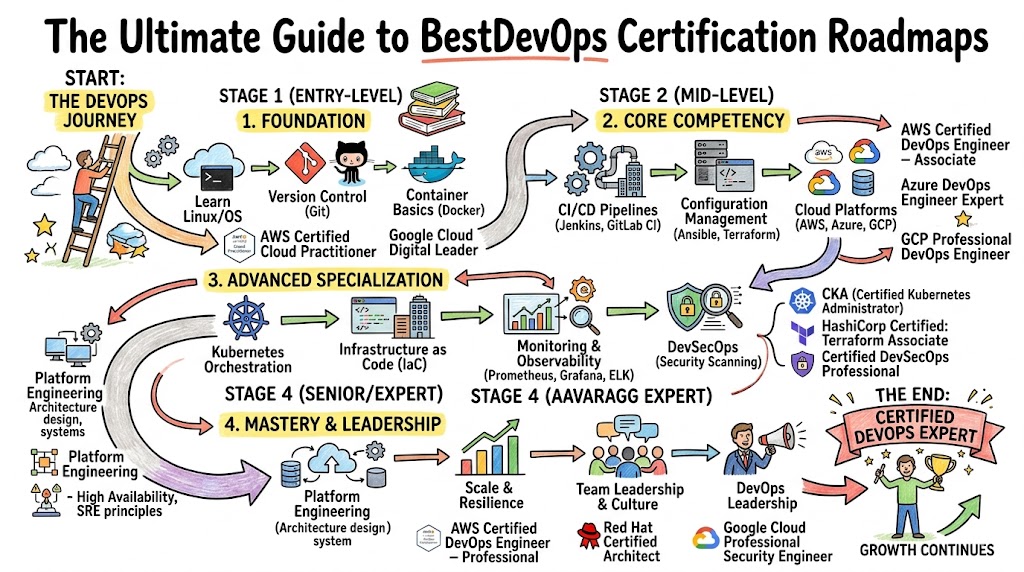
DevOps Certification Roadmap
Building a successful career requires layering your certifications logically. Attempting advanced architectural certifications before mastering core systems automation will often lead to confusion and exam setbacks.
Table 2 – Recommended Certification Path
| Career Goal | Recommended Certification Path | Why It Fits |
| Cloud DevOps Specialist | AWS Cloud Practitioner / Azure Fundamentals → HashiCorp Terraform Associate → AWS DevOps Professional / Azure DevOps Expert | Builds a solid foundational cloud layer, adds infrastructure automation skills, and validates senior deployment patterns. |
| Cloud Native & Kubernetes Specialist | Linux Foundation LFCS → Docker Certified Associate → CKA → CKS | Validates core operating system skills, shifts into container layers, masters orchestration, and finishes with advanced platform security. |
| DevSecOps Architect | AWS/Azure Associate → Certified DevSecOps Professional (CDP) → Certified Kubernetes Security Specialist (CKS) | Combines platform baseline administration with specialized pipeline security practices and container runtime defense. |
| Site Reliability & Observability Engineer | Linux Foundation LFCS → Certified Kubernetes Administrator (CKA) → Prometheus Certified Associate → Datadog Fundamentals | Blends deep infrastructure and container mastery with specialized cloud-native alerting, visualization, and metric analysis. |
| GitOps Platform Engineer | HashiCorp Terraform Associate → Certified Kubernetes Administrator (CKA) → Certified GitOps Associate → Argo CD Associate | Focuses heavily on declarative cloud native systems, combining base cluster administration with pull-based automation pipelines. |
Types of DevOps Certifications
Certifications generally fall into three distinct conceptual categories, each serving a unique purpose throughout your engineering journey.
- Cloud Platform Specific: Credentials offered directly by major cloud providers (AWS, Azure, Google Cloud) that focus heavily on utilizing their proprietary ecosystem tools, identity management platforms, and release frameworks.
- Tool-Specific and Cloud-Native Open Source: Platform-agnostic certifications managed by vendor foundations (such as the Cloud Native Computing Foundation or HashiCorp) that validate deep operational expertise in a specific piece of software, like Kubernetes or Terraform, across any cloud.
- Methodology and Role-Focused Security: Credentials that assess your holistic architectural execution, looking at how you integrate distinct security frameworks, compliance standards, and collaborative methodologies across multiple engineering verticals.
Common Mistakes to Avoid
- Chasing Multiple Certifications Simultaneously: Focusing on passing three different baseline exams at once instead of deeply mastering a single complete technical track.
- Relying Solely on Exam Dumps: Memorizing exam answers to pass multiple-choice tests without building the hands-on labs required to survive technical interviews or performance exams.
- Neglecting Core Operating System Fundamentals: Trying to learn advanced container orchestrators like Kubernetes without mastering foundational Linux networking, file system controls, and process troubleshooting.
- Ignoring the Software Security Layer: Designing fast, highly automated deployment pipelines that completely overlook access control, secret management, and vulnerability scanning.
- Failing to Maintain and Update Credentials: Letting highly valuable professional certifications expire by neglecting continuing education requirements or missing newer platform feature revisions.
5 Real-Life Examples of Certified DevOps Impact
- Example 1: A certified AWS DevOps Engineer redesigned a legacy infrastructure setup into a modular Terraform structure, reducing environment provisioning times from four days to eleven minutes.
- Example 2: An engineering team member earned their CKA and CKS credentials, using that knowledge to migrate an enterprise application to Kubernetes, cutting infrastructure overhead costs by 35%.
- Example 3: A certified DevSecOps Professional integrated automated secrets detection into a client’s GitHub Actions workflow, successfully intercepting and blocking over 40 accidental database credential leaks in under a year.
- Example 4: An SRE professional utilized their Prometheus and Datadog certification training to establish early-warning metric alerts, dropping a major financial platform’s Mean Time to Resolution (MTTR) from 2 hours down to 4 minutes.
- Example 5: A software delivery team standardized their platform around an Argo CD GitOps workflow designed by their certified platform lead, eliminating manual production hotfixes and achieving clean, auditable deployments.
FAQs
1. Which DevOps certification is best for absolute beginners?
The HashiCorp Certified: Terraform Associate or a foundational cloud certificate like AWS Certified Cloud Practitioner is an excellent starting point. They introduce key concepts like cloud infrastructure and automation without overwhelming you with complex coding structures or advanced systems architecture.
2. Are performance-based DevOps certificates harder than multiple-choice exams?
Yes, exams like the CKA, CKAD, and CKS require you to interact directly with real, live command-line environments to solve complex scenarios under a strict clock. They test genuine engineering execution and troubleshooting skills rather than simple conceptual recall.
3. How long does it typically take to prepare for an expert-level DevOps certification?
For professionals working with cloud infrastructure daily, deep preparation usually takes between 3 to 6 months of structured study. For engineers transitioning from other IT backgrounds, it can take 6 to 12 months to properly absorb and practice the complete toolset.
4. Can I secure a high-paying DevOps position by only holding certifications?
Certifications provide immediate entry to technical interviews by validating your skills to recruiters. However, you must pair those credentials with a portfolio of functional hands-on projects, clear communication skills, and real-world system debugging capabilities to secure senior engineering positions.
5. Why should I choose Kubernetes certifications over general cloud certifications?
Kubernetes credentials like the CKA are entirely platform-agnostic, meaning the skills you prove map perfectly to any environment running containers, whether it is AWS, Azure, on-premises bare-metal servers, or a private hybrid cloud setup.
6. Do DevOps certifications expire, and how often do I need to recertify?
Most major cloud and cloud-native certifications expire after 2 to 3 years. Recertification typically involves passing an updated version of the exam or successfully completing a higher-tier expert credential within that same provider track.
7. What is the fundamental difference between the CKA and CKAD exams?
The CKA focus is tailored specifically for administrators building, upgrading, networking, and securing the core Kubernetes cluster infrastructure. The CKAD focuses heavily on application developers who deploy, configure, and scale cloud-native applications within an existing cluster.
8. Is learning Linux system administration mandatory before taking DevOps certificates?
Yes, a solid baseline knowledge of Linux commands, permissions, file systems, and shell configuration scripts is essential. The vast majority of production container systems, automation agents, and cloud instances run directly on Linux distributions.
9. How does an MLOps certification path differ from a standard DevOps track?
While a standard DevOps track focuses on application code availability, an MLOps pipeline adds data versioning, model training automation, feature store monitoring, and continuous deployment of machine learning algorithms into production applications.
10. Is the AWS Certified DevOps Engineer Professional exam worth it if my company uses multiple clouds?
Yes, the overarching delivery principles, CI/CD designs, blue-green deployment strategies, and governance methodologies you learn translate directly to other cloud platforms, even though the specific service names will differ.
Conclusion
Accelerating your career requires transitioning from manual IT management to automated, resilient, and secure system architectures. Earning the best DevOps certification for your specific career stage provides the rigorous framework, market recognition, and engineering confidence needed to excel in complex modern technical environments. By matching your career objectives to a logical certification path, dedicating time to building realistic sandbox labs, and learning how to secure your automation pipelines, you transform yourself into a highly sought-after engineering asset. Explore the complete collection of learning tracks on the BestDevOps Certification Page to map your professional journey, validate your infrastructure expertise, and lead your engineering teams with confidence.
Call to Action
Do not let your engineering skills plateau in a fast-evolving tech market. Take ownership of your professional trajectory today by selecting a certification path that fits your current goals, setting a definitive exam target date, and writing the infrastructure code that transforms your abstract knowledge into real-world engineering projects. Success in DevOps belongs to practitioners who continuously build, break, test, and automate. Dive into the official blueprints, configure your local terminal labs, and begin your step-by-step journey toward industry-wide professional validation right now!
Great guide! The certification roadmap is explained clearly, helping professionals choose the right DevOps learning path and advance their careers with confidence.