
Introduction
In the rapidly evolving landscape of modern infrastructure, observability has transitioned from a niche concern to a critical requirement for every Master in Observability Engineering professional. As systems grow in complexity and distributed architectures become the standard, the ability to monitor, trace, and troubleshoot production environments determines the stability of any platform. Whether you are working within devopsschool or exploring advanced monitoring frameworks, this guide is designed to help engineers and managers navigate the path to technical mastery. By leveraging resources from aiopsschool, you can gain the insight needed to make informed career decisions and build resilient, data-driven systems that stand the test of time.
What is the Master in Observability Engineering?
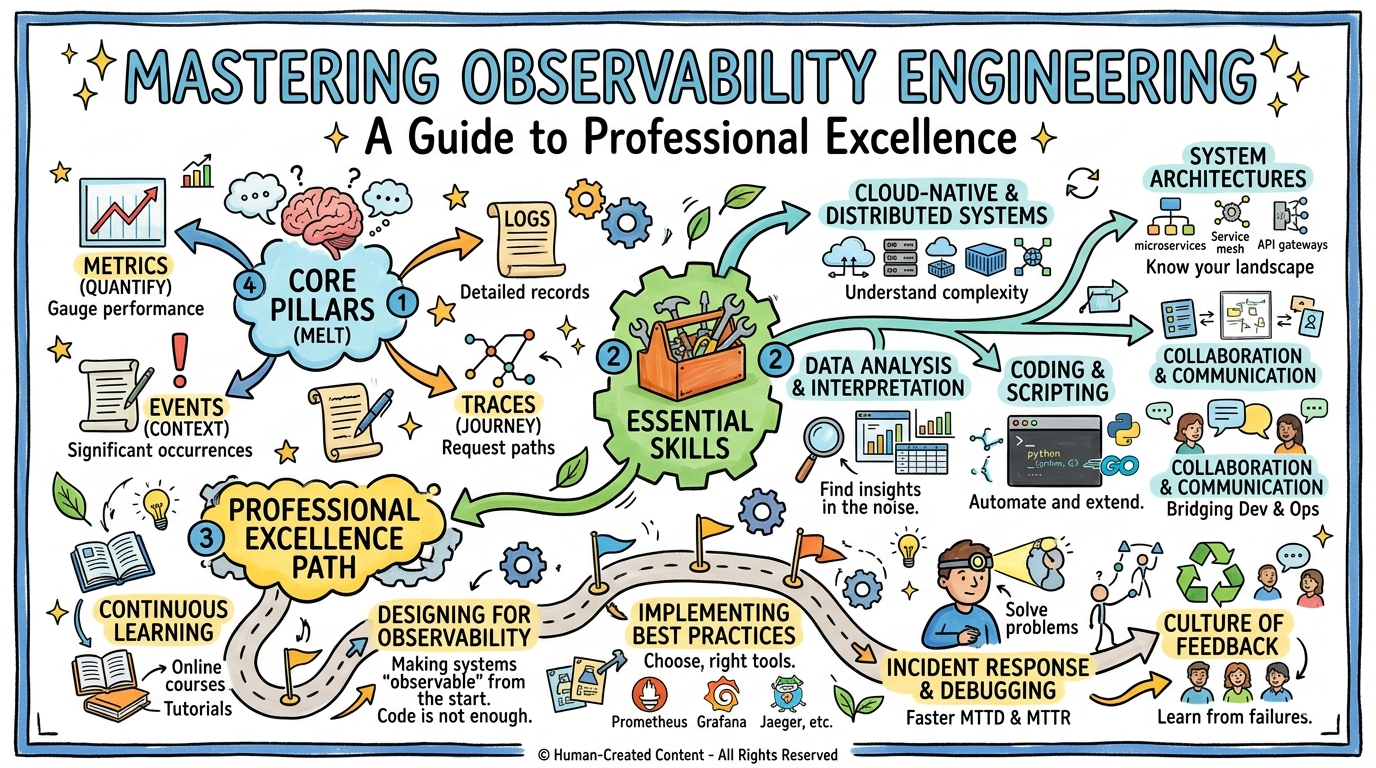
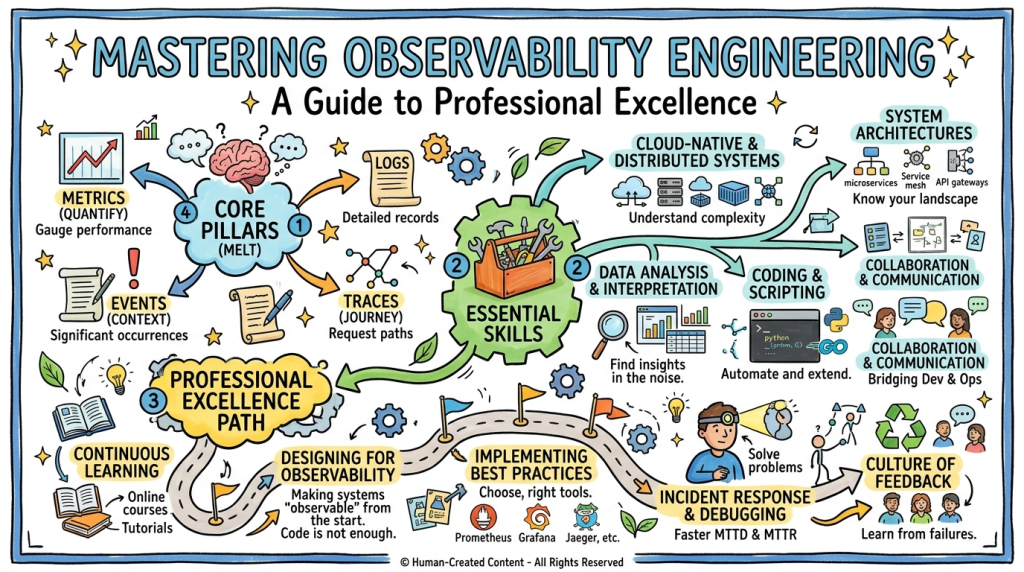
The Master in Observability Engineering represents a comprehensive framework focused on the collection, analysis, and interpretation of telemetry data from complex software ecosystems. It exists to bridge the gap between reactive monitoring and proactive system health management in production environments. Rather than focusing on abstract theory, this discipline emphasizes the practical application of logs, metrics, and traces to identify the root cause of system anomalies. It aligns perfectly with modern engineering workflows by ensuring that developers and operators share a unified view of system performance. In enterprise practices, it serves as the foundation for maintaining high availability and improving the overall end-user experience across distributed clouds.
Who Should Pursue Master in Observability Engineering?
This pursuit is ideal for software engineers looking to deepen their understanding of how their code behaves under production stress. Site Reliability Engineers and platform architects will find the core concepts essential for reducing toil and managing service-level objectives effectively. Cloud and security professionals can leverage these skills to detect unauthorized access patterns and infrastructure vulnerabilities in real-time. Data engineers and managers will benefit from the increased visibility into pipeline health and data flow consistency. Whether you are based in India or managing global teams, the ability to observe and troubleshoot complex systems is a universal requirement for professional growth.
Why Master in Observability Engineering
The demand for observability skills has risen sharply as organizations move away from monolithic architectures toward microservices and serverless models. By mastering these concepts, professionals ensure their long-term relevance regardless of the specific monitoring tools an organization chooses to adopt. This knowledge provides a significant return on investment by allowing engineers to solve problems faster, thereby reducing downtime and increasing team productivity. It also empowers individuals to take on higher-level architectural roles that require a deep understanding of system telemetry. Ultimately, this expertise transforms engineers into high-value assets who can navigate and stabilize even the most volatile production environments.
Master in Observability Engineering Certification Overview
This program is delivered via the Master in Observability Engineering platform and hosted on [devopsschool]. The certification is structured to provide a clear progression from fundamental concepts to advanced architectural implementation in real-world scenarios. It follows a practical assessment approach, requiring candidates to demonstrate their ability to handle real-world telemetry data and configuration tasks. Ownership of the certification reflects a verified ability to manage system health across diverse technical environments. By focusing on hands-on application, the certification ensures that every professional is prepared to face the challenges of modern infrastructure management.
Master in Observability Engineering Certification Tracks & Levels
The certification program is divided into three distinct levels: foundation, professional, and advanced. The foundation level covers the core pillars of monitoring and the basic collection of telemetry data. The professional level introduces complex troubleshooting, alert management, and the integration of diverse toolsets into unified dashboards. The advanced level focuses on architectural design, cost optimization of telemetry pipelines, and predictive analysis. These levels allow professionals to align their certification journey with their specific career trajectory, whether they are focused on operational efficiency or strategic leadership.
Complete Master in Observability Engineering Certification Table
| Track | Level | Who it’s for | Prerequisites | Skills Covered | Recommended Order |
| Core | Foundation | Beginners/Ops | Basic Linux | Monitoring, Metrics | 1 |
| Advanced | Professional | Engineers | Foundation | Tracing, Alerting | 2 |
| Architectural | Expert | SRE/Architects | Professional | Pipeline Design | 3 |
Detailed Guide for Each Master in Observability Engineering Certification
Master in Observability Engineering – Foundation
What it is
This certification validates the fundamental ability to collect and visualize system metrics and logs in a standard environment.
Who should take it
Suitable for junior DevOps engineers, system administrators, and developers beginning their journey into infrastructure monitoring.
Skills you’ll gain
- Understanding telemetry collection agents.
- Configuring basic threshold-based alerts.
- Building simple dashboard visualizations.
Real-world projects you should be able to do
- Setting up a basic monitoring agent on a Linux server.
- Creating a dashboard that tracks CPU and memory utilization.
- Configuring email alerts for critical service failures.
Preparation plan
- 7 Days: Focus on reading core documentation and understanding metrics.
- 30 Days: Build a home lab to practice deploying monitoring agents.
- 60 Days: Review exam patterns and simulate production failure scenarios.
Common mistakes
Focusing too much on tool features rather than the underlying principles of data collection and effective alerting.
Best next certification after this
Master in Observability Engineering – Professional level.
Choose Your Learning Path
DevOps Path
The DevOps path focuses on integrating observability into CI/CD pipelines to ensure that deployments are safe and observable. It emphasizes the importance of shift-left monitoring, where performance data is considered during the development phase. Engineers learn to automate the configuration of alerts and dashboards as code. This approach ensures that every release is accompanied by the necessary telemetry to measure its success.
DevSecOps Path
The DevSecOps path incorporates security monitoring and audit logging into the broader observability framework. It teaches engineers how to detect security threats in real-time by analyzing anomalous logs and system behaviors. Professionals learn to build secure pipelines that maintain compliance while providing deep visibility into potential attack vectors. This path is crucial for organizations that prioritize proactive security posture.
SRE Path
The SRE path is centered on reliability, service-level indicators, and error budgeting. It provides the tools necessary to manage uptime and performance against strict service-level agreements. Professionals learn to perform deep post-mortem analysis using historical telemetry data to prevent recurring incidents. This path is essential for those responsible for the mission-critical health of large-scale infrastructure.
AIOps Path
The AIOps path focuses on leveraging machine learning to automate the analysis of massive telemetry datasets. It teaches engineers how to move from reactive alerting to predictive incident management. Professionals learn to implement anomaly detection models that identify issues before they impact users. This path is perfect for those dealing with massive, complex distributed systems.
MLOps Path
The MLOps path is dedicated to monitoring the health and performance of machine learning models in production. It covers data drift, model decay, and the infrastructure required to support continuous model retraining. Professionals gain the skills to ensure that production models remain accurate and reliable over time. This path is critical for data science teams scaling their operations.
DataOps Path
The DataOps path focuses on observing the health of data pipelines and the quality of information flowing through the enterprise. It covers the detection of data bottlenecks, ingestion failures, and schema inconsistencies. Professionals learn to ensure that data-driven decisions are based on accurate and timely telemetry. This path is vital for teams managing large-scale data lakes and analytics platforms.
FinOps Path
The FinOps path centers on observability as a means to control and optimize cloud infrastructure spending. It teaches professionals to correlate performance metrics with cost data to identify resource wastage. This path enables engineers to make data-backed decisions about scaling infrastructure without compromising performance. It is essential for managing cloud budgets in a highly dynamic environment.
Role → Recommended Master in Observability Engineering Certifications
| Role | Recommended Certifications |
| DevOps Engineer | Foundation, Professional |
| SRE | Professional, Expert |
| Platform Engineer | Foundation, Professional |
| Cloud Engineer | Foundation, Professional |
| Security Engineer | Foundation, Professional |
| Data Engineer | Foundation, Professional |
| FinOps Practitioner | Foundation, Professional |
| Engineering Manager | Foundation |
Next Certifications to Take After Master in Observability Engineering
Same Track Progression
Once you have mastered observability, consider advancing into specialized performance engineering or complex capacity planning. This allows you to deepen your knowledge of how systems behave under extreme load and refine your skills in high-frequency data analysis.
Cross-Track Expansion
Expand your expertise by exploring certifications in cloud architecture, security, or data engineering. Combining observability skills with these disciplines creates a holistic profile that is highly sought after by top-tier organizations globally.
Leadership & Management Track
For those transitioning into management, focus on certifications related to team leadership, strategic decision-making, and project management. This enables you to apply your technical knowledge to drive organizational change and mentor future generations of engineers.
Training & Certification Support Providers for Master in Observability Engineering
DevOpsSchool
Offers structured training programs and comprehensive certification preparation for individuals looking to gain professional-level mastery.
Cotocus
Provides specialized workshops and hands-on learning experiences for engineers focusing on modern infrastructure and automation strategies.
Scmgalaxy
Delivers focused educational content and practical guidance for professionals looking to sharpen their skills in configuration and system health.
BestDevOps
Focuses on delivering high-quality training resources that align with industry-standard practices and career development goals for DevOps professionals.
devsecopsschool
Offers tailored courses that emphasize the intersection of security and development within the context of observability and system integrity.
sreschool
Provides deep-dive education for reliability engineers focusing on error budgeting, incident response, and proactive system maintenance.
aiopsschool
Focuses on the integration of artificial intelligence and machine learning into the observability workflow for smarter operations.
dataopsschool
Offers comprehensive programs for data professionals looking to improve the reliability and observability of their data infrastructure.
finopsschool
Provides education on managing cloud costs through better observability and data-driven resource optimization strategies.
Frequently Asked Questions
- How difficult is the Master in Observability Engineering certification?
The difficulty level is moderate, designed to challenge experienced engineers while remaining accessible to those with a strong foundation in system administration. It requires a commitment to hands-on practice rather than just theoretical reading. - How much time is required to prepare for this certification?
Most professionals dedicate between four to eight weeks, depending on their existing experience with monitoring and logging tools in a production environment. Consistent daily practice is more effective than intermittent study. - Are there any prerequisites for these certifications?
A basic understanding of Linux systems, networking, and general software architecture is highly recommended before starting any certification track. These prerequisites ensure you can focus on mastering the specific observability concepts. - What is the return on investment for this certification?
The ROI is significant, as it provides a standardized skill set that is highly valued in the job market, often leading to better career opportunities and increased project responsibilities. It is a long-term investment in your professional credibility. - Can I choose the order of my certifications?
It is highly recommended to follow the logical progression from foundation to professional and then to expert levels, as each builds upon the core knowledge established in the previous stage. - How does this certification help with career progression?
It provides objective proof of your technical expertise, helping you stand out in competitive hiring processes and preparing you for senior-level roles that demand high system reliability. - Is this training suitable for beginners?
Yes, the foundation track is specifically structured to help newcomers build the necessary knowledge to start their journey in the world of observability engineering. - Do I need to be a developer to pursue this?
While development experience is beneficial, the primary requirement is an operational mindset and a willingness to understand the full stack of modern infrastructure. - What are the common mistakes made by candidates?
The most common mistake is neglecting hands-on practice, as the certification requires a practical understanding of how to implement and maintain observability solutions in real-world environments. - How does this certification compare to vendor-specific exams?
This certification is vendor-neutral, focusing on the core principles and practices that apply regardless of the specific toolset you use in your day-to-day work. - Will this certification stay relevant as technology changes?
Because the program focuses on fundamental engineering principles and design patterns, the skills you gain remain relevant even as specific tools and platforms evolve. - How do I get started with the learning path?
Begin by reviewing the foundation course materials and setting up a practice environment where you can experiment with telemetry data collection and visualization.
FAQs on Master in Observability Engineering
- What specific telemetry data is covered?
The program covers the three pillars: metrics, logs, and traces, ensuring you have a complete view of system performance. - How does this program improve incident response?
It teaches you to build precise alerts and dashboards that reduce the time spent identifying the root cause of service failures. - Are there lab exercises involved?
Yes, the program emphasizes practical, scenario-based labs that simulate production-grade challenges for engineers to resolve. - Can this help with cloud cost optimization?
By using observability to identify underutilized resources, you can make informed decisions that align with FinOps best practices. - Is there a focus on automated alerting?
The program includes modules on configuring intelligent, actionable alerts that minimize alert fatigue for on-call teams. - Does it cover distributed system tracing?
Yes, distributed tracing is a core component, helping you understand how requests flow across microservices in a cluster. - How does this relate to AIOps practices?
The advanced tracks teach you how to integrate AI-driven analysis into your observability pipeline for better prediction and resolution. - Is this certification recognized globally?
The certification is recognized by global industry professionals as a benchmark for competency in observability and infrastructure management.
Final Thoughts: Is Master in Observability Engineering Worth It?
Mastering observability is about much more than just passing an exam; it is about adopting a mindset that prioritizes clarity, reliability, and data-driven decision-making in everything you build. If you are an engineer or manager committed to excellence, this path provides the necessary structure to elevate your professional profile significantly. The knowledge you acquire will serve as a permanent advantage in your career, helping you manage complexity with confidence. Approach your studies with the intent to apply these concepts in your daily work, and you will find that the value of this certification extends far beyond a digital badge. Invest the time to build your expertise, and your systems—and your career—will be stronger for it.
Excellent article! The insights into observability engineering and its practical applications make this a valuable resource for professionals aiming to improve system visibility and performance.