
Introduction
The modern IT landscape has evolved into an incredibly complex web of cloud-native architectures, containerized environments, and distributed microservices. For many enterprises, this digital transformation has resulted in a “data explosion.” Teams are no longer just monitoring servers; they are managing millions of telemetry data points across hybrid infrastructures. This influx often leads to significant alert fatigue, where engineers are overwhelmed by thousands of notifications, making it nearly impossible to identify the root cause of service disruptions quickly.
This is where the paradigm of Artificial Intelligence for IT Operations AIOps becomes a strategic necessity. By leveraging machine learning, advanced data science, and intelligent automation, AIOps transforms raw, noisy data into actionable intelligence. For professionals aiming to stay relevant and lead this operational transformation, structured learning is the most effective path forward. Whether you are an SRE, a DevOps engineer, or an IT manager, mastering these concepts requires a dedicated, industry-focused approach. This is where AIOpsSchool provides the necessary guidance, resources, and certification paths to help you navigate this domain and master the next generation of intelligent operations.
What Is AIOps?
AIOps (Artificial Intelligence for IT Operations) is the application of machine learning, data science, and automation to IT operations data. It automates the analysis of massive datasets from logs, metrics, and events to detect anomalies, correlate incidents, identify root causes, and provide proactive solutions, significantly reducing downtime and manual effort.
Understanding AIOps
What Is Artificial Intelligence for IT Operations?
In simple terms, AIOps is the “intelligence layer” added to your existing monitoring stack. Instead of humans manually checking dashboards, AIOps systems continuously analyze performance patterns, identifying deviations that indicate an emerging problem before it impacts the end-user.
Why Traditional IT Operations Are No Longer Enough
Traditional monitoring relies on static, threshold-based alerts (e.g., “CPU > 80%”). In a microservices environment, these static rules fail because traffic patterns are dynamic. This creates “alert fatigue,” where teams become desensitized to notifications, often missing critical issues buried within the noise.
How AI and Machine Learning Improve Operations
AI models analyze temporal patterns over time. If a service spike occurs every Friday at 2:00 PM, an AIOps system learns that this is normal behavior. By distinguishing “noise” from true “signals,” AIOps allows teams to focus only on high-priority incidents.
Evolution from Monitoring to Intelligent Operations
| Traditional Operations | AIOps-Driven Operations |
| Manual incident response | Automated incident remediation |
| Static threshold alerts | Dynamic anomaly detection |
| Reactive troubleshooting | Proactive predictive analysis |
| Siloed data views | Unified, intelligent correlation |
Why AIOps Skills Are Becoming Essential
In Simple Terms
Modern systems change too fast for manual management. AIOps skills allow you to build “self-healing” systems that automatically adjust or alert you to issues before they cascade into outages.
Real-World Example
An e-commerce platform experiences a checkout failure. Traditional monitoring might trigger 50 individual alerts for various services. An AIOps system correlates these into one single “Database Connection Timeout” event, saving the SRE team hours of manual investigation.
Why It Matters
For businesses, it means high availability and revenue protection. For engineers, it means reclaiming time from repetitive firefighting to focus on innovation and reliability engineering.
Key Takeaways
- Scalability: Managing distributed systems at scale becomes feasible.
- Efficiency: Automating repetitive troubleshooting tasks reduces human toil.
- Precision: Drastically reducing false alarms increases operational focus.
AIOps Certification Explained
What Is an AIOps Certification?
A professional credential that validates your technical ability to design, implement, and maintain AI-powered operational frameworks within an enterprise.
Benefits of Professional Certification
- Career Advancement: Demonstrates you have the specialized skills requested by modern employers.
- Operational Confidence: Provides a proven framework for solving complex infrastructure problems.
- Industry Standards: Ensures your practices align with modern observability and SRE principles.
AIOps Training and Courses
What Learners Typically Study
- Event Correlation: Merging related alerts into a single, manageable incident.
- Predictive Analytics: Forecasting potential failures before they occur based on historical trends.
- Incident Automation: Triggering automated workflows to resolve known issues instantly.
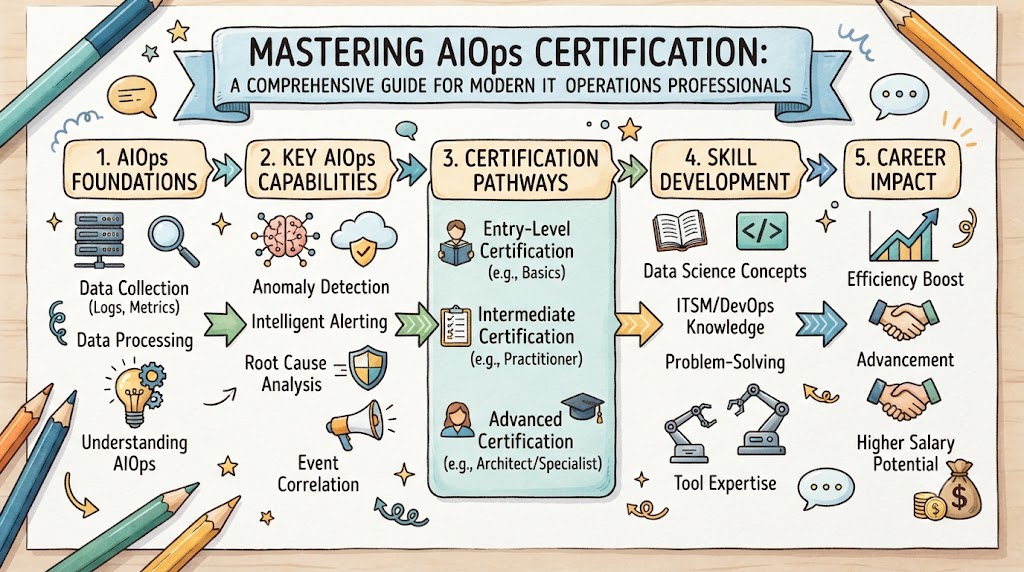
AIOps Engineer Certification Path
| Level | Skills Covered | Outcome |
| Beginner | Monitoring basics, Data collection | Foundations of Observability |
| Intermediate | ML models, Alert suppression, Python | Proficiency in AIOps tools |
| Advanced | Predictive analytics, Auto-remediation | Architect-level expertise |
AIOps Engineer Career Roadmap
Required Technical Skills
To succeed, you need a balance of:
- Infrastructure: Kubernetes, Cloud Platforms (AWS/Azure/GCP).
- Observability: Prometheus, Grafana, OpenTelemetry.
- Data Science: Basic Python for automation and data analysis.
- Automation: CI/CD pipelines and IaC (Infrastructure as Code).
AI Observability Training
What Is AI Observability?
Observability is the practice of understanding the internal state of a system based on its external outputs (logs, metrics, and traces). AI Observability takes this further by using AI to interpret these signals automatically.
Monitoring vs. Observability
| Feature | Monitoring | Observability |
| Focus | “Is the system up?” | “Why is the system slow?” |
| Data | Predefined metrics | Unlimited granular data |
| Goal | Alerting on known issues | Debugging unknown issues |
AIOps for SRE and DevOps Engineers
In Simple Terms
AIOps acts as an extension of the SRE team. While SREs focus on reliability targets (SLOs), AIOps provides the automation required to maintain those targets at massive scale.
Real-World Example
A deployment pushes a configuration error. An AIOps-integrated pipeline detects a spike in error rates compared to the “golden signal” baseline and automatically triggers a rollback.
Why It Matters
It creates a “safety net” for continuous deployment, allowing teams to ship updates faster with lower risk.
Enterprise AIOps Consulting
Why Organizations Need AIOps Consulting
Most organizations fail because they purchase expensive tools without an underlying strategy. Consulting helps assess your current maturity level and defines a roadmap that aligns with business goals.
Implementation Services
The Implementation Lifecycle
- Assessment: Audit current data sources and observability gaps.
- Design: Architect the data pipeline for optimal signal ingestion.
- Tool Selection: Choose the right stack for your specific infrastructure.
- Integration: Connect tools via APIs for unified visibility.
- Continuous Improvement: Refine models as the infrastructure evolves.
Real-World Enterprise Use Cases
- Banking: Detecting fraudulent transaction patterns and system latencies in real-time.
- Healthcare: Ensuring 24/7 uptime for critical patient monitoring systems.
- SaaS: Predictive capacity planning to prevent system crashes during seasonal traffic spikes.
Common Mistakes Professionals Make
- Tool-First Approach: Buying software before defining the operational process.
- Ignoring Fundamentals: Attempting to layer AI over poor data collection.
- Lack of Automation Strategy: Having the insight without the mechanism to act.
Why Learn with AIOpsSchool
Learning at AIOpsSchool provides a unique blend of theoretical knowledge and enterprise-grade consulting experience. The curriculum is built for real-world scenarios, ensuring that you graduate with the practical skills needed to lead AIOps transformations in your organization.
FAQ SECTION
1. What is AIOps Certification?
It is a formal credential that validates your expertise in applying machine learning and automation to IT operations, proving you can manage complex, data-heavy environments.
2. Who should learn AIOps?
It is ideal for DevOps Engineers, SREs, Cloud Engineers, Monitoring Specialists, and IT Managers who want to lead technical strategy.
3. What skills are required for AIOps Engineers?
You need a solid foundation in cloud infrastructure, observability tools (like Prometheus), basic Python scripting, and an understanding of data correlation.
4. How does AIOps help DevOps teams?
AIOps reduces “toil,” automates incident response, and helps DevOps teams ship code faster by providing instant feedback on deployment health.
5. What is AI Observability?
It is the use of AI to analyze the telemetry (logs, metrics, traces) of a system to gain deep insights into performance, rather than just knowing that a system is “up” or “down.”
6. What is OpenTelemetry?
It is an industry-standard framework for collecting and exporting telemetry data, which acts as the foundation for modern AI observability.
7. How long does it take to learn AIOps?
With a structured, professional curriculum, most engineers can develop core proficiency in a few months of dedicated study and practice.
8. What are AIOps Implementation Services?
These are expert consulting services that guide organizations through the process of auditing, planning, and deploying AI-driven monitoring systems.
9. Is AIOps a good career choice?
Yes. As enterprises shift toward autonomous operations, the demand for professionals who can bridge the gap between AI and IT Ops is currently outpacing supply.
10. What is the future of AIOps?
The future lies in “Autonomous Operations,” where systems move beyond just alerting to being self-healing, self-optimizing, and self-scaling without human intervention.
FINAL SUMMARY
AIOps is the bridge between the overwhelming complexity of modern IT and the demand for constant, reliable uptime. By mastering AI-powered observability and automation, you position yourself as a leader in the next generation of infrastructure management. Certification is the fastest way to validate your skills and gain the authority needed to guide enterprise-level adoption. We encourage you to visit AIOpsSchool today to start your journey with specialized training, consulting insights, and certification paths tailored for the future of IT operations.