
Introduction
In the modern landscape of distributed systems, high availability, and rapid delivery, the role of a reliable engineer has never been more critical. Whether you are transitioning from traditional operations or seeking to solidify your expertise in cloud-native environments, the Certified Site Reliability Professional stands as a benchmark for excellence. This guide is designed for software engineers, DevOps practitioners, and platform architects who want to understand the true impact of this credential. By mapping this certification to real-world operational challenges, we help you decide if it is the right step for your professional growth within the ecosystem of sreschool and allied fields like aiopsschool. Understanding these pathways is essential for making informed decisions in an industry that demands both technical depth and operational discipline.
What is the Certified Site Reliability Professional?
The Certified Site Reliability Professional represents a comprehensive validation of your ability to manage large-scale, mission-critical systems. It moves beyond theoretical definitions of reliability, focusing instead on the practical implementation of error budgets, incident response, and capacity planning. This certification exists to bridge the gap between abstract DevOps philosophy and the concrete execution required in high-pressure production environments. It aligns directly with the needs of modern enterprises that require engineers to be as skilled at writing code as they are at managing system availability and performance under load.
Who Should Pursue Certified Site Reliability Professional?
This certification is designed for a broad spectrum of technical professionals, including software engineers, infrastructure specialists, and system administrators looking to specialize in reliability engineering. It is equally valuable for managers who need to oversee SRE teams and want to understand the methodologies driving their operations. Whether you are an early-career professional building your foundational skills or an experienced engineer aiming to formalize your expertise, the curriculum offers actionable insights. Both global teams and professionals in India will find the focus on scalable, resilient architectures highly relevant to current industry demands.
Why Certified Site Reliability Professional
In an era of complex microservices and hybrid-cloud deployments, the ability to maintain system uptime is a high-value skill set that transcends specific tool choices. While specific technologies like Kubernetes or monitoring platforms may evolve, the core principles of reliability, automation, and incident management remain constant. This certification proves that you understand the lifecycle of a service, which helps you remain relevant regardless of changing market trends. The return on investment is found in your increased capacity to handle complex outages and your ability to design systems that fail gracefully, making you a vital asset to any organization.
Certified Site Reliability Professional Certification Overview
The Certified Site Reliability Professional program is delivered via the official training portal and is hosted on sreschool. It utilizes a structured assessment approach designed to test both conceptual understanding and the ability to apply these concepts to real-world scenarios. The certification is owned and managed by industry practitioners who emphasize practical, production-grade outcomes. The structure is built to accommodate different levels of expertise, ensuring that candidates can progress from foundational concepts to more advanced, architecture-level responsibilities as their experience grows.
Certified Site Reliability Professional Certification Tracks & Levels
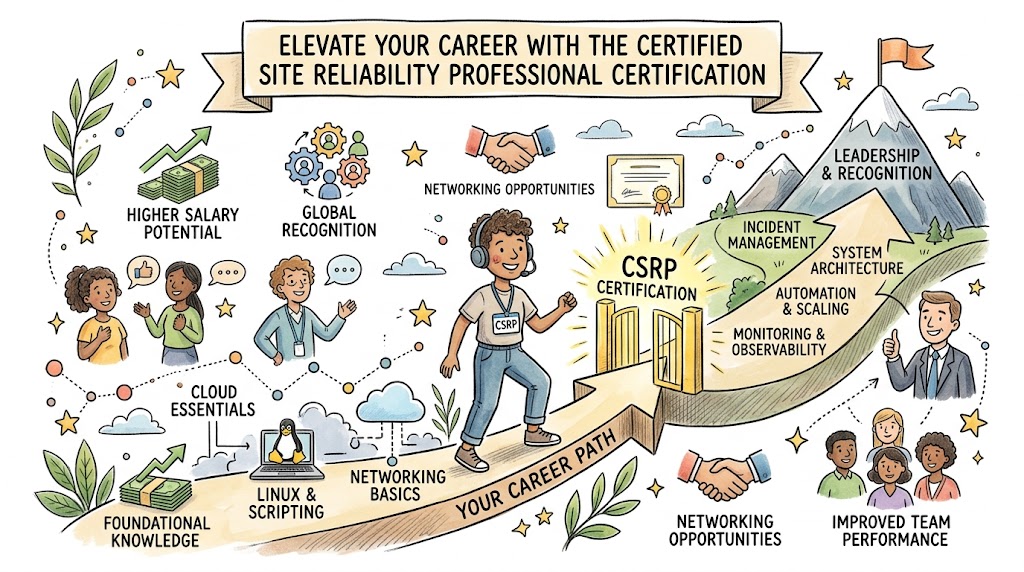
The certification framework is organized into progression tiers, starting with foundational knowledge and moving toward expert-level professional mastery. Each level is structured to align with career milestones, allowing professionals to specialize in areas like incident management, observability, or platform scaling. By following these tracks, candidates can map their specific career aspirations to the skills they need to acquire. The progression is logical, ensuring that each level builds upon the previous one to create a comprehensive and cohesive expertise in site reliability practices.
Complete Certified Site Reliability Professional Certification Table
| Track | Level | Who it’s for | Prerequisites | Skills Covered | Recommended Order |
| SRE Fundamentals | Foundation | Beginners | Basic Linux/Cloud knowledge | SLIs, SLOs, Error Budgets | 1 |
| SRE Practitioner | Professional | Experienced Engineers | Foundation level | Incident Response, Automation | 2 |
| SRE Architect | Advanced | Senior Engineers/Managers | Professional level | System Design, Reliability Strategy | 3 |
Detailed Guide for Each Certified Site Reliability Professional Certification
Certified Site Reliability Professional – Foundation
What it is
This level validates the core terminology and fundamental metrics that define modern reliability engineering.
Who should take it
Aspiring SREs or DevOps engineers with basic cloud familiarity who want to start their reliability journey.
Skills you’ll gain
- Understanding Service Level Indicators (SLIs) and Objectives (SLOs).
- Calculating and managing error budgets effectively.
- Basics of monitoring and alerting strategies.
Real-world projects you should be able to do
- Define SLOs for a sample web service based on user traffic.
- Configure basic dashboard alerts for system latency.
- Perform a simple post-mortem analysis on a simulated outage.
Preparation plan
- 7–14 days: Focus on core SRE principles and reading the standard site reliability books.
- 30 days: Complete all labs and practice tests provided in the curriculum.
- 60 days: Apply these concepts to your current work environment to ensure practical retention.
Common mistakes
Focusing too much on theory and ignoring the mathematical application of error budgets.
Best next certification after this
- Same-track: Certified Site Reliability Professional – Professional.
- Cross-track: DevOps Foundation.
- Leadership: Engineering Manager Fundamentals.
Choose Your Learning Path
DevOps Path
The DevOps path focuses on the intersection of development and operations, emphasizing the automation of the entire software delivery lifecycle. It helps professionals understand how to create seamless integration and deployment pipelines that prioritize both speed and stability. By mastering these techniques, you become a bridge between writing code and managing infrastructure at scale.
DevSecOps Path
The DevSecOps path integrates security into every phase of the development lifecycle, ensuring that reliability does not come at the cost of safety. You will learn to automate security testing and vulnerability management within your existing CI/CD workflows. This path is essential for those who want to ensure their resilient systems are also secure against modern threat vectors.
SRE Path
The SRE path is the dedicated track for those focused on high-availability, performance tuning, and incident management. It delves deep into how systems fail and how to build self-healing architectures that can withstand unexpected load. This is the primary path for engineers who want to specialize in the day-to-day survival of production systems.
AIOps Path
The AIOps path leverages machine learning and artificial intelligence to automate complex operational tasks and improve incident detection. You will learn how to use data-driven insights to reduce noise in your monitoring systems and predict failures before they impact users. This is for forward-thinking engineers who want to modernize their operations.
MLOps Path
The MLOps path focuses on the lifecycle of machine learning models, from training to deployment and monitoring. You will learn how to manage the unique challenges of data pipelines and ensure that your ML models remain reliable and accurate in production. It is a specialized path for data-centric organizations.
DataOps Path
The DataOps path focuses on creating reliable data pipelines and ensuring data quality across an organization’s infrastructure. You will learn how to manage complex data ecosystems while maintaining the reliability required for business intelligence. This path is crucial for professionals handling large-scale data processing and analytics.
FinOps Path
The FinOps path centers on the financial accountability of cloud infrastructure, helping engineers optimize costs while maintaining performance. You will learn how to attribute cloud spend to specific services and implement strategies for cost-effective scaling. This path is becoming increasingly critical for senior engineers and technical leaders.
Role → Recommended Certified Site Reliability Professional Certifications
| Role | Recommended Certifications |
| DevOps Engineer | SRE Foundation + DevOps Professional |
| SRE | SRE Foundation + SRE Professional + SRE Architect |
| Platform Engineer | SRE Professional + Platform Automation |
| Cloud Engineer | SRE Foundation + Cloud Infrastructure |
| Security Engineer | DevSecOps Professional |
| Data Engineer | DataOps Foundation |
| FinOps Practitioner | FinOps Professional |
| Engineering Manager | SRE Foundation + Leadership Strategy |
Next Certifications to Take After Certified Site Reliability Professional
Same Track Progression
Once you have achieved your professional certification, you should aim for the architect-level credentials. These focus on high-level system design and organizational reliability strategy, moving you away from individual contributor tasks toward broader architectural oversight and design patterns.
Cross-Track Expansion
Consider branching into FinOps or DevSecOps to add specialized dimensions to your skill set. Understanding how security and cost intersect with system reliability makes you a more holistic engineer capable of making architectural decisions that benefit the business on multiple fronts simultaneously.
Leadership & Management Track
For those transitioning into management, focus on certifications that emphasize team structure, incident command leadership, and human-centric operational design. Leading a team of SREs requires a different set of skills than acting as an individual contributor, focusing on culture and process over raw technical output.
Training & Certification Support Providers for Certified Site Reliability Professional
DevOpsSchool is a leading provider offering comprehensive training programs for professionals looking to master SRE practices. They emphasize hands-on learning and practical application of concepts in real-world scenarios.
Cotocus provides advanced certification paths that cater to engineers seeking deeper technical proficiency. Their curriculum is designed to challenge experienced practitioners and prepare them for complex, enterprise-grade environments.
Scmgalaxy focuses on the integration of SCM and reliability practices, ensuring that engineers understand how version control and code management influence overall system stability and deployment success.
BestDevOps specializes in delivering high-quality training that bridges the gap between traditional IT and modern, cloud-native operational paradigms. Their programs are highly regarded for their depth and clarity.
devsecopsschool offers specialized tracks for professionals aiming to integrate security into their reliability engineering workflows. They focus on practical tools and methodologies for securing modern production environments.
sreschool is the primary hub for all SRE-focused certifications, providing the official platform for learning, assessment, and certification attainment. They maintain the standards and depth of the overall program.
aiopsschool offers cutting-edge courses for engineers looking to integrate intelligence into their operational workflows. They focus on the practical use of AI to solve complex monitoring and incident management challenges.
dataopsschool provides targeted training for those managing data-heavy applications, focusing on the intersection of data reliability, pipeline automation, and organizational data strategy.
finopsschool is dedicated to teaching engineers how to manage cloud costs effectively. Their programs focus on accountability, visibility, and the optimization of resource allocation within production environments.
Frequently Asked Questions
1. Is the Certified Site Reliability Professional exam difficult?
The difficulty depends on your background, but it is designed to be rigorous. It requires a solid grasp of production systems, not just theoretical concepts, so preparation is essential.
2. How much time should I dedicate to preparation?
We recommend at least 30 to 60 days of consistent study, including hands-on lab work. Cramming is usually ineffective for this level of certification as it requires practical judgment.
3. Are there any strict prerequisites?
While anyone can enroll, it is highly recommended to have a basic understanding of Linux, cloud computing, and standard software development lifecycles before starting.
4. How does this certification improve my career?
It provides a standardized validation of your skills, which can lead to higher-paying roles, internal promotions, and increased confidence when tackling large-scale production outages.
5. Is this certification recognized globally?
Yes, the concepts taught are industry-standard and highly valued by global technology organizations that prioritize high availability and scalable infrastructure.
6. Can I take this if I am a manager?
Absolutely. Understanding the mechanics of reliability helps managers set realistic SLOs and support their teams during incidents, making them more effective leaders.
7. How often should I renew my certification?
Industry practices change quickly; while certifications may not always require annual renewal, it is recommended to stay updated every two years to ensure your knowledge remains current.
8. What is the ROI of getting certified?
The ROI is realized through improved operational efficiency, reduced downtime, and the ability to command higher salaries by proving you can handle high-stakes environments.
9. Can this help me transition from a dev role?
Yes, it is one of the most effective ways to pivot into a reliability-focused career as it provides the necessary vocabulary and methodology to shift your mindset.
10. Is the exam all multiple choice?
The assessment typically combines theory with practical scenarios to ensure that you can not only define concepts but also apply them in a simulated production environment.
11. What if I fail the first attempt?
Most providers offer multiple attempts, but it is best to review the areas where you scored lowest and gain more practical experience before rescheduling your exam.
12. Is the training online or in-person?
Most of the professional training providers offer flexible online learning, allowing you to learn at your own pace while balancing your current professional responsibilities.
FAQs on Certified Site Reliability Professional
1. What specific metrics are covered in the training?
The curriculum extensively covers SLIs, SLOs, SLAs, and error budgets, teaching you how to define them for various service architectures to maintain high availability.
2. How does this differ from general DevOps certifications?
While DevOps focuses on delivery, this certification focuses on the long-term reliability and performance of those services once they are running in production environments.
3. Does it cover incident management?
Yes, incident response, post-mortem creation, and the psychological aspects of handling outages are core components of the professional level certification.
4. Will I learn specific tools or just theory?
The program emphasizes the practical application of tools for monitoring, alerting, and automated recovery, rather than just abstract theory or marketing-heavy definitions.
5. Is knowledge of coding required?
Yes, basic coding proficiency is necessary, as SRE is essentially about managing production systems through automation and software-based solutions rather than manual effort.
6. How do I prepare for the lab portions?
Use the provided environment to practice common scenarios like simulated traffic spikes, configuration errors, and service latency issues to build muscle memory.
7. Is this relevant for small startups?
Even small startups benefit from these practices, as implementing reliability early prevents technical debt and allows the infrastructure to scale seamlessly as the company grows.
8. Does this include cloud-specific content?
The program focuses on platform-agnostic reliability principles that can be applied to AWS, GCP, Azure, or private cloud environments, ensuring universal relevance.
Final Thoughts: Is Certified Site Reliability Professional Worth It?
The decision to pursue this certification should be based on your desire to master the discipline of reliability. If you want to move beyond being a reactive administrator and become a proactive engineer who designs systems for resilience, this is the right path. It is not a magic badge that replaces experience, but it is a powerful tool to focus your learning and prove your capability to peers and employers. Approach it with the intent to learn, apply, and master, and you will find the time invested is well worth the effort for your long-term career trajectory.