
Introduction
Canada represents more than just a destination; it is a gateway to a life defined by professional security, inclusive growth, and unparalleled quality of life. Whether you are an IT specialist dreaming of working in a global tech hub or a healthcare professional seeking to make a difference in a stable system, the dream of moving to Canada is a powerful motivator.
However, the path to Permanent Residency (PR) is paved with specific requirements. The primary mechanism for this is the Express Entry system. To navigate it successfully, you must master the Canada PR Points Calculator. This tool—and the Comprehensive Ranking System (CRS) it represents—is the bridge between your aspirations and your official invitation to settle in the “True North.”
In this guide, we will break down the mechanics of the points system, explore how to optimize your profile, and provide the clarity you need to move forward with confidence.
What Is the Canada PR Points Calculator?
The Canada PR Points Calculator is an essential tool for estimating your Comprehensive Ranking System (CRS) score. The CRS is a point-based formula used by Immigration, Refugees and Citizenship Canada (IRCC) to rank candidates in the Express Entry pool.
Why Canada Uses the CRS
Canada receives far more applications than it has spots for. The CRS system ensures that the selection process is transparent, data-driven, and focused on selecting candidates most likely to integrate quickly into the Canadian economy.
Eligibility Score vs. CRS Score
It is common to confuse these two:
- Eligibility Score: A “passing mark” (typically 67 points under the Federal Skilled Worker Program) required to be eligible to enter the pool.
- CRS Invitation Score: The “cut-off” mark set by IRCC during periodic draws. Only those whose CRS scores meet or exceed this cut-off receive an Invitation to Apply (ITA).
Example: You might pass the 67-point barrier easily, but if your CRS is 450 and the current draw requires 510, you remain in the pool until you improve your ranking.
How Canada PR Points System Works
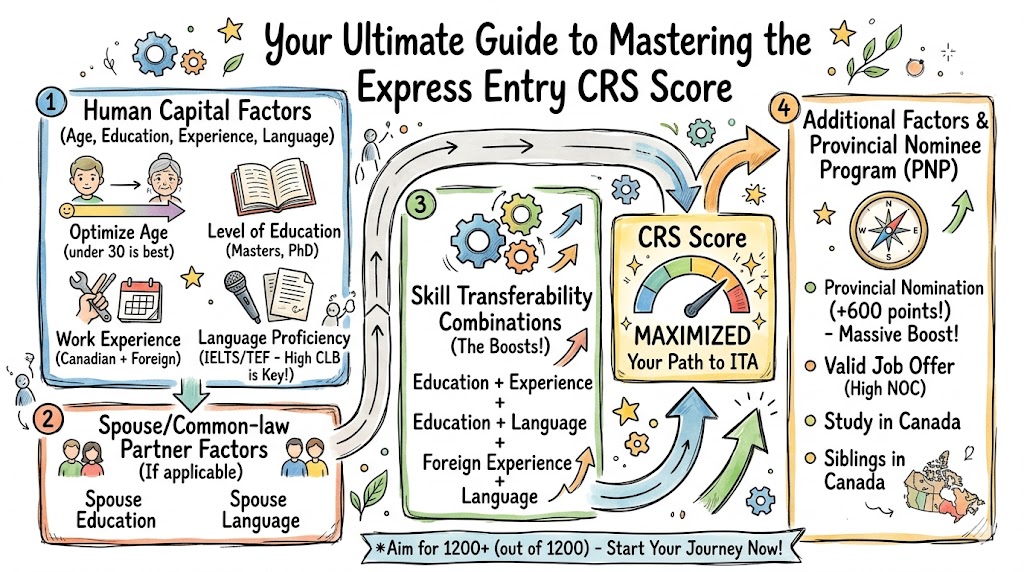
Your CRS score is a reflection of your “human capital”—the skills, experience, and attributes you bring to Canada.
Core Scoring Factors
Points are divided into several key categories:
| Factor | Description | Max Points (Approx.) |
| Age | Peak eligibility is between 20–29 years old. | 110 |
| Education | Based on your highest completed degree (ECA required). | 150 |
| Language | Proficiency in English (IELTS/CELPIP) or French. | 160 |
| Work Experience | Years of skilled work (TEER 0, 1, 2, or 3). | 80 |
| Spouse Factors | Education, language, and Canadian experience of your partner. | 40 |
| Skill Transferability | Combination of factors (e.g., Education + Language). | 100 |
Note: You can earn up to 600 additional points through a Provincial Nomination.
Canada Express Entry System Explained
Express Entry manages three primary federal programs. Understanding these helps you identify which pathway suits your background:
- Federal Skilled Worker Program (FSWP): For international professionals with skilled work experience abroad.
- Canadian Experience Class (CEC): Specifically for individuals who have already gained at least one year of skilled work experience inside Canada.
- Federal Skilled Trades Program (FSTP): For qualified tradespeople (e.g., electricians, welders) with a valid job offer or certification.
- Provincial Nominee Program (PNP): A “fast-track” where provinces nominate candidates based on regional labor needs.
Step-by-Step Example Calculation
Let’s calculate the score for a hypothetical candidate: Rahul, a 29-year-old Software Engineer.
- Age: 29 (Max points) = 110
- Education: Master’s Degree (with ECA) = 135
- Language: IELTS CLB 9 = 124
- Work Experience: 3 years of skilled experience = 64
- Skill Transferability: High language + Degree = 50
- Total Estimated CRS: 483
How to Improve Your CRS Score
If you are just shy of the recent cut-offs, don’t be discouraged. Strategic adjustments can make a significant difference.
- The Language Boost: Retaking the language test is the most common way to gain points. Jumping from CLB 8 to CLB 9 can add over 30 points to your total.
- Provincial Nomination (The Game Changer): Securing a nomination from an Ontario, Alberta, or BC stream adds 600 points, effectively guaranteeing your PR.
- Second Language: If you have even basic French skills, achieving an NCLC 7 in a French test alongside your English proficiency can unlock significant bonus points.
- Education Updates: If you have a second degree that hasn’t been assessed, get an ECA for it. Sometimes, “two or more post-secondary credentials” can push your score up.
Provincial Nominee Programs (PNPs)
PNPs are provincial-level immigration pathways designed to meet local labor shortages. Because these programs are targeted, they often have different requirements than the federal Express Entry system.
| Province | Common Focus | Why It Matters |
| Ontario (OINP) | Tech, Healthcare, Human Capital | Offers specific streams for tech professionals. |
| Alberta (AAIP) | Skilled workers in high-demand sectors | Highly responsive to labor market gaps. |
| British Columbia (BC PNP) | Tech-pilots and Health professionals | Streamlined process for high-demand roles. |
| Saskatchewan (SINP) | In-demand occupations | Lower CRS barriers for specific trades. |
Documents Required
Preparation is the key to a smooth process. Start collecting these as early as possible:
- Valid Passport: Must have at least 6 months of validity.
- ECA Report: Educational Credential Assessment for your foreign degrees.
- Language Results: IELTS, CELPIP, or TEF/TCF results not older than 2 years.
- Work Experience Proof: Detailed reference letters on company letterhead showing duties, hours, and salary.
- Police Clearance Certificates: From every country where you have lived for 6+ months.
- Proof of Funds: Bank statements to show you can support your settlement.
Processing Time & The PR Journey
- Create Profile: Submit your details to the Express Entry pool.
- ITA: Once selected in a draw, you receive an Invitation to Apply (ITA).
- Application: Submit your full documents within 60 days.
- Medical & Biometrics: Complete your health checks and digital identification.
- COPR: Once approved, you receive your Confirmation of Permanent Residence (COPR).
Processing time is typically 6 months from the date of a complete application.
Common Mistakes to Avoid
- NOC Misclassification: Choosing a National Occupational Classification (NOC) code that does not match your actual job duties is the most frequent cause of rejection.
- Ignoring Expiration Dates: Your language results expire. Ensure they are valid throughout the entire application process.
- Overestimating Work History: Only count “skilled” work (TEER 0-3). Internships and volunteer roles do not count toward points.
Real-Life Case Studies
Case 1: The IT Professional
Profile: 32-year-old developer.
Initial Score: 460 (Too low for general draws).
Strategy: Focused on the “French-Language proficiency” category draw and improved IELTS to CLB 10.
Result: Invited in a French-targeted draw with a lower cut-off score.
Case 2: The Married Couple
Profile: Husband (Principal Applicant) + Wife.
Initial Score: 430.
Strategy: Wife obtained an ECA for her degree and took the IELTS test.
Result: Gained 25 extra points from spouse’s credentials; secured ITA.
Case 3: The Healthcare Worker
Profile: Nurse in a rural province.
Initial Score: 410.
Strategy: Applied for a specific Provincial Nominee Program (PNP) for healthcare.
Result: Received provincial nomination (+600 points) and landed in Canada within 8 months.
Frequently Asked Questions (FAQs)
- What is a “good” CRS score? Generally, 480–500+ is considered competitive, but this fluctuates based on the draw type.
- How many points for Canada PR? There is no fixed “passing” mark for PR; it depends on the cut-off of the specific draw you participate in.
- Can I apply without a job offer? Yes, most FSWP candidates apply without a job offer.
- Does age affect CRS? Yes, you start losing points annually after age 29.
- Is IELTS mandatory? Yes, it is the standard way to prove language proficiency.
- Does a spouse increase my points? Yes, their education, language, and work experience can add up to 40 points.
- Is there an age limit? No, you can apply at any age, but your points decrease as you get older.
- Can I work while my PR is processing? Not automatically. You usually need a separate work permit.
- Which province is easiest? It depends on your skill set; there is no “easy” province, only “right-fit” provinces.
- What is an ECA? It’s a report verifying that your foreign education is equal to a Canadian standard.
- Do I need a lawyer? No, but for complex cases, an immigration consultant can save you from costly mistakes.
- How often are draws held? Usually every two weeks, but IRCC can hold them whenever they choose.
Conclusion: Take Control of Your Future
Your CRS score is not just a number; it is a strategic roadmap. While the Canadian immigration system is highly competitive, it is also exceptionally fair to those who prepare with diligence and foresight. Whether you choose to boost your language scores, pursue a provincial nomination, or gain additional work experience, every action you take is a step toward building a new life in Canada.
The most successful applicants are those who do not wait for the “perfect” score but instead proactively improve their profiles while staying updated on changing draw patterns. If you are serious about your future, start by calculating your score today, identify your strongest and weakest categories, and begin the process of strengthening your profile.
Very helpful guide! The explanation of Express Entry CRS scores is clear and practical, making it easier to understand ways to improve immigration prospects.
Excellent guide! The CRS score breakdown is easy to understand and provides practical insights for improving Express Entry eligibility and achieving immigration goals.