
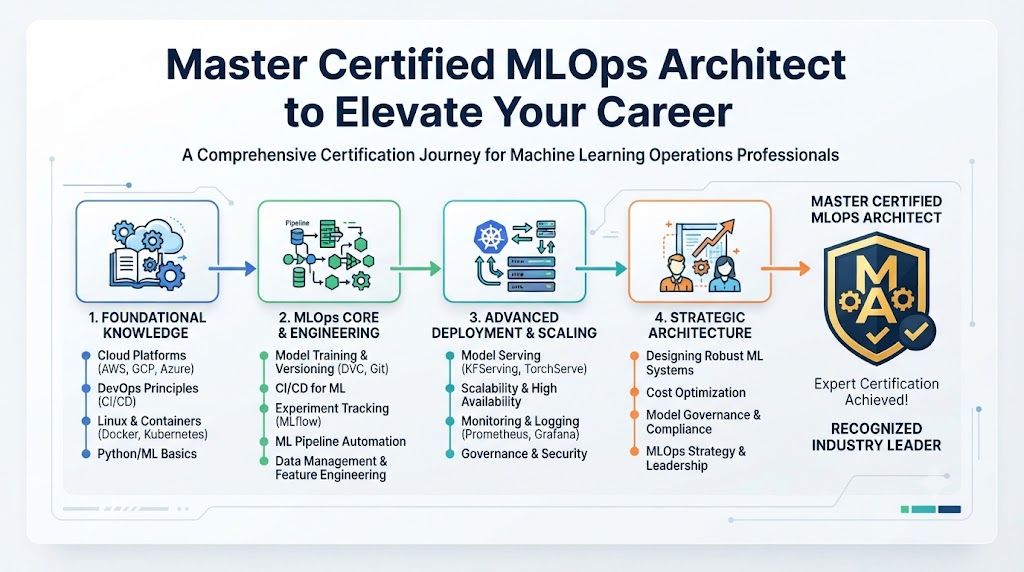
Introduction
In the rapidly evolving landscape of modern software and artificial intelligence, mastering machine learning operations has become essential for building scalable, reliable, and production-ready systems. This comprehensive guide is designed for software engineers, platform architects, site reliability engineers, and technical leaders looking to bridge the gap between experimental data science and robust enterprise infrastructure. By understanding the core principles of aiopsschool, professionals can make informed career choices, enhance their technical capabilities, and lead successful transformations in cloud-native environments. Whether you are navigating the transition from traditional software development or scaling up AI initiatives, this resource provides the clarity and direction needed to succeed in today’s competitive tech ecosystem.
What is the Certified MLOps Architect?
The Certified MLOps Architect credential represents a rigorous, industry-recognized validation of your ability to design, deploy, and manage machine learning lifecycles at scale. It exists to separate theoretical knowledge from hands-on engineering capability, ensuring practitioners can handle real-world challenges such as model drift, CI/CD pipeline automation, and infrastructure orchestration. Emphasizing production-focused learning over abstract concepts, the curriculum aligns directly with modern enterprise workflows where reliability, security, and reproducibility are paramount. By focusing on practical architecture, this designation prepares engineers to build systems that seamlessly integrate data engineering, model training, and continuous deployment without manual bottlenecks.
Who Should Pursue Certified MLOps Architect?
This certification is tailored for a diverse spectrum of technology professionals who are eager to expand their expertise in automated machine learning workflows. Software engineers transitioning into machine learning engineering, DevOps and SRE professionals managing AI workloads, and data engineers scaling model pipelines will find immediate value in the curriculum. Beginners with a solid foundation in cloud infrastructure, as well as experienced technical leaders and engineering managers, will gain the strategic insights needed to oversee complex AI deployments. The curriculum holds profound relevance for professionals across global markets and India’s booming tech hubs, where companies are rapidly scaling their artificial intelligence infrastructure.
Why Certified MLOps Architect
The demand for professionals who understand both software reliability and machine learning lifecycles has surged exponentially as organizations move beyond experimental AI pilots. This certification provides enduring career longevity by focusing on fundamental architectural patterns rather than fleeting software tools, ensuring your skills remain relevant despite the rapid pace of technological change. By bridging the gap between data science and operational execution, it delivers a phenomenal return on your time and career investment. Enterprises actively seek certified architects who can reduce deployment friction, optimize resource utilization, and secure machine learning pipelines against emerging production vulnerabilities.
Certified MLOps Architect Certification Overview
The Certified MLOps Architect program is delivered via and hosted on. The certification is structured into practical levels that test both conceptual understanding and hands-on implementation capabilities through rigorous assessments. Ownership of the program rests with industry veterans who ensure that the curriculum reflects the current state of enterprise production environments. The evaluation approach emphasizes end-to-end pipeline design, automation strategies, and troubleshooting methodologies rather than rote memorization.
Certified MLOps Architect Certification Tracks & Levels
The certification path is meticulously organized into foundation, professional, and advanced tiers to accommodate professionals at various stages of their careers. Specialization tracks branch out into dedicated domains such as automated continuous delivery for machine learning, infrastructure reliability, and cost optimization. This tiered progression ensures that engineers can start with core operational concepts before advancing to enterprise-grade multi-cluster architecture design. Each level builds logically upon the previous one, creating a clear and structured pathway for continuous professional growth and technical mastery.
Complete Certified MLOps Architect Certification Table
| Track | Level | Who it’s for | Prerequisites | Skills Covered | Recommended Order |
| MLOps Core | Foundation | Junior Engineers, Data Analysts | Basic Python, Git | Pipeline Basics, Version Control | 1 |
| MLOps Engineering | Professional | DevOps Engineers, ML Engineers | Foundation Track | CI/CD for ML, Model Registry | 2 |
| MLOps Architecture | Advanced | Senior Architects, Tech Leads | Professional Track | Multi-Cloud Scaling, Governance | 3 |
Detailed Guide for Each Certified MLOps Architect Certification
Certified MLOps Architect – Foundation Level
What it is
This credential validates foundational knowledge of machine learning lifecycles, basic pipeline automation, and version control principles for data and code.
Who should take it
Suitable for junior software engineers, data analysts, and aspiring machine learning practitioners looking to understand production workflows.
Skills you’ll gain
- Basic CI/CD pipeline construction for data projects
- Version control strategies for datasets and model weights
- Introduction to containerization using Docker
- Basic monitoring and logging principles for models
Real-world projects you should be able to do
- Package a simple machine learning script into a reproducible container
- Set up a basic Git repository tracking code and dataset versions
- Deploy a basic prediction script to a local development server
Preparation plan
- 7–14 days: Focus on foundational documentation, basic containerization tutorials, and understanding the core machine learning lifecycle stages.
- 30 days: Build practice pipelines, experiment with local orchestration tools, and review core concepts of data versioning.
- 60 days: Complete guided lab exercises, review sample architectural diagrams, and take practice assessments to build confidence.
Common mistakes
- Focusing entirely on model accuracy while ignoring infrastructure reproducibility.
- Neglecting proper version control for training datasets.
- Skipping foundational containerization concepts before moving to orchestration.
Best next certification after this
- Same-track option: Certified MLOps Architect – Professional Level
- Cross-track option: Certified DevOps Professional
- Leadership option: Certified Engineering Manager
Certified MLOps Architect – Professional Level
What it is
This certification validates intermediate to advanced skills in automating end-to-end machine learning workflows, setting up model registries, and managing production inference endpoints.
Who should take it
Designed for experienced DevOps engineers, machine learning engineers, and platform builders with hands-on cloud experience.
Skills you’ll gain
- Automated training and evaluation pipelines
- Model registry and artifact management implementation
- Scalable API deployment for low-latency inference
- Automated testing for data quality and model drift
Real-world projects you should be able to do
- Build a fully automated retraining pipeline triggered by data drift alerts
- Implement a centralized model registry with strict governance and tagging
- Deploy a scalable inference service using Kubernetes and cloud load balancers
Preparation plan
- 7–14 days: Deep dive into orchestration frameworks, automated testing methodologies, and cloud-native deployment patterns.
- 30 days: Build end-to-end staging environments, implement drift detection mechanisms, and configure secure model endpoints.
- 60 days: Execute complex lab scenarios, optimize pipeline execution times, and study enterprise case studies.
Common mistakes
- Failing to implement robust automated testing for incoming data schemas.
- Overlooking security vulnerabilities in model serialization formats.
- Ignoring resource cost optimization during large-scale batch inference runs.
Best next certification after this
- Same-track option: Certified MLOps Architect – Advanced Level
- Cross-track option: Certified SRE Architect
- Leadership option: Certified AI Platform Director
Certified MLOps Architect – Advanced Level
What it is
This advanced credential validates expert-level capability in designing multi-region, highly scalable, and secure enterprise machine learning architectures.
Who should take it
Ideal for senior cloud architects, principal engineers, and technical leaders responsible for enterprise-wide AI platform strategy.
Skills you’ll gain
- Multi-cloud and hybrid MLOps architecture design
- Enterprise security, compliance, and governance frameworks
- Advanced cost management and resource orchestration for large LLMs
- High-availability disaster recovery strategies for inference systems
Real-world projects you should be able to do
- Design a multi-region disaster recovery architecture for real-time inference services
- Implement enterprise-grade governance and lineage tracking across multiple business units
- Optimize GPU cluster utilization and cost allocation for large-scale training jobs
Preparation plan
- 7–14 days: Review enterprise governance frameworks, multi-cloud networking patterns, and advanced cost optimization strategies.
- 30 days: Design comprehensive multi-region architectural blueprints and evaluate disaster recovery protocols.
- 60 days: Participate in architectural design reviews, study complex failure case studies, and master enterprise security compliance.
Common mistakes
- Designing overly complex architectures without considering operational overhead.
- Neglecting compliance and data privacy regulations across international jurisdictions.
- Failing to establish clear cost-tracking mechanisms for resource-intensive training workloads.
Best next certification after this
- Same-track option: Certified Enterprise AI Architect
- Cross-track option: Certified FinOps Master
- Leadership option: Certified Chief Technology Officer
Choose Your Learning Path
DevOps Path
The DevOps path focuses on establishing robust CI/CD pipelines, infrastructure as code, and continuous monitoring practices for modern software systems. Professionals learn to automate deployment workflows, manage containerized environments, and ensure high system availability. This track forms the backbone of any reliable engineering organization, enabling rapid delivery without sacrificing operational stability. Mastery of this path empowers engineers to bridge development and operations seamlessly.
DevSecOps Path
The DevSecOps path integrates security seamlessly into every phase of the software development and deployment lifecycle. Learners focus on vulnerability scanning, automated compliance auditing, and secure configuration management across cloud environments. This track ensures that security is treated as a shared responsibility rather than an afterthought at the end of the pipeline. Practitioners gain the expertise required to protect critical infrastructure against modern cyber threats.
SRE Path
The Site Reliability Engineering path emphasizes software engineering approaches to IT infrastructure and operational problem-solving. Professionals master concepts such as service level objectives, error budgets, incident management, and automated toil reduction. This track is essential for maintaining large-scale distributed systems with high uptime requirements. Engineers learn to design resilient architectures that gracefully handle failures and traffic spikes.
AIOps / MLOps Path
The AIOps / MLOps path combines artificial intelligence with operational workflows to automate infrastructure management and machine learning lifecycles. Learners explore model training automation, drift detection, inference scaling, and intelligent incident remediation. This specialized track equips engineers to handle the unique demands of production-grade machine learning systems. It serves as the ultimate bridge between data science experimentation and enterprise reliability.
DataOps Path
The DataOps path applies agile and DevOps principles to data engineering and analytics pipelines. Professionals focus on data quality automation, pipeline orchestration, version control for data assets, and efficient storage management. This track ensures that data flowing into analytical and machine learning systems is reliable, timely, and secure. Practitioners learn to eliminate data bottlenecks and accelerate insights delivery.
FinOps Path
The FinOps path centers on financial accountability and cloud cost optimization across engineering teams. Learners master cost allocation, resource right-sizing, budgeting strategies, and value-driven cloud financial management. This track empowers organizations to maximize their return on cloud investment without hindering innovation speed. Engineers and managers gain the financial visibility needed to make smart architectural decisions.
Role → Recommended Certified MLOps Architect Certifications
| Role | Recommended Certifications |
| DevOps Engineer | Certified MLOps Architect – Professional Level |
| SRE | Certified MLOps Architect – Professional Level |
| Platform Engineer | Certified MLOps Architect – Advanced Level |
| Cloud Engineer | Certified MLOps Architect – Foundation Level |
| Security Engineer | Certified MLOps Architect – Professional Level |
| Data Engineer | Certified MLOps Architect – Professional Level |
| FinOps Practitioner | Certified MLOps Architect – Foundation Level |
| Engineering Manager | Certified MLOps Architect – Advanced Level |
Next Certifications to Take After Certified MLOps Architect
Same Track Progression
Advancing within the same track involves moving from professional execution to enterprise-level architecture and governance. Professionals deepen their specialization by mastering multi-region scaling, cost optimization for large language models, and advanced security frameworks. This path ensures technical leadership and deep domain authority in production machine learning environments.
Cross-Track Expansion
Cross-track expansion allows experienced architects to broaden their skill set by exploring complementary domains like site reliability engineering or cloud financial management. By combining MLOps expertise with SRE or FinOps principles, engineers become versatile leaders capable of solving holistic organizational challenges. This multidisciplinary approach significantly enhances career mobility and value.
Leadership & Management Track
Transitioning to the leadership track shifts focus from hands-on implementation to strategic vision, team building, and enterprise transformation. Engineering managers and directors leverage their technical background to align AI initiatives with business goals. This path prepares professionals for executive roles where they oversee large technical organizations and drive innovation.
Training & Certification Support Providers for Certified MLOps Architect
DevOpsSchool is a premier platform offering comprehensive training and certification support for professionals aiming to master modern engineering practices. With expert-led instruction and hands-on labs, they prepare candidates thoroughly for rigorous industry assessments. Their curriculum focuses heavily on real-world applicability and enterprise-grade scenarios.
Cotocus provides specialized technical training and consulting services designed to accelerate cloud-native transformation and operational excellence. They offer targeted mentoring programs that help engineers bridge skill gaps and achieve recognized certifications. Their experienced trainers bring invaluable industry insights into every classroom session.
Scmgalaxy serves as a trusted knowledge hub and training provider for software configuration management and automation engineering. They deliver structured learning paths that guide candidates from fundamentals to advanced architectural concepts. Their commitment to practical learning ensures high success rates for certification aspirants.
BestDevOps delivers focused educational resources and certification bootcamps tailored to modern infrastructure and automation professionals. Their programs emphasize interactive learning, peer collaboration, and real-world project execution. Candidates benefit from updated course materials aligned with current industry standards.
devsecopsschool focuses exclusively on integrating security into DevOps pipelines through specialized training and certification preparation courses. They equip security professionals and engineers with the skills needed to identify vulnerabilities and automate compliance. Their expert mentors emphasize proactive defense strategies in cloud environments.
sreschool offers dedicated training programs designed to build robust site reliability engineering capabilities within technical teams. Their curriculum covers incident management, observability, automation, and resilient system design. Professionals learn directly from seasoned practitioners with extensive production experience.
aiopsschool provides cutting-edge education and certification tracks focused on artificial intelligence operations and machine learning architectures. Their courses bridge the gap between data science and reliable enterprise infrastructure. They are recognized for delivering rigorous, up-to-date training tailored to modern engineering demands.
dataopsschool specializes in data engineering automation, pipeline orchestration, and data quality management training. Their programs help professionals streamline data workflows and implement agile data practices. Learners gain practical experience in building scalable and reliable data architectures.
finopsschool delivers expert-led training on cloud financial management, cost optimization, and economic accountability for engineering teams. Their courses teach practitioners how to balance performance with budget constraints effectively. This education empowers organizations to achieve financial transparency across all cloud operations.
Frequently Asked Questions
1. What is the difficulty level of the Certified MLOps Architect exam?
The exam is designed to test practical, real-world engineering capability rather than mere memorization. Candidates with solid cloud and automation experience will find it challenging yet achievable with proper preparation.
2. How much time is required to prepare for the certification?
Preparation typically ranges from four to eight weeks depending on your existing background in DevOps, software engineering, or machine learning pipelines. Dedicated daily study and hands-on lab practice are essential.
3. Are there any strict prerequisites for taking the exam?
While formal prerequisites vary by level, a working knowledge of Python, containerization tools, and cloud infrastructure fundamentals is strongly recommended for success.
4. What is the return on investment for this certification?
Certified professionals often experience accelerated career growth, higher earning potential, and enhanced credibility when leading enterprise-scale machine learning initiatives.
5. How should I sequence my learning if I am a beginner?
Beginners should start with the Foundation level to master basic version control and containerization before progressing to automated pipelines and advanced multi-cloud architecture.
6. Can this certification help me secure global remote roles?
Yes, industry-recognized credentials validate your expertise to international employers who value standardized proof of architectural competence.
7. Is coding experience mandatory to clear the assessment?
Yes, familiarity with scripting and pipeline definition languages is necessary as the evaluation includes practical architectural and automation scenarios.
8. How often is the certification curriculum updated?
The curriculum is continuously reviewed and updated by industry experts to reflect the latest advancements in cloud-native technologies and AI tooling.
9. What support is available during the preparation phase?
Candidates have access to accredited training providers, official documentation, community forums, and hands-on lab environments to aid their study journey.
10. How does this certification differ from data science credentials?
Unlike data science certifications that focus on model accuracy and algorithms, this credential focuses entirely on infrastructure, deployment, automation, and reliability.
11. Is the assessment format practical or theoretical?
The evaluation combines conceptual questions with practical architectural scenarios to ensure candidates can design and troubleshoot real production environments.
12. What career paths open up after earning this credential?
Graduates frequently step into roles such as MLOps Architect, AI Platform Lead, Senior Reliability Engineer, and Technical Director of Engineering.
FAQs on Certified MLOps Architect
1. How does the Certified MLOps Architect credential improve collaboration between data scientists and software engineers?
It establishes a common operational vocabulary and standardized workflows, bridging the gap between experimental modeling and robust production engineering.
2. What role do model registries play in the advanced modules of the curriculum?
Model registries serve as the single source of truth for versioned model artifacts, metadata, and lineage tracking required for enterprise auditing.
3. Does the certification cover cost management for large language model deployments?
Yes, advanced tracks explore resource allocation, GPU utilization tracking, and financial optimization strategies for resource-intensive AI models.
4. How are deployment rollbacks and failure recovery handled in the practical labs?
Candidates learn to implement automated canary deployments, blue-green strategies, and automated health checks to ensure zero-downtime rollbacks.
5. Why is data drift monitoring emphasized so heavily in the professional level?
Data drift directly impacts model accuracy in production; detecting it early prevents degraded user experiences and costly automated classification errors.
6. Can software engineers without prior machine learning modeling experience pursue this path?
Yes, the curriculum focuses heavily on the operational, infrastructural, and deployment aspects rather than advanced mathematical algorithm design.
7. What specific cloud environments are covered in the architecture tracks?
The program covers platform-agnostic architectural principles that apply seamlessly across major cloud providers like AWS, Azure, and Google Cloud Platform.
8. How does this certification address enterprise security and data privacy compliance?
It includes dedicated modules on secure artifact storage, network isolation, role-based access control, and regulatory compliance frameworks for AI systems.
Final Thoughts: Is Certified MLOps Architect Worth It?
Investing your time in the Certified MLOps Architect program is a pragmatic step for any engineer or technical leader serious about mastering production artificial intelligence. The industry has moved past the era of isolated Jupyter notebooks, demanding instead resilient, scalable, and secure operational pipelines. By focusing on foundational principles over transient software trends, this credential provides lasting career value and technical authority. If you are committed to building reliable systems that bridge data science and enterprise infrastructure, this learning journey will reward your dedication with profound professional growth.