
Introduction
As organizations transition artificial intelligence projects from experimental research environments to scalable production infrastructure, standard software delivery practices often falter under the weight of dynamic data assets and complex model training pipelines. This specific challenge has driven the creation of the MLOps Foundation Certification program, establishing a baseline of engineering excellence required to manage operational machine learning lifecycles. This comprehensive guide serves as an analytical framework for software engineers, operations specialists, and technology leaders looking to systematically integrate continuous integration, delivery, and training practices into complex business infrastructures. By focusing on practical engineering paradigms rather than theoretical mathematical abstractions, this guide empowers enterprise professionals to evaluate the direct operational utility of the curriculum, streamline their technical capability matrix, and make highly informed career progression decisions within the evolving cloud-native and platform engineering landscape hosted on aiopsschool.com.
What is the MLOps Foundation Certification?
The MLOps Foundation Certification represents a rigorous professional validation framework designed to evaluate an engineer’s capability to deploy, monitor, and manage machine learning workloads within automated production environments. It addresses the systemic operational friction that occurs between isolated data science work and resilient, scalable infrastructure deployments. Rather than focusing on algorithmic design or statistical theory, this program emphasizes practical, automated pipelines, configuration management, version control for data, and structural observability. It directly aligns with modern software engineering workflows by extending classical DevOps methodologies into the specialized domain of non-deterministic code and dynamic datasets. Enterprise environments benefit substantially from this framework as it codifies reproducible system architectures, leading to predictable release cycles, reduced system downtime, and standardized deployment patterns across multi-cloud topologies.
Who Should Pursue MLOps Foundation Certification?
This certification program is structurally engineered for infrastructure professionals, platform developers, systems engineers, and data practitioners who are actively tasked with scaling technology platforms. Systems administrators and Site Reliability Engineers will find direct relevance in learning how to manage the specialized computational workloads, hardware accelerators, and unpredictable memory footprints associated with large-scale model serving. For software developers and data engineers, the curriculum provides the foundational pipeline knowledge required to construct robust continuous integration and automated deployment systems for data products. Furthermore, engineering managers, technical directors, and enterprise architects operating across global and regional markets can utilize this program to establish uniform operational standards, optimize cross-functional team workflows, and manage organizational technical debt effectively.
Why MLOps Foundation Certification
The modern enterprise tech stack is rapidly evolving around automated intelligent services, creating an unprecedented structural demand for engineering professionals who understand both system reliability and data pipelines. The value of this certification lies heavily in its structural tool-agnostic approach, which prioritizes core architectural principles, design patterns, and operational paradigms over transient software versions or specific vendor ecosystems. By mastering the fundamentals of continuous training loops, data lineage systems, and automated testing, professionals insulate their careers against inevitable shifts in the underlying cloud tools or framework preferences. The long-term return on time and career investment is distinct, as organizations increasingly refuse to fund unmanaged data experiments and instead demand deterministic, highly reliable, and auditable deployment pipelines.
MLOps Foundation Certification Overview
The professional training and assessment program is delivered via the official channel at and is natively hosted on the aiopsschool.com enterprise education infrastructure. The structure of this program centers around a rigorous evaluation model that combines targeted technical knowledge validation with simulated operational scenarios. Candidates are assessed on their understanding of configuration management, pipeline orchestration, artifact registry tracking, and structural monitoring patterns for production services. The ownership and continuous maintenance of the curriculum are managed by industry practitioners, ensuring that the validated competencies accurately reflect real-world enterprise infrastructure challenges, compliance requirements, and delivery standards.
MLOps Foundation Certification Tracks & Levels
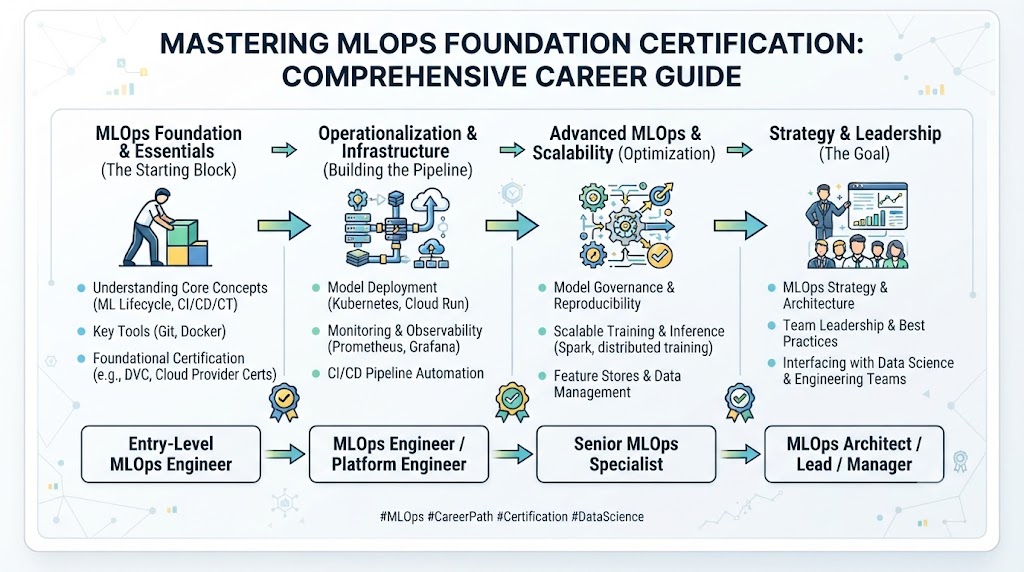
The certification framework is organized into a progressive hierarchy designed to accommodate professionals at varying stages of technical maturity. The foundation level serves as the entry gate, establishing common terms, structural components, and architectural topologies required for cross-functional communication. As engineers advance into professional and specialized tracks, the focus shifts toward hands-on architecture design, infrastructure as code integration, and granular performance tuning for highly distributed cloud environments. These structured tracks allow systems engineers, security specialists, and financial analysts to map out customized learning paths that align exactly with their specialized operational responsibilities and long-term technical leadership objectives.
Complete MLOps Foundation Certification Table
| Track | Level | Who it’s for | Prerequisites | Skills Covered | Recommended Order |
| Infrastructure Systems | Foundation | DevOps Engineers, SREs | Basic Cloud Infrastructure | GitOps, Artifact Versioning, Basic CI/CD | First |
| Platform Engineering | Professional | Cloud Architects, SREs | Foundation Certification | Pipeline Automation, Data Lineage, Tracking | Second |
| Specialized Data | Advanced | Data Engineers, Tech Leads | Professional Certification | Continuous Training, Feature Stores, Scale | Third |
Detailed Guide for Each MLOps Foundation Certification
MLOps Foundation Certification – Foundation Level
What it is
This initial certification validates a professional’s foundational understanding of automated machine learning infrastructure, model artifact lifecycle management, and standard configuration protocols within production environments.
Who should take it
Systems administrators, entry-level DevOps practitioners, cloud support engineers, and data analysts seeking to transition into dedicated infrastructure engineering roles within data-driven technology organizations.
Skills you’ll gain
- Configuration management for distributed compute instances
- Implementation of version control for text and data structures
- Understanding of automated artifact storage and tracking mechanisms
- Basic monitoring setup for cloud-native applications and microservices
Real-world projects you should be able to do
- Construct a functional continuous integration pipeline that runs automated code formatting and quality checks on every commit
- Deploy a basic containerized application stack with automated environment variable injection and resource limits
Preparation plan
- 7–14 days: Review official core documentation, focus entirely on defining terms, and complete all practice modular quizzes.
- 30 days: Spend two hours daily building local deployment pipelines using standard container platforms and git workflows to solidify theoretical concepts.
- 60 days: Engage with comprehensive mock assessments, configure end-to-end sandbox tracking infrastructure, and deep dive into troubleshooting resource utilization.
Common mistakes
- Spending too much time studying advanced statistical mathematics instead of focusing on fundamental system configuration rules and pipelines.
- Neglecting the fundamentals of standard containerization and basic environment reproducibility.
Best next certification after this
- Same-track option: MLOps Professional Specialist Certification
- Cross-track option: Site Reliability Engineering Professional Certification
- Leadership option: Technical Platform Delivery Manager
Choose Your Learning Path
DevOps Path
This pathway focuses heavily on the seamless integration of model delivery pipelines into established enterprise continuous integration and continuous deployment ecosystems. Engineers learn to treat configuration, source data definitions, and model deployment artifacts as executable code structures within standard code repositories. This path minimizes operational friction by ensuring that data workflows adhere strictly to the same testing, linting, and quality gates that govern traditional corporate microservices.
DevSecOps Path
The security-focused pathway ensures that data workflows, containerized artifacts, and public cloud endpoints conform strictly to corporate governance policies and global compliance regulations. Professionals on this track focus deeply on data masking, secure storage access permissions, container vulnerability scanning, and automated audit trails for model lineage. This mitigation-first approach protects organizations from data exposure risks and unauthorized modifications to critical production artifacts.
SRE Path
The reliability pathway prioritizes the long-term stability, optimization, and absolute availability of distributed processing platforms and prediction endpoints. Engineers study the concrete dynamics of cloud resource usage, memory allocation strategy, automated horizontal scaling architectures, and detailed log aggregation for distributed clusters. This ensures that latency targets and system availability service level objectives are continuously met under variable request volumes.
AIOps Path
This learning path explores the optimization of enterprise IT operations by utilizing automated systems to analyze systemic telemetry data, log streams, and infrastructure events. Engineers focus on building algorithmic monitoring frameworks that detect anomalies, predict system infrastructure failures, and orchestrate self-healing tasks across multi-cloud ecosystems. The primary goal is to minimize manual incident response efforts through automated system intelligence.
MLOps Path
The dedicated machine learning operations path concentrates exclusively on the structural synchronization of software code, changing data schemas, and trained parameter binaries. Practitioners build automated validation systems, feature engineering repositories, and orchestration engines capable of executing continuous retraining loops based on production data drift. This distinct engineering path guarantees that live services adapt predictably to real-world behavioral changes without manual code deployments.
DataOps Path
This specialized track centers entirely on the reliability, version integrity, and continuous quality assurance of upstream data pipelines feeding enterprise software platforms. Engineers master the construction of resilient distributed storage networks, real-time data streaming architectures, and automated schema validation frameworks. By treating data as a continuously delivered software asset, this path eliminates ingestion errors and upstream processing bottlenecks.
FinOps Path
The financial management track provides engineers with the tools and monitoring strategies required to trace, audit, and optimize cloud infrastructure spend across large compute topologies. Professionals focus on cloud billing data analysis, automated resource down-scaling during idle periods, and mapping model execution costs directly to business value. This path ensures that highly scale-intensive computational workloads remain sustainable and aligned with corporate budget metrics.
Role → Recommended MLOps Foundation Certification Certifications
| Role | Recommended Certifications |
| DevOps Engineer | MLOps Foundation Certification, Professional CI/CD Specialist |
| SRE | MLOps Foundation Certification, Automated Systems Reliability Professional |
| Platform Engineer | MLOps Foundation Certification, Cloud Architecture Master Track |
| Cloud Engineer | MLOps Foundation Certification, Infrastructure as Code Professional |
| Security Engineer | MLOps Foundation Certification, DevSecOps Compliance Specialist |
| Data Engineer | MLOps Foundation Certification, Large Scale Distributed Data Master |
| FinOps Practitioner | MLOps Foundation Certification, Cloud Financial Optimization Expert |
| Engineering Manager | MLOps Foundation Certification, Enterprise Technical Leadership |
Next Certifications to Take After MLOps Foundation Certification
Same Track Progression
Upon successful completion of the foundational curriculum, engineers should move directly toward advanced architecture tracks that challenge their design capabilities in large-scale multi-tenant environments. This progression involves mastering automated deployment patterns, constructing enterprise-grade feature repositories, and configuring high-availability continuous training frameworks that operate completely independent of manual engineering interventions.
Cross-Track Expansion
To build a highly resilient professional profile, engineers are encouraged to branch outwards into adjacent disciplines such as platform engineering and cloud security automation. Expanding competencies to encompass distributed network policies, advanced container network configurations, and declarative infrastructure automation tools allows engineering professionals to manage comprehensive systems end-to-end, removing dependencies on isolated cloud teams.
Leadership & Management Track
For senior engineers looking to transition away from day-to-day configuration tasks toward strategic organizational planning, the logical next step involves focusing on technical leadership and resource management. This educational path builds capability in assessing software total cost of ownership, structuring high-performance cross-functional product teams, managing vendor delivery agreements, and driving digital transformation programs across legacy enterprise environments.
Training & Certification Support Providers for MLOps Foundation Certification
DevOpsSchool offers an extensive selection of practical, lab-based engineering courses designed to assist professionals in mastering configuration management, pipeline deployment, and automation concepts required for enterprise-grade validation.
Cotocus provides targeted corporate training solutions focused on real-world system migration, container orchestration platforms, and custom infrastructure setups that help engineering teams align with modern delivery workflows.
Scmgalaxy maintains a comprehensive technical knowledge base, community forums, and specialized tutorials that help systems engineers solve day-to-day deployment, configuration tracking, and version management issues.
BestDevOps structures intensive technical bootcamps and localized training paths that emphasize practical implementation methods for establishing reproducible development, staging, and production environments.
devsecopsschool focuses exclusively on delivering security-first infrastructure education, teaching engineers how to integrate compliance auditing, vulnerability analysis, and access controls into automated delivery pipelines.
sreschool guides engineering professionals through the complex domains of systems reliability, incident resolution workflows, performance tracing, and the design of highly resilient cloud infrastructure setups.
aiopsschool serves as a specialized provider of advanced operations training, offering deep-dive curriculum tracks focused on telemetry analysis, automated infrastructure monitoring, and intelligent system maintenance.
dataopsschool focuses on educating teams on the design, optimization, and lifecycle tracking of data collection systems, ensuring high data quality and predictable delivery across enterprise environments.
finopsschool delivers structured financial engineering programs that show cloud architects and systems administrators how to effectively analyze, track, optimize, and report infrastructure expenditures across modern cloud architectures.
Frequently Asked Questions (General)
- What are the basic prerequisite requirements for entering this professional validation track?Candidates should possess a working understanding of basic cloud concepts, command-line interfaces, and standard software development workflows.
- How long does it typically take an engineering professional to prepare for the assessment exam?Most working professionals comfortably prepare for the foundational exam within a window of thirty to sixty days depending on prior hand-on experience.
- Does this program focus heavily on specific proprietary enterprise cloud platforms or software packages?No, the curriculum is intentionally designed around open structural paradigms and patterns that can be applied universally across any cloud provider.
- What is the overall format and structure of the final certification examination process?The final evaluation comprises structured technical scenarios and knowledge verification questions administered through a secure online platform.
- How does this certification directly impact an engineer’s salary or professional market positioning?It explicitly signals to enterprise employers that you possess the specialized architectural knowledge required to manage highly modern data platforms.
- Are there recertification requirements to maintain the active status of this professional credential?Yes, credentials require renewal every two to three years to ensure that professionals stay updated on modern infrastructural developments.
- Is it necessary to hold a computer science degree to pass this certification assessment?No, practical experience with system configuration, infrastructure as code, and automated deployment pipelines is highly valued over formal degrees.
- Can this validation program help a traditional software engineer transition into a platform engineering role?Yes, it bridges the distinct knowledge gaps regarding system observability, pipeline construction, and production lifecycle management.
- What resources are included in the official registration package for this certification exam?Registration includes access to core study documentation blueprints, example curriculum paths, and mock verification assessment modules.
- How does this learning program address the concepts of software configuration and pipeline orchestration?It treats pipelines as declarative code artifacts that must be versioned, tested, and systematically deployed using rigorous engineering steps.
- Is there an active global community of professionals who hold these specific credentials?Yes, the hosting platform supports active forums, peer discussions, and alumni groups focused on real-world infrastructure problem solving.
- Can a company register entire technical teams for this educational track simultaneously?Yes, enterprise group programs are available to help engineering departments build a uniform operational language and skill baseline.
FAQs on MLOps Foundation Certification
- Does the MLOps Foundation Certification require writing complex python code for machine learning model design?No, the exam does not test your ability to construct mathematical algorithms or deep learning models from scratch. The core focus remains firmly on the operational engineering layers, pipeline reliability, environment automation, and the management of model artifacts within a secure hosting platform.
- How does this specific curriculum address the problem of production data drift and model performance decay?The training outlines the structural monitoring strategies required to continuously collect system telemetry and model predictions. It details the setup of automated alert triggers and conditional retraining loops that execute whenever live production data deviates significantly from validated baseline tracking datasets.
- What is the specific value of incorporating an asset feature store within an automated pipeline architecture?A feature store acts as a centralized repository that standardizes the computation, storage, and retrieval of data characteristics for training and live serving. The curriculum teaches engineers how this component prevents data duplication, ensures feature consistency, and lowers computational costs across services.
- Are open-source orchestration tools covered extensively within the certification blueprint materials?The certification focuses primarily on foundational architectural design patterns, meaning that while popular open-source frameworks are utilized to demonstrate key concepts, the underlying skills taught are entirely transferable to any enterprise orchestration engine or custom workflow system.
- How does the MLOps Foundation Certification differ fundamentally from a traditional DevOps certification program?Traditional DevOps programs focus heavily on compiling static code, running unit tests, and managing deterministic web services. This program introduces the unique elements of managing dynamic data inputs, maintaining massive parameter tracking files, and monitoring statistical performance metrics over time.
- Can this specific certification track help reduce cloud infrastructure waste within enterprise data projects?Yes, by educating engineers on how to deploy lightweight prediction containers, implement efficient model caching strategies, and scale up expensive GPU acceleration clusters only when active training pipelines run, it cuts unnecessary operational expenditures.
- What strategy does the program recommend for maintaining strict data lineage and historical compliance records?The blueprint emphasizes using immutable metadata tracking systems that log every code commit alongside the exact dataset version and environment settings used to create a model. This strict lineage guarantees that any production prediction can be fully audited.
- Is the MLOps Foundation Certification globally recognized by major technological enterprises and hiring firms?Yes, it is widely utilized by international organizations, platform consulting firms, and modern engineering departments to screen technical candidates for roles requiring sophisticated automated infrastructure delivery capabilities.
Final Thoughts: Is MLOps Foundation Certification Worth It?
Investing time and professional effort into an educational track should always be evaluated by its direct impact on day-to-day engineering outcomes and long-term career resilience. The MLOps Foundation Certification delivers measurable professional value because it intentionally ignores short-lived market hype and focuses squarely on the foundational engineering challenges of automation, consistency, and platform reliability. For the modern systems practitioner or engineering leader, this program provides a clear, production-tested methodology to handle complex data workloads with the same rigor applied to mission-critical infrastructure. It is a highly practical investment for anyone tasked with transforming unpredictable development efforts into robust, scalable enterprise systems.