
Introduction
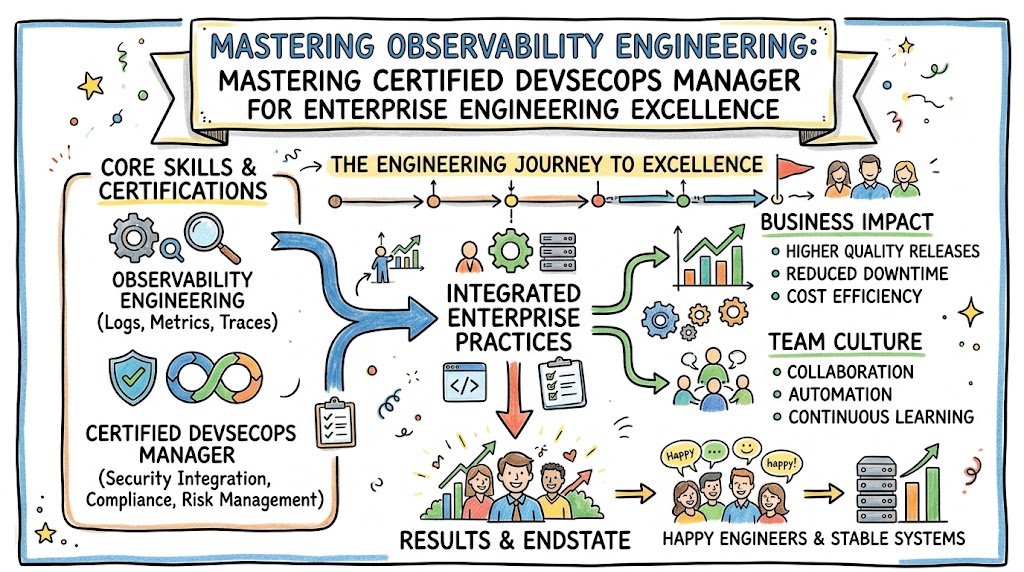
In the current landscape of rapid software delivery and complex infrastructure, professional development remains a cornerstone for career growth. This guide aims to elevate your technical standing by exploring the Certified DevSecOps Manager program. Whether you are navigating the intricacies of cloud-native environments or aiming to bridge the gap between development, security, and operations, understanding these certifications is vital. This roadmap provides clarity on how to align your learning with industry demands across various platforms like devopsschool, sreschool, and aiopsschool, ensuring you make informed decisions for your professional journey.
What is the Certified DevSecOps Manager?
The Certified DevSecOps Manager certification represents a comprehensive framework for professionals responsible for integrating security into the software development lifecycle. It exists to bridge the traditional silos that separate security teams from development and operations units, fostering a culture of shared responsibility. This certification is not merely a theoretical badge; it is designed to validate your ability to oversee secure pipelines, manage vulnerability workflows, and implement automated compliance in production environments. By focusing on real-world, production-focused learning, it prepares practitioners to handle the complexities of enterprise-grade security without stalling the velocity of software delivery.
Who Should Pursue Certified DevSecOps Manager?
This certification is designed for a broad spectrum of professionals who influence the engineering lifecycle, including security-conscious DevOps engineers, SREs, and cloud architects. It is equally relevant for engineering managers and technical leads who are tasked with overseeing the security posture of complex microservices or distributed systems. Whether you are based in India or working within global distributed teams, the principles covered are universal. Beginners with a firm grasp of infrastructure will find it a pathway to security specialization, while experienced engineers can use it to validate their expertise in managing secure, scalable engineering workflows.
Why Certified DevSecOps Manager
The demand for professionals who can balance high-speed deployment with rigorous security is growing exponentially as enterprise adoption of cloud-native technology matures. Holding this certification demonstrates that you possess the skills to remain relevant even as specific toolsets and security frameworks evolve over time. It offers a significant return on your investment of time by equipping you with the methodology to handle security as code, which is a highly sought-after capability. By focusing on architectural principles rather than temporary trends, professionals can ensure their career trajectory remains stable and growth-oriented in an increasingly digitized global economy.
Certified DevSecOps Manager Certification Overview
The program is delivered via and hosted on devopsschool. This certification approach is rooted in practical application, requiring candidates to demonstrate knowledge through assessments that mirror actual industry scenarios. The structure ensures that you do not just memorize concepts but understand how to apply security policies across complex stacks. It provides a structured path for certification, allowing you to validate your skills in a way that is recognized by industry peers and organizations looking for competent leadership in secure development environments.
Certified DevSecOps Manager Certification Tracks & Levels
The certification framework is segmented into levels that reflect the progression of professional expertise. Foundation levels establish the baseline understanding of security integration, while professional and advanced levels delve into strategic implementation, policy enforcement, and incident management. These tracks cover distinct specializations such as automated security, threat modeling, and regulatory compliance. By aligning these levels with your career progression, you can move from a practitioner who executes security tasks to a manager who defines and enforces secure engineering standards across an entire organization.
Complete Certified DevSecOps Manager Certification Table
| Track | Level | Who it’s for | Prerequisites | Skills Covered | Recommended Order |
| Security Operations | Foundation | Aspiring Security Engineers | Basic Linux & Cloud Knowledge | Security Fundamentals, CI/CD Security | 1 |
| DevSecOps Integration | Professional | DevOps Engineers | Foundation Level | Automated Testing, Vulnerability Management | 2 |
| Strategic Leadership | Advanced | Engineering Managers | Professional Level | Threat Modeling, Compliance, Governance | 3 |
Detailed Guide for Each Certified DevSecOps Manager Certification
Certified DevSecOps Manager – Foundation Level
What it is
This certification validates the fundamental understanding of how security principles are integrated into the modern software development lifecycle.
Who should take it
It is ideal for system administrators, junior developers, and cloud engineers looking to build a strong foundation in secure software delivery.
Skills you’ll gain
- Understanding the DevSecOps methodology
- Implementing basic security scans in pipelines
- Principles of secure coding and configuration
Real-world projects you should be able to do
- Setting up a basic automated vulnerability scanner in a CI pipeline
- Configuring secure access control for cloud resources
- Documenting security best practices for internal teams
Preparation plan
- 7–14 days: Focus on core security concepts and theory.
- 30 days: Engage in hands-on labs with CI/CD tools.
- 60 days: Review case studies and prepare for assessment scenarios.
Common mistakes
Focusing too much on theory without practicing pipeline integration.
Best next certification after this
- Same-track: Certified DevSecOps Manager Professional
- Cross-track: Certified SRE Practitioner
- Leadership: IT Service Management Foundations
Choose Your Learning Path
DevOps Path
The DevOps path focuses on the automation of the entire delivery pipeline, ensuring that efficiency is not compromised by security requirements. Professionals in this path will learn to treat security as a component of the infrastructure, using code to define and enforce security boundaries.
DevSecOps Path
The DevSecOps path is a deeper dive into the intersection of development, security, and operations, emphasizing the cultural shift required for secure delivery. It involves learning advanced threat detection, automated governance, and the integration of security tools directly into the developer workflow.
SRE Path
The SRE path bridges the gap between software engineering and system operations, focusing on reliability and security at scale. This path is essential for those who need to maintain highly available systems while ensuring that security patches and updates do not cause downtime.
AIOps Path
The AIOps path integrates artificial intelligence and machine learning into operational workflows to detect anomalies and security threats faster. It is designed for those who want to leverage data-driven insights to predict and mitigate security risks before they affect production.
MLOps Path
The MLOps path is tailored for engineers managing machine learning models, ensuring that data pipelines and model deployments are secure and compliant. This path focuses on the unique security challenges of AI systems, including data privacy and model integrity.
DataOps Path
The DataOps path emphasizes the secure management of data pipelines, ensuring that data is protected throughout its lifecycle, from ingestion to consumption. It focuses on privacy, access control, and the automated validation of data security policies.
FinOps Path
The FinOps path centers on the financial accountability and cost-optimization aspects of secure cloud operations. It teaches professionals how to align security investments with budget requirements, ensuring that security measures are both effective and financially sustainable.
Role → Recommended Certified DevSecOps Manager Certifications
| Role | Recommended Certifications |
| DevOps Engineer | Certified DevSecOps Manager Foundation & Professional |
| SRE | Certified DevSecOps Manager Professional |
| Platform Engineer | Certified DevSecOps Manager Professional |
| Cloud Engineer | Certified DevSecOps Manager Foundation |
| Security Engineer | Certified DevSecOps Manager Advanced |
| Data Engineer | Certified DevSecOps Manager Foundation |
| FinOps Practitioner | Certified DevSecOps Manager Professional |
| Engineering Manager | Certified DevSecOps Manager Advanced |
Next Certifications to Take After Certified DevSecOps Manager
Same Track Progression
Once you have mastered the management level, the next step involves deep specialization in specific security domains like cloud-native security, identity management, or advanced threat hunting. This ensures your expertise remains sharp as you take on more complex organizational security challenges.
Cross-Track Expansion
Broadening your skills into areas like SRE or FinOps allows you to understand the complete engineering ecosystem. This versatility makes you an invaluable asset to organizations, as you can communicate effectively with different technical teams while maintaining a cohesive security strategy.
Leadership & Management Track
Transitioning to the leadership track involves focusing on organizational strategy, policy definition, and team management. This pathway prepares you for roles like Chief Information Security Officer or Director of Engineering, where your focus shifts from hands-on implementation to strategic governance.
Training & Certification Support Providers for Certified DevSecOps Manager
DevOpsSchool
An industry-standard platform offering structured training programs for professionals looking to enhance their technical capabilities through hands-on learning and comprehensive certification paths.
Cotocus
Provides specialized training services focusing on practical engineering skills and modern delivery methodologies, catering to both individuals and enterprise teams globally.
Scmgalaxy
Offers a wide range of training and certification resources centered on configuration management, continuous delivery, and advanced DevOps practices for modern software teams.
BestDevOps
A dedicated training provider focusing on the core principles of DevOps, helping practitioners build the skills necessary to excel in high-performance engineering environments.
devsecopsschool
Focuses exclusively on security integration within the DevOps lifecycle, providing tailored certification programs for professionals aiming to specialize in secure engineering workflows.
sreschool
Specializes in Site Reliability Engineering training, helping professionals build reliable and scalable systems while integrating essential security and operational practices.
aiopsschool
Provides training on the application of AI and ML in IT operations, enabling engineers to leverage data-driven insights for better system performance and security.
dataopsschool
Dedicated to data operations training, focusing on the management, security, and optimization of data pipelines within the modern enterprise landscape.
finopsschool
Focuses on the intersection of cloud finance and operations, providing training to help professionals manage costs effectively without compromising on security or performance.
Frequently Asked Questions (General)
- What is the primary difficulty level of these certifications?
The certifications are designed to be challenging but achievable, requiring a solid mix of theoretical understanding and practical lab experience. - How much time is typically required to prepare for a certification?
Preparation time varies based on your existing experience, but generally ranges from four to eight weeks for focused study and practice. - Are there any specific prerequisites for starting these courses?
While foundation levels are open to all, some professional and advanced tracks require a basic understanding of cloud environments and Linux. - What is the return on investment for obtaining these certifications?
The ROI is significant as these certifications validate your skills to employers, often leading to better job opportunities and career advancement. - How should I sequence these certifications for my career?
It is recommended to start with the foundation level in your primary domain and then branch out into professional and specialized tracks as you gain experience. - Are these certifications recognized globally?
Yes, the frameworks taught are based on industry-standard practices that are applicable and recognized by organizations around the world. - Do I need to have a programming background?
Having a basic understanding of scripting and programming concepts is highly beneficial for implementing security as code. - How often should I update my certification status?
Industry standards evolve rapidly, so it is advisable to engage in continuous learning and recertification every two to three years. - Can I use the skills learned immediately in my current role?
Absolutely, the curriculum is designed to be practical, allowing you to implement security improvements in your projects from day one. - Is there any support available during the learning process?
Most providers offer access to forums, labs, and mentorship to help you overcome technical challenges while preparing for your exam. - How do these certifications help in leadership transitions?
They provide the foundational knowledge and management methodologies required to lead secure engineering teams effectively. - Are there any group training options for organizations?
Many of the listed providers offer tailored enterprise training programs to help entire teams upskill simultaneously.
FAQs on Certified DevSecOps Manager
- What specific value does this certification provide for managers?
It provides the framework to manage risk, ensure compliance, and oversee secure pipelines effectively across teams. - How does this differ from standard security certifications?
It focuses specifically on the intersection of security with rapid delivery, rather than traditional perimeter security approaches. - Is hands-on practice mandatory for the exam?
Yes, the assessments are designed to test your ability to solve real-world problems in simulated environments. - Can this help me move from a DevOps role to a Security role?
It is an ideal bridge, as it builds upon your existing DevOps knowledge and adds the necessary security specialization. - Does the certification cover compliance frameworks like GDPR or HIPAA?
It covers the methodology for implementing compliance, which can be applied to various regulatory frameworks. - What is the focus of the advanced level assessment?
The advanced level focuses on architectural decision-making, threat modeling, and incident response planning. - How do I maintain my certification once earned?
You maintain your certification through continuous learning, participation in community updates, and periodic renewal assessments. - Is this certification appropriate for a Cloud Security Architect?
It is highly relevant, as it provides the operational context needed to implement cloud-native security strategies.
Final Thoughts: Is Certified DevSecOps Manager Worth It?
Choosing to pursue the Certified DevSecOps Manager program is a significant step toward aligning your skills with the modern engineering requirements of the enterprise. It is a practical, no-nonsense path for those who are serious about building secure systems that don’t bottleneck development velocity. If you are an engineer or manager looking to solidify your expertise and stay ahead of the curve, this certification offers the structured guidance you need. Approach it with the intent to learn and apply, and you will find it to be a valuable asset in your long-term career strategy.