
Introduction
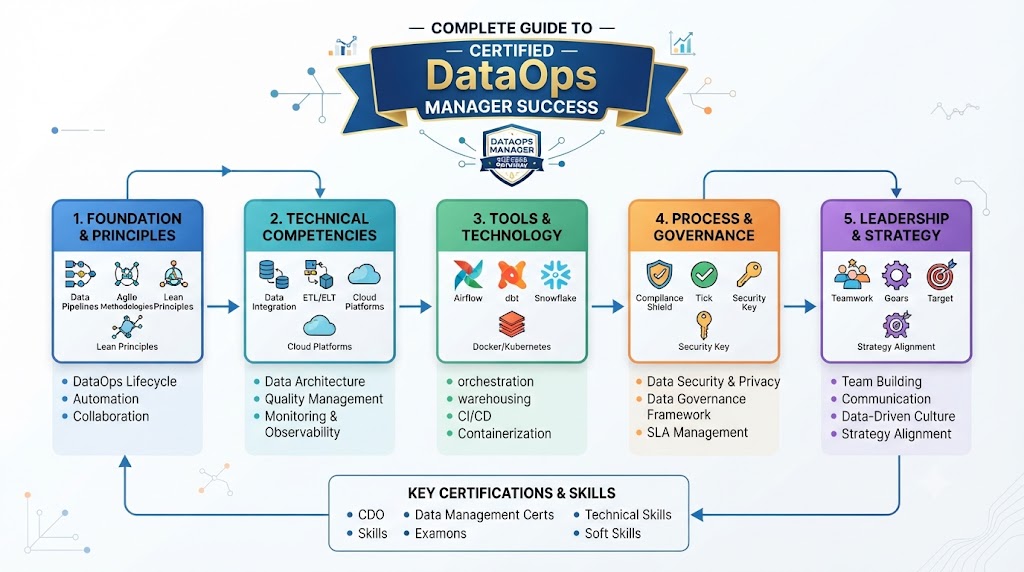
CDOM – Certified DataOps Manager is an industry-recognized professional credential designed for modern data leaders. This comprehensive guide is built for engineers, architects, and technical leaders who want to master scalable data operations. It matters today because enterprise data pipelines require rigorous automation, governance, and reliability. Positioned firmly within DevOps, cloud-native architectures, and platform engineering careers, this certification bridges the gap between raw data engineering and operational excellence. This guide helps professionals make informed career decisions by detailing requirements, learning tracks, and real-world outcomes.
What is the CDOM – Certified DataOps Manager?
[CDOM – Certified DataOps Manager] represents a standardized benchmark of excellence in managing complex data pipelines, automated testing, and team collaboration. It exists to solve persistent data silo issues, reducing friction between data engineering, analytics, and infrastructure teams. The curriculum emphasizes real-world, production-focused learning over abstract theory. It aligns directly with modern engineering workflows, version control systems, and continuous delivery practices. Enterprise organizations adopt these methodologies to ensure high data availability, trust, and operational efficiency.
Who Should Pursue CDOM – Certified DataOps Manager?
This professional path benefits a broad spectrum of technical roles across the globe, including in India’s rapidly growing tech ecosystem. Software engineers, Site Reliability Engineers (SREs), cloud architects, and data professionals find immense value in the curriculum. Beginners aiming to specialize in data operations, experienced engineers scaling pipelines, and managers leading data departments all gain strategic advantages. It provides foundational clarity for newcomers while offering advanced architectural governance strategies for seasoned technical leaders.
Why CDOM – Certified DataOps Manager
Enterprise demand for operational reliability in data workflows continues to accelerate exponentially. This credential provides long-term career longevity because it focuses on core methodologies rather than short-lived tools. Professionals who understand automated data governance stay relevant despite constant shifts in the technology landscape. The return on time and career investment is exceptionally high, opening doors to senior engineering, consulting, and executive leadership positions.
CDOM – Certified DataOps Manager Certification Overview
The program is delivered via the official course portal at and hosted on. Certification levels range from foundation concepts to advanced enterprise strategies. The assessment approach tests practical problem-solving capabilities, configuration management, and pipeline observability through hands-on scenarios. Program ownership centers on maintaining high industry standards for automated data movement and delivery lifecycle management.
CDOM – Certified DataOps Manager Certification Tracks & Levels
The curriculum features foundation, professional, and advanced tiers tailored to progressive career milestones. Foundation tiers introduce core data lifecycle philosophies, version control, and basic pipeline automation. Professional levels explore multi-stage orchestration, data observability, and infrastructure as code principles. Advanced levels target enterprise-scale team management, financial governance, and cross-departmental data strategy. Specialization tracks align seamlessly with SRE, DevOps, and platform engineering domains.
Complete CDOM – Certified DataOps Manager Certification Table
| Track | Level | Who it’s for | Prerequisites | Skills Covered | Recommended Order |
| DataOps | Foundation | Junior Data Engineers & Analysts | Basic SQL & Python | DataOps Manifesto, Pipeline Basics | 1 |
| DataOps | Professional | Mid-Level Data Engineers & SREs | Foundation Certificate | Observability, Orchestration, IaC | 2 |
| DataOps | Advanced | Data Architects & Managers | Professional Certificate | Governance, Team Scaling, ROI | 3 |
Detailed Guide for Each CDOM – Certified DataOps Manager Certification
CDOM – Certified DataOps Manager – Foundation
What it is
This certification validates a professional’s understanding of foundational DataOps tenets, focusing on cultural and technical shifts required to automate data delivery. It acts as the starting point for anyone transitioning into data-centric operations.
Who should take it
It is ideal for data analysts, junior data engineers, and traditional database administrators who want to modernize their skill set without prior automation experience.
Skills you’ll gain
- Understanding the DataOps Manifesto and core principles
- Identifying bottlenecks in traditional data delivery cycles
- Basic knowledge of version control for data assets
- Understanding the role of automated testing in pipelines
Real-world projects you should be able to do
- Setting up a basic version-controlled schema repository
- Implementing automated syntax checks for SQL scripts
- Creating simple pipeline documentation and runbooks
- Mapping data flows from source to basic storage endpoints
Preparation plan
- 7–14 days: Review core documentation and introductory architecture notes
- 30 days: Complete guided labs on version control and basic pipeline triggers
- 60 days: Take practice assessments and review foundational case studies
Common mistakes
- Focusing too much on specific tools rather than the underlying methodology
- Skipping cultural aspects to focus solely on code
Best next certification after this
- Same-track option: CDOM Professional Level
- Cross-track option: Certified DevOps Foundation
- Leadership option: Technical Team Lead Program
CDOM – Certified DataOps Manager – Professional
What it is
This certification validates intermediate proficiency in building robust, observable, and self-healing data delivery pipelines across complex enterprise environments.
Who should take it
Designed for mid-level data engineers, cloud administrators, and DevOps practitioners seeking deeper specialization in data platform operations.
Skills you’ll gain
- Advanced orchestration of multi-stage data pipelines
- Implementing observability and monitoring for data health
- Designing self-healing data integration systems
- Managing data infrastructure as code
Real-world projects you should be able to do
- Deploying a fully orchestrated multi-source ETL pipeline using containers
- Setting up automated anomaly detection alerts for missing data rows
- Provisioning data infrastructure components using Terraform
- Configuring automated CI/CD deployment gates for data models
Preparation plan
- 7–14 days: Deep dive into technical labs and advanced configuration scenarios
- 30 days: Work on a capstone project integrating multiple data sources into a single automated flow
- 60 days: Conduct extensive mock exams and review case studies of failed data migrations
Common mistakes
- Over-engineering simple pipelines with unnecessary complexity
- Neglecting the monitoring aspect until after system deployment
Best next certification after this
- Same-track option: Expert DataOps Strategist
- Cross-track option: Certified SRE Professional
- Leadership option: Technical Product Manager
CDOM – Certified DataOps Manager – Advanced
What it is
This designation validates executive capability in directing enterprise-wide DataOps transformations, governing large-scale architectures, and scaling high-performance engineering teams.
Who should take it
Aimed at senior architects, engineering directors, and technical managers responsible for enterprise data strategy and departmental performance.
Skills you’ll gain
- Building and scaling high-performance DataOps teams
- Calculating and presenting ROI of DataOps initiatives to stakeholders
- Advanced data governance and compliance at scale
- Long-term strategic planning for enterprise data evolution
Real-world projects you should be able to do
- Designing a multi-region secure datamesh governance framework
- Executing an enterprise migration strategy with zero data loss
- Establishing organizational SLAs, SLOs, and error budgets for analytics
- Directing cross-functional value stream mapping workshops
Preparation plan
- 7–14 days: Analyze enterprise case studies and governance frameworks
- 30 days: Draft comprehensive transformation roadmaps for legacy systems
- 60 days: Participate in peer review simulations and leadership strategy clinics
Common mistakes
- Focusing exclusively on technology while ignoring organizational workflow bottlenecks
- Failing to align operational metrics with broader business goals
Best next certification after this
- Same-track option: Continued executive education
- Cross-track option: FinOps Certified Practitioner
- Leadership option: Executive Leadership Program
Choose Your Learning Path
DevOps Path
The DevOps path focuses on bridging software development and IT operations through continuous integration and continuous deployment pipelines. Professionals learn how to automate infrastructure provisioning, configuration management, and release management workflows. Integrating CDOM principles into this track ensures that data payloads are treated with the same rigor as application code. Practitioners build resilient deployment cycles that minimize manual interventions across cloud environments.
DevSecOps Path
The DevSecOps path embeds security practices directly into every stage of the software and data development lifecycle. Learners master automated vulnerability scanning, compliance auditing, identity management, and secure artifact repositories. Applying these concepts within data operations protects sensitive customer records and analytical assets from modern cyber threats. Professionals ensure that security checks run automatically without slowing down production delivery speeds.
SRE Path
The Site Reliability Engineering path emphasizes software engineering approaches to IT infrastructure and operational problem-solving. Engineers learn how to design scalable architectures, define precise error budgets, and automate incident response workflows. Incorporating data reliability engineering ensures that analytical pipelines maintain high availability and predictable performance under heavy loads. Teams utilize rigorous telemetry to detect pipeline anomalies before they impact downstream consumers.
AIOps / MLOps Path
The AIOps / MLOps path focuses on operationalizing machine learning models and artificial intelligence workflows in production environments. Practitioners learn experiment tracking, model versioning, automated retraining triggers, and high-performance inference serving. Because artificial intelligence models depend entirely on continuous data streams, mastering CDOM concepts is vital for ensuring model accuracy. This track bridges data science innovation with reliable enterprise IT operations.
DataOps Path
The DataOps path applies agile manufacturing principles, lean concepts, and automated testing to data analytics engineering pipelines. Professionals learn how to optimize data movement, establish robust quality gates, and foster close cross-departmental collaboration. This track transforms sluggish data warehouses into fast, reliable, and observable enterprise analytics engines. Leaders master the governance patterns necessary to scale data trust across the entire organization.
FinOps Path
The FinOps path centers on financial accountability and cloud cost optimization across complex multi-cloud infrastructure footprints. Practitioners learn how to allocate cloud spending, eliminate idle storage waste, and right-size compute instances. Integrating these financial disciplines into data operations helps organizations maintain cost-efficient pipelines without sacrificing processing speed. Leaders align technical data workflows directly with enterprise budgetary limitations.
Role → Recommended CDOM – Certified DataOps Manager Certifications
| Role | Recommended Certifications |
| DevOps Engineer | CDOM Foundation & Professional |
| SRE | CDOM Professional |
| Platform Engineer | CDOM Professional & Advanced |
| Cloud Engineer | CDOM Foundation |
| Security Engineer | CDOM Professional |
| Data Engineer | CDOM Foundation & Professional |
| FinOps Practitioner | CDOM Advanced |
| Engineering Manager | CDOM Advanced |
Next Certifications to Take After CDOM – Certified DataOps Manager
Same Track Progression
Advancing within the same track involves pursuing expert-level specializations that focus on architectural mastery. Professionals dive deeper into multi-cloud data orchestration, complex distributed streaming frameworks, and enterprise-grade compliance automation. This vertical progression establishes recognized industry authority and opens doors to principal engineering roles.
Cross-Track Expansion
Broadening skills across different tracks prevents technical obsolescence and fosters a holistic platform engineering mindset. Data managers frequently expand their expertise into security, site reliability, or cloud financial management disciplines. This multi-disciplinary capability enables engineers to design cohesive, secure, and cost-effective enterprise ecosystems.
Leadership & Management Track
Transitioning into leadership involves shifting focus from hands-on configuration to strategic planning, budgeting, and team empowerment. Leaders learn how to construct high-performing organizational units, manage cross-functional stakeholders, and drive digital transformations. This path prepares technical professionals for director, vice president, and chief technology officer responsibilities.
Training & Certification Support Providers for CDOM – Certified DataOps Manager
DevOpsSchool is a globally recognized platform offering rigorous technical training programs for modern engineering professionals. Their comprehensive curriculum focuses on hands-in production scenarios, practical toolchains, and real-world deployment challenges.
Cotocus specializes in enterprise consulting, corporate training, and advanced software engineering certification tracks. They help organizations modernize their software delivery pipelines through expert-led instruction and customized mentorship.
Scmgalaxy is a long-standing community and training hub dedicated to configuration management, version control, and release engineering. They provide extensive resources for engineers mastering modern continuous integration methodologies.
BestDevOps delivers focused educational courses designed to bridge the gap between development teams and IT operations environments. Their programs emphasize automation, cloud-native tooling, and agile operational workflows.
devsecopsschool.com provides niche educational modules centered exclusively on security automation, compliance auditing, and threat mitigation. They enable engineers to build secure software development lifecycles from the ground up.
sreschool.com offers specialized training programs dedicated to site reliability engineering, incident management, and system observability. Their courses help technical teams maximize uptime and maintain stringent availability targets.
aiopsschool.com focuses on artificial intelligence operations, automated incident remediation, and machine learning pipeline scaling. They equip professionals with the skills needed to manage intelligent systems in production.
dataopsschool.com provides specialized educational paths centered on data lifecycle management, continuous pipeline validation, and data governance. They maintain high standards of technical competence in automated data movement.
finopsschool.com explicitly teaches financial accountability models and cloud cost optimization architectures. They enable technical professionals to construct cost-efficient pipelines aligned with enterprise budgets.
Frequently Asked Questions
1. What is the typical difficulty level encountered during these technical certification examinations?
The examinations are designed to test practical competence, analytical thinking, and real-world troubleshooting capabilities rather than rote memorization. Candidates with hands-on production experience find the questions straightforward, while beginners need dedicated lab practice.
2. How does the CDOM credential differ from a standard DevOps certification?
The CDOM specifically addresses the volatility, quality assurance requirements, validation gates, and governance policies unique to enterprise data delivery streams, moving past generic software deployment cycles.
3. What specific technical tools are covered within the curriculum?
Students gain practical experience with major pipeline orchestration utilities, data transformation tools, container environments, and continuous system monitoring suites.
4. Are there any strict coding prerequisites required to enroll in the foundation level?
Basic familiarity with scripting logic and relational database concepts is helpful, but extensive software development experience is not mandatory for the introductory foundation tier.
5. How long does a typical candidate need to prepare for the professional level assessment?
Most working professionals dedicate between four to six weeks of consistent part-time study, combining official course modules with practical lab exercises.
6. Do these credentials expire, and is there a renewal policy in place?
Certifications typically remain valid for a multi-year period, after which professionals can recertify through continuing education credits or updated advanced exams.
7. Can these certifications help secure remote or international engineering roles?
Because these credentials validate standardized global industry methodologies, they are widely recognized by multinational enterprises and remote-first technology organizations.
8. How do employers verify the authenticity of a completed certification?
Every successful candidate receives a unique digital badge and verification record hosted securely on the official training provider portal.
9. Is prior management experience required to attempt the advanced level?
While leadership experience helps contextualize the strategic modules, technical individual contributors who understand enterprise architecture can successfully clear the assessment.
10. What kind of lab environment is provided during the training process?
Students receive access to simulated cloud-native environments pre-configured with industry-standard orchestration and observability utilities.
11. How does this credential impact salary potential in the current market?
Specialized operations credentials validate scarce skills, frequently enabling professionals to transition into higher-paying engineering, architecture, or leadership positions.
12. Can teams undergo corporate group training through these platforms?
Yes, institutional providers offer customized cohort training programs tailored to specific enterprise tech stacks and migration timelines.
FAQs on CDOM – Certified DataOps Manager
1. What core operational bottlenecks does a certified manager solve?
Certified managers eliminate manual handoffs, reduce pipeline failure rates, and streamline data delivery cycles across disparate analytics teams.
2. How does the program address data quality assurance?
The curriculum teaches automated testing frameworks, anomaly detection mechanisms, and rigorous data validation gates deployed directly into production pipelines.
3. Is this certification suitable for traditional database administrators?
Yes, it provides an ideal transition path for DBAs looking to modernize their skills into automated cloud-native data operations.
4. How does CDOM integrate with existing infrastructure management tools?
It teaches how to combine infrastructure-as-code utilities with data orchestration platforms to maintain reproducible deployment environments.
5. What is the focus of the advanced management module?
The advanced module centers on team scaling, economic value demonstration, and enterprise-wide data governance policy enforcement.
6. Does the curriculum cover cloud-native data warehouse platforms?
Students learn architectural patterns that apply universally across modern cloud data warehouses and distributed lakehouse environments.
7. How are practical problem-solving skills tested in the exam?
Assessments feature scenario-based questions that require diagnosing pipeline failures, configuration errors, and governance bottlenecks.
8. Can data scientists benefit from taking this manager-level course?
Data scientists benefit significantly by understanding how their models interact with production infrastructure and automated data pipelines.
Final Thoughts
Mastering modern data operations requires a balanced commitment to technical automation, cultural collaboration, and robust architectural governance. The [CDOM – Certified DataOps Manager] credential offers a structured roadmap for professionals eager to lead high-performing data engineering teams. By focusing on repeatable frameworks rather than fleeting software trends, this program ensures lasting career relevance. Committing to this learning path represents a solid investment in your long-term technical and leadership growth.