
Introduction
Managing cloud infrastructure was once strictly about uptime, performance, and scaling. Today, cloud cost management has become an engineering priority that directly impacts corporate strategy, product margins, and technical velocity. Uncontrolled cloud expenditure creates severe operational drag, forcing organizations to re-evaluate how they architect, deploy, and scale resources across multi-cloud environments.
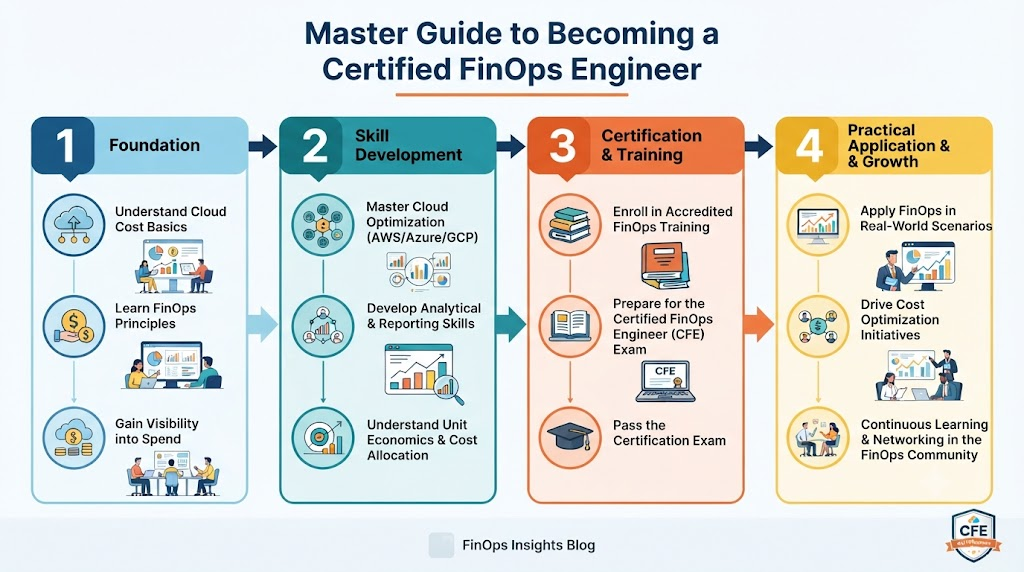
The Certified FinOps Engineer designation bridges the gap between deep technical cloud engineering and financial accountability. It equips professionals with the expertise to establish cloud cost transparency, automate optimization workflows, and build a culture of financial responsibility within engineering teams. This comprehensive guide breaks down everything you need to know about pursuing this certification, evaluating its career impact, and mapping your learning path.
What is the Certified FinOps Engineer?
The Certified FinOps Engineer program is a specialized credential designed to validate an engineer’s ability to operationalize cloud financial management. Unlike purely theoretical frameworks or high-level executive overviews, this certification focuses on hands-on technical execution, production workflows, and real-world infrastructure automation.
It prepares engineers to work directly with infrastructure as code, tag enforcement, cost anomaly detection, serverless rightsizing, and automated lifecycle policies. By aligning technical architecture decisions with financial metrics, certified engineers ensure that cloud platforms scale efficiently without sacrificing innovation or speed.
Who Should Pursue Certified FinOps Engineer?
This certification is built for professionals who interact directly with cloud platforms, platform engineering workflows, and infrastructure budgets. It caters to a wide spectrum of technical roles, from individual contributors seeking specialized skills to leaders driving organizational efficiency.
- DevOps Engineers and SREs: Looking to automate cost controls, implement policy-as-code, and integrate cost metrics directly into CI/CD pipelines and observability dashboards.
- Cloud Infrastructure & Platform Engineers: Responsible for designing scalable multi-tenant architecture, managing reserved capacity, and establishing tagging and governance models.
- FinOps Practitioners and Cloud Economists: Seeking deep technical validation to work closely with engineering teams and enforce automated financial guardrails.
- Engineering Managers and Technical Directors: Needing a clear operational framework to manage cloud budgets, forecast growth, and establish financial accountability across product squads.
Globally and across the rapidly expanding cloud ecosystem in India, demand for certified engineers is growing rapidly. Organizations operating at scale require dedicated technical expertise to prevent cloud cost overruns without slowing down development cycles.
Why Certified FinOps Engineer
Cloud adoption has reached a maturity level where baseline migration is complete, and operational efficiency is the new benchmark for success. Organizations are actively scrutinizing their cloud bills to eliminate waste, rightsized oversized instances, and optimize dynamic workloads across public, private, and hybrid clouds.
Earning this credential demonstrates that you possess transferable skills that remain vital regardless of specific tool changes or vendor shifts. Tools and dashboard interfaces evolve, but the core principles of unit economics, lifecycle automation, anomaly response, and rate optimization remain consistent.
Investments in FinOps education deliver high returns on career growth. Engineers who master financial accountability alongside deep technical execution distinguish themselves as cross-functional technical leaders capable of influencing high-level architectural decisions.
Certified FinOps Engineer Certification Overview
The Certified FinOps Engineer program is delivered via specialized training modules and structured hands-on evaluations. The certification evaluates an engineer’s proficiency across cloud cost visibility, resource allocation, architectural rightsizing, rate optimization, and automated enforcement.
The assessment approach combines practical real-world scenarios with technical evaluation, ensuring candidates understand both strategic principles and hands-on execution. The curriculum covers major cloud ecosystems, including AWS, Microsoft Azure, and Google Cloud Platform, providing a vendor-agnostic foundation for enterprise applications.
Certified FinOps Engineer Certification Tracks & Levels
To accommodate varying levels of experience and career goals, the certification path is structured into distinct tiers:
- Foundation Level: Focuses on core FinOps concepts, cloud cost drivers, basic tagging strategies, usage visibility, and foundational unit economics.
- Professional Level: Deep dives into technical implementation, policy-as-code, dynamic auto-scaling policies, anomaly detection, rightsizing workflows, and rate optimization strategies.
- Advanced Level: Targets enterprise governance, multi-cloud financial architectures, custom automated remediation tooling, business unit cost allocation, and executive forecasting models.
Specialization tracks allow professionals in DevOps, SRE, Platform Engineering, and Data Engineering to tailor their learning directly to their day-to-day stack and operational responsibilities.
Complete Certified FinOps Engineer Certification Table
| Track | Level | Who it’s for | Prerequisites | Skills Covered | Recommended Order |
| Cloud Financial Fundamentals | Foundation | Junior Engineers, Analysts, Cloud Beginners | Basic Cloud Awareness | Tagging, Cost Allocation, Cloud Pricing Models, Visibility | 1 |
| Infrastructure Cost Engineering | Professional | DevOps, SREs, Cloud Engineers | 2+ Years Cloud Experience | Rightsizing, Anomaly Detection, Reserved Instance Management, Policy-as-Code | 2 |
| Enterprise FinOps Architecture | Advanced | Principal Engineers, Technical Architects, Managers | 5+ Years Technical Leadership | Multi-Cloud Governance, Custom Automation, Enterprise Forecasting, Unit Economics | 3 |
Detailed Guide for Each Certified FinOps Engineer Certification
Certified FinOps Engineer – Foundation
What it is
This entry-level certification validates a baseline understanding of cloud cost structure, visibility tools, tagging standards, and foundational FinOps principles across public cloud platforms.
Who should take it
System administrators, junior cloud engineers, technical project managers, and finance professionals who need to understand technical cloud billing terminology and core financial workflows.
Skills you’ll gain
- Understanding cloud billing data formats and cost allocation tags.
- Identifying unattached resources, idle storage, and over-provisioned instances.
- Navigating native cloud cost management consoles and configuring basic alerts.
- Calculating baseline cloud unit metrics and tracking regional cost variations.
Real-world projects you should be able to do
- Design and implement a standard tagging policy for a small-to-medium cloud environment.
- Build custom cost management dashboards to track monthly departmental spending.
- Generate automated reports identifying unused cloud assets and orphan volumes.
Preparation plan
- 7–14 days: Review official FinOps framework documentation, basic cloud pricing models, and cloud provider billing guides.
- 30 days: Hands-on practice creating billing alerts, configuring native budget reports, and writing tagging scripts.
- 60 days: In-depth study of cloud architecture pricing calculators, multi-account hierarchy setups, and practice assessments.
Common mistakes
- Treating cloud cost management purely as an accounting function rather than an engineering discipline.
- Neglecting the practical mechanics of tagging enforcement across diverse engineering squads.
- Relying exclusively on high-level vendor calculators without analyzing actual usage patterns.
Best next certification after this
- Same-track option: Certified FinOps Engineer – Professional
- Cross-track option: Certified DevOps Engineer
- Leadership option: Cloud Engineering Manager Track
Certified FinOps Engineer – Professional
What it is
A comprehensive technical credential that certifies an engineer’s ability to implement automated rightsizing, continuous cost optimization, policy-as-code enforcement, and anomaly response in active production environments.
Who should take it
Working DevOps engineers, Site Reliability Engineers, Cloud Architects, and Systems Engineers responsible for running production infrastructure and optimizing compute, storage, and networking layers.
Skills you’ll gain
- Building automated scripts to terminate, snapshot, or downsize underutilized compute nodes.
- Configuring policy-as-code guardrails using tools like Open Policy Agent (OPA) or native cloud policies.
- Managing commitment-based discount strategies, including Savings Plans, Reserved Instances, and Committed Use Discounts.
- Implementing automated cost anomaly detection integrated directly with Slack, PagerDuty, or Microsoft Teams.
Real-world projects you should be able to do
- Construct a continuous CI/CD pipeline step that estimates pull request infrastructure cost changes before deployment.
- Deploy automated serverless functions to stop non-production environments during non-business hours.
- Re-architect storage tiers dynamically using automated lifecycle management and intelligent tiering configurations.
Preparation plan
- 7–14 days: Intensive review of advanced cloud pricing models, commitment mechanics, and automated remediation scripts.
- 30 days: Build end-to-end cost automation scripts using CLI/SDKs, policy engines, and serverless workflow orchestrators.
- 60 days: Execute deep architectural cost audits on simulated enterprise environments and master cross-cloud commitment strategies.
Common mistakes
- Over-optimizing infrastructure at the expense of system availability, fault tolerance, or performance SLAs.
- Failing to establish automated guardrails, resulting in manual, unsustainable cleanup tasks.
- Ignoring cross-region networking and egress costs while focusing strictly on compute instances.
Best next certification after this
- Same-track option: Certified FinOps Engineer – Advanced
- Cross-track option: Certified SRE / Platform Engineer
- Leadership option: Technical Director / Enterprise Architect Certification
Certified FinOps Engineer – Advanced
What it is
An enterprise-level credential validating deep expertise in governance, multi-cloud financial architecture, custom automation development, unit economics modeling, and organizational FinOps transformation.
Who should take it
Principal Engineers, Enterprise Cloud Architects, Technical Directors, and FinOps Directors leading large-scale multi-cloud initiatives across multiple business units.
Skills you’ll gain
- Designing advanced unit economics models aligning cloud cost to specific business metrics (e.g., cost per transaction).
- Establishing multi-tenant cost allocation and chargeback/showback systems across hybrid infrastructure.
- Authoring custom FinOps automation frameworks and governance engines for multi-cloud deployments.
- Formulating long-term enterprise capacity forecasts and negotiating multi-year committed spend agreements.
Real-world projects you should be able to do
- Architect an enterprise-wide showback platform integrating AWS CUR, Azure Consumption API, and GCP BigQuery billing exports.
- Implement custom organizational governance frameworks enforcing automated budget compliance at the organizational unit level.
- Lead a complete architectural migration from fixed infrastructure to auto-scaling containerized microservices to optimize density.
Preparation plan
- 7–14 days: Focus on enterprise governance frameworks, multi-tenant financial architecture, and complex billing data schema.
- 30 days: Design end-to-end enterprise FinOps blueprints, multi-cloud cost aggregation pipelines, and chargeback engine concepts.
- 60 days: Conduct complete financial architectural reviews, execute real-world enterprise cost optimizations, and refine executive presentation strategy.
Common mistakes
- Designing overly complex chargeback models that create operational friction without adding real insight.
- Failing to build cross-functional trust between engineering leadership, product teams, and executive finance.
- Focusing exclusively on immediate savings rather than building scalable, long-term financial architectures.
Best next certification after this
- Same-track option: Executive Cloud Financial Management
- Cross-track option: Certified Enterprise Solution Architect
- Leadership option: VP of Engineering / CTO Executive Track
Choose Your Learning Path
DevOps Path
In the DevOps path, cost optimization is embedded directly into the continuous integration and continuous deployment pipeline. Engineers learn to integrate static cost estimation tools into pull requests, allowing developers to see financial impacts before code is merged. Emphasis is placed on Infrastructure as Code (IaC) linting, policy enforcement, and ephemeral test environment management.
DevSecOps Path
The DevSecOps track combines cost control with security posture management and compliance automation. Unused, misconfigured, or unpatched cloud assets represent both financial waste and significant security vulnerabilities. Engineers learn to author unified policy-as-code rules that simultaneously eliminate orphaned resources and close potential attack vectors across multi-cloud environments.
SRE Path
Site Reliability Engineers approach FinOps through the lens of system availability, error budgets, and performance efficiency. This path focuses on balancing cost controls against strict Service Level Objectives (SLOs). SREs master intelligent auto-scaling, dynamic load distribution, graceful degradation, and cost-effective disaster recovery architectures.
AIOps Path
The AIOps track leverages machine learning models and algorithmic telemetry analysis to automate cost governance at scale. Engineers focus on training predictive models for capacity planning, pattern recognition for immediate anomaly detection, and automated event-driven remediation. This ensures complex cloud environments adjust dynamically to workload fluctuations without human intervention.
MLOps Path
The MLOps path addresses the significant computational costs associated with training, tuning, and deploying large-scale machine learning models. Engineers learn to optimize GPU usage, implement spot instance orchestration for model training runs, rightsize inference endpoints, and set up dynamic model-scaling rules without degrading inference performance.
DataOps Path
DataOps professionals tackle the massive storage, query, and pipeline costs inherent in modern data platforms. This track emphasizes optimizing cloud data warehouses, managing storage lifecycle tiers, tuning distributed query engines, and monitoring pipeline execution costs to prevent runaway queries from inflating operational bills.
FinOps Path
The dedicated FinOps path is designed for engineers and specialized practitioners leading cultural and technical transformation. It focuses on mastering unit economics, chargeback mechanisms, rate optimization, cross-functional alignment, and building organizational practices that make financial accountability a core engineering value.
Role → Recommended Certified FinOps Engineer Certifications
| Role | Recommended Certifications |
| DevOps Engineer | Certified FinOps Engineer – Professional, CI/CD Cost Automation Specialist |
| SRE | Certified FinOps Engineer – Professional, SRE Performance & Cost Optimization |
| Platform Engineer | Certified FinOps Engineer – Advanced, Multi-Cloud Governance Specialist |
| Cloud Engineer | Certified FinOps Engineer – Foundation, Certified FinOps Engineer – Professional |
| Security Engineer | Certified FinOps Engineer – Professional, DevSecOps Policy Specialist |
| Data Engineer | Certified FinOps Engineer – Professional, DataOps Cost Optimization |
| FinOps Practitioner | Certified FinOps Engineer – Professional, Certified FinOps Engineer – Advanced |
| Engineering Manager | Certified FinOps Engineer – Foundation, Certified FinOps Engineer – Advanced |
Next Certifications to Take After Certified FinOps Engineer
Same Track Progression
After mastering core FinOps concepts, continuing down this specialized track involves deepening your expertise in multi-cloud financial engineering, advanced unit economics, and custom governance software development. Professionals move from executing baseline optimizations to architecting self-healing infrastructure that balances cost and performance automatically.
Cross-Track Expansion
Broadening your technical domain is essential for holistic platform engineering. Combining FinOps credentials with advanced certifications in DevOps, Site Reliability Engineering, Kubernetes Security, or Cloud Architecture allows you to design systems that are secure, reliable, highly scalable, and financially efficient by design.
Leadership & Management Track
For engineers transitioning into management, executive leadership certifications provide the tools required to lead high-performing teams, manage multi-million-dollar technology budgets, align technical roadmaps with business objectives, and communicate platform value directly to C-suite executives.
Training & Certification Support Providers for Certified FinOps Engineer
The Core Platform Authority
Selecting an authoritative training provider is vital to mastering cloud financial engineering. The right platform provides hands-on sandbox environments, real-world scenario training, and expert-led instruction to turn theoretical concepts into practical capability.
DevOpsSchool
DevOpsSchool is a global leader in technical training, providing deep, hands-on, enterprise-grade education across DevOps, SRE, FinOps, and Cloud Engineering disciplines. Their comprehensive Certified FinOps Engineer program is built and taught by industry veterans with decades of production experience. The curriculum focuses heavily on real-world implementation, teaching students how to automate cost optimization, write policy-as-code, and manage complex multi-cloud financial architectures. Through real-world project simulations, live instructor-led sessions, and dedicated mentorship, DevOpsSchool equips engineers with practical capabilities required by top-tier enterprise organizations worldwide.
Cotocus
Cotocus offers specialized IT consulting and hands-on training programs engineered to transform workforce capabilities. Their FinOps courses emphasize practical execution, cloud governance frameworks, and automated cost management setups for enterprise teams.
Scmgalaxy
Scmgalaxy provides extensive educational resources, technical tutorials, and community-driven learning modules focused on configuration management, DevOps, continuous delivery, and modern cloud cost management tools.
BestDevOps
BestDevOps delivers practical engineering courses tailored for working professionals looking to upgrade their technical skills in cloud optimization, infrastructure automation, platform management, and continuous cost controls.
devsecopsschool.com
This platform specializes in integrating security practices with modern cloud operations, offering structured training on policy enforcement, compliance automation, and secure, cost-optimized cloud infrastructure design.
sreschool.com
Focused entirely on site reliability engineering principles, sreschool.com provides courses covering SLO/SLI management, chaos engineering, auto-scaling performance tuning, and cost-aware infrastructure resilience.
aiopsschool.com
Dedicated to algorithmic IT operations, aiopsschool.com educates professionals on leveraging machine learning models, predictive analytics, and automated telemetry monitoring to maintain cost-effective cloud platforms.
dataopsschool.com
This specialized provider delivers targeted training on managing data pipeline architectures, distributed query engine tuning, data warehouse cost optimization, and dynamic storage lifecycle management.
finopsschool.com
FinOpsSchool serves as a premier dedicated hub for cloud financial management education, offering targeted certification programs, practical workshops, and structured learning tracks for engineers and financial leaders alike.
Frequently Asked Questions (General)
- How difficult is the Certified FinOps Engineer exam?
The exam is designed to be rigorous and practical, testing real-world knowledge of cloud billing, optimization techniques, policy automation, and financial architecture rather than pure theoretical memorization. - How long does it take to prepare for the certification?
Preparation time typically ranges from 30 to 60 days, depending on your prior experience with public cloud infrastructure, CLI tools, and cost management consoles. - Are there any strict prerequisites before taking the course?
While there are no mandatory formal prerequisites for foundational levels, having at least one year of hands-on experience with AWS, Azure, or GCP is highly recommended for professional tiers. - Is this certification recognized globally?
Yes, the certification is recognized globally across enterprises, technology startups, and consulting firms seeking qualified professionals to manage and optimize cloud investments. - What is the return on investment (ROI) of earning this credential?
Certified engineers often command higher compensation packages and achieve faster career progression by addressing one of the most critical operational challenges facing modern technology organizations. - Should I complete a general cloud certification before pursuing FinOps?
Having an associate-level cloud architect or DevOps certification provides a strong foundation, though it is not strictly required if you already work with cloud platforms daily. - How does this certification compare to vendor-specific credentials?
Unlike vendor-specific certifications that focus on a single platform’s proprietary tools, this program offers a vendor-agnostic framework applicable across multi-cloud environments. - How often does the certification need to be renewed?
The certification is typically valid for two years, after which recertification or continuing education credits are required to ensure knowledge remains current with evolving cloud technologies. - Is coding experience necessary to pass the exam?
Basic scripting skills in Python, Bash, or JSON/YAML formatting are beneficial for professional levels that cover policy-as-code and automated remediation scripts. - Can non-engineering professionals take this certification?
Finance managers, IT procurement specialists, and product managers can complete the Foundation level, though higher tiers require technical infrastructure knowledge. - What tools are covered during the training modules?
The modules cover native cloud cost management consoles (AWS Cost Explorer, Azure Cost Management, GCP Billing), Terraform, Open Policy Agent, Kubernetes cost allocators, and third-party management tools. - How does FinOps differ from traditional IT financial management?
FinOps brings financial accountability directly to engineering teams in real-time, replacing slow, annual procurement cycles with continuous, variable cloud cost management.
FAQs on Certified FinOps Engineer
- What specific skills make a Certified FinOps Engineer different from a general Cloud Engineer?
A Certified FinOps Engineer combines deep technical infrastructure knowledge with financial analysis skills. While a general cloud engineer focuses primarily on availability, speed, and architecture, a FinOps engineer specifically evaluates the cost-efficiency, unit economics, dynamic scaling parameters, and long-term financial impacts of those architectural decisions. - How does this certification help an engineering team reduce cloud waste immediately?
The curriculum provides actionable, practical frameworks for identifying unattached storage volumes, over-provisioned compute nodes, idle databases, and inefficient cross-region data transfers. Engineers learn to immediately implement automated cleanup policies and rightsizing rules that eliminate waste without impacting production availability. - Is the certification focused on a single cloud vendor like AWS or multi-cloud setups?
The certification framework is inherently multi-cloud and vendor-agnostic. It covers core cost management principles, data structures, and optimization methodologies across Amazon Web Services, Microsoft Azure, Google Cloud Platform, and hybrid cloud architectures. - Can this certification help me transition from a traditional finance role into cloud engineering?
Yes, for finance or procurement professionals working in tech companies, the Foundation level provides a structured technical bridge. It teaches the underlying cloud architecture concepts necessary to communicate effectively with engineering teams and understand technical billing data. - What role does policy-as-code play in the Certified FinOps Engineer curriculum?
Policy-as-code is a central component of modern automated FinOps. The certification teaches engineers how to author, test, and deploy automated policies that prevent non-compliant, un-tagged, or excessively costly resources from being deployed into cloud environments via CI/CD pipelines. - How does earning this certification prepare an engineer to work with containerized workloads like Kubernetes?
The program includes dedicated modules on microservices and container cost allocation. Engineers learn how to track resource requests versus actual usage, implement pod rightsizing, assign dynamic cost attribution in multi-tenant clusters, and optimize node pool scaling. - What is the value of this certification for engineering managers and leaders?
For managers, the certification provides a strategic framework to establish a culture of financial accountability across development squads. It teaches how to set up meaningful showback/chargeback systems, establish accurate forecasting models, and align cloud spend with product unit metrics. - How does this certification address commitment-based discount strategies like Savings Plans and Reserved Instances?
The certification provides detailed training on evaluating, purchasing, and managing commitment-based discounts. Engineers learn how to analyze baseline usage patterns, model coverage versus flexibility risks, and manage active commitment portfolios across complex enterprise organizations.
Final Thoughts: Is Certified FinOps Engineer Worth It?
Cloud financial management is no longer a temporary project or a secondary task handed to engineering teams at the end of the quarter. It has matured into a permanent engineering practice that directly determines how efficiently organizations operate in the cloud.
Pursuing the Certified FinOps Engineer path offers a clear, practical route to mastering these skills. The certification forces you to look beyond basic deployment scripts and evaluate how architectural choices impact operational economics at scale. For engineers who want to expand their technical influence, drive measurable enterprise value, and position themselves at the intersection of infrastructure engineering and business strategy, this credential is a deeply rewarding investment.