
Introduction
As data volumes scale across modern enterprises, operationalizing data pipelines with reliability, speed, and automation has become a core business requirement. This comprehensive guide explores the Certified DataOps Engineer credential, designed for professionals navigating data, platform engineering, and modern operational frameworks on dataopsschoo. Whether you are scaling up your technical expertise or guiding engineering teams, this resource provides actionable insights to help you make informed career choices. DataOps sits at the crucial intersection of data engineering, DevOps methodologies, and automated quality assurance, transforming how organizations deliver value from raw data. By understanding the core tenets of this certification framework, you will be well-equipped to design resilient architectures, eliminate data silos, and accelerate delivery cycles across complex cloud environments.
What is the Certified DataOps Engineer?
The Certified DataOps Engineer credential represents a rigorous validation of technical competency in automating and orchestrating data pipelines. It exists to bridge the persistent gap between traditional data engineering and modern continuous delivery paradigms. This program emphasizes real-world, production-focused learning over abstract theory, ensuring that candidates master tools and processes used in enterprise environments. It aligns seamlessly with modern engineering workflows, version-controlled data models, and automated testing frameworks. By focusing on practical execution, the certification prepares practitioners to handle large-scale data drift, pipeline failures, and infrastructure scaling challenges effectively.
Who Should Pursue Certified DataOps Engineer?
This certification is tailored for a diverse group of technical professionals aiming to specialize in data pipelining and automation. Software engineers transitioning into data platform roles will find the structured methodology invaluable for building reliable systems. Site Reliability Engineers and cloud professionals benefit by extending their observability and automation skills into the data domain. Data engineers and database administrators gain modern continuous integration practices to streamline their daily workflows. Furthermore, engineering managers and technical leaders can leverage this curriculum to standardize operational excellence and data governance across their teams.
Why Certified DataOps Engineer
Enterprise adoption of data-driven decision-making has driven unprecedented demand for professionals who can manage reliable data pipelines at scale. This credential offers long-term career longevity because it focuses on core architectural principles rather than temporary tool trends. Professionals who master these practices stay relevant even as specific technologies evolve within the cloud ecosystem. The return on time and career investment is substantial, frequently leading to senior engineering roles, specialized consulting opportunities, and leadership positions. Organizations actively seek certified practitioners to reduce data downtime, ensure compliance, and maximize the return on their data infrastructure investments.
Certified DataOps Engineer Certification Overview
The program is delivered via Certified DataOps Engineer and hosted on dataopsschool.com. The certification structure incorporates practical assessments, architectural reviews, and hands-on evaluations rather than simple multiple-choice tests. It validates a candidate’s ability to design, implement, monitor, and scale automated data workflows in production environments. Ownership of the certification denotes a verified standard of excellence recognized across global enterprise markets. Candidates undergo a transparent evaluation process designed to test real troubleshooting capabilities and operational maturity.
Certified DataOps Engineer Certification Tracks & Levels
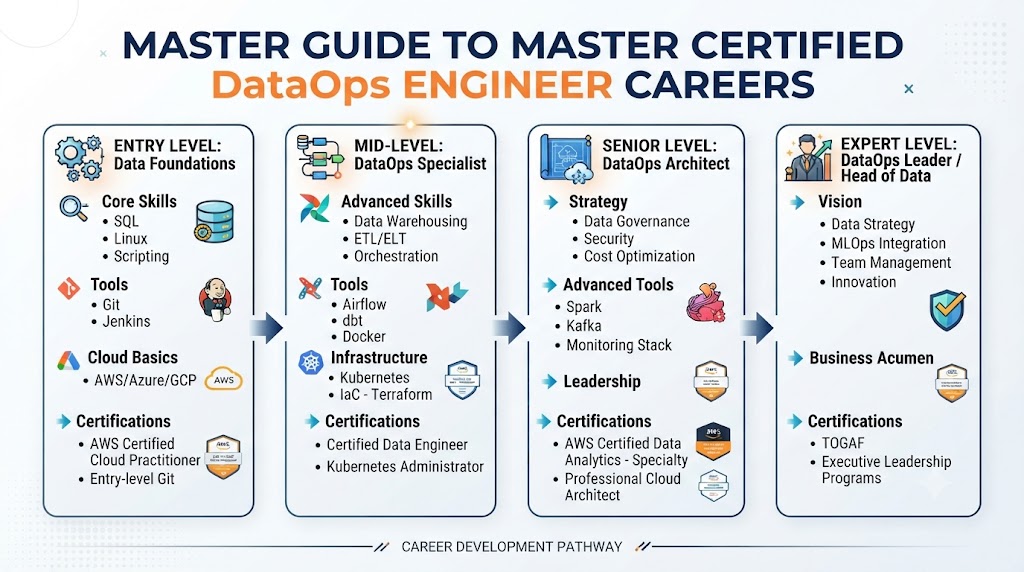
The certification framework features foundational, professional, and advanced levels designed to match varying career stages. Foundation tracks establish core competencies in data pipeline orchestration, version control, and basic monitoring. Professional tracks dive deep into CI/CD for data, automated testing, security compliance, and infrastructure as code. Advanced tracks focus on enterprise-wide architecture, multi-cloud data governance, and resilience engineering. Specialization pathways allow practitioners to tailor their expertise toward specific operational domains like cloud data warehousing and real-time streaming pipelines.
Complete Certified DataOps Engineer Certification Table
| Track | Level | Who it’s for | Prerequisites | Skills Covered | Recommended Order |
| Core DataOps | Foundation | Junior Engineers, Analysts | Basic Python, SQL | Pipeline Orchestration, Git Basics | 1 |
| Pipeline Automation | Professional | Data Engineers, DevOps | Linux, CI/CD Fundamentals | Automated Testing, Docker, Airflow | 2 |
| Enterprise Architecture | Advanced | Senior Engineers, Architects | 3+ Years Data Experience | Multi-cloud Governance, Observability | 3 |
Detailed Guide for Each Certified DataOps Engineer Certification
Certified DataOps Engineer – Foundation Track
What it is
This entry-level certification validates foundational knowledge of data pipeline concepts, basic orchestration, and version control practices.
Who should take it
Suitable for junior software engineers, data analysts, and IT professionals starting their journey into data operations and pipeline management.
Skills you’ll gain
- Understanding core data lifecycle management
- Basic pipeline scheduling and execution
- Version control workflows for data assets
- Introduction to monitoring and alerting
Real-world projects you should be able to do
- Build a simple scheduled ETL pipeline using open-source tools
- Implement basic git branching strategies for SQL scripts
- Set up basic log monitoring for daily data loads
Preparation plan
- 7-14 days: Review foundational documentation, understand basic data structures, and practice writing simple automation scripts.
- 30 days: Complete hands-on lab exercises, configure basic orchestration tools, and run test data pipelines locally.
- 60 days: Build a portfolio project integrating source control, scheduling, and basic monitoring, followed by practice exams.
Common mistakes
- Relying solely on theoretical study without building hands-on pipelines.
- Neglecting version control best practices for data schema changes.
- Ignoring basic error-handling and retry logic in scripts.
Best next certification after this
- Same-track option: Certified DataOps Engineer – Professional Track
- Cross-track option: Cloud DevOps Foundation Certification
- Leadership option: Agile Data Engineering Management
Certified DataOps Engineer – Professional Track
What it is
This mid-level certification validates advanced pipeline automation, continuous integration, continuous delivery, and robust data testing strategies.
Who should take it
Mid-level data engineers, DevOps practitioners, and platform engineers looking to specialize in scalable data infrastructure.
Skills you’ll gain
- Advanced CI/CD pipeline implementation for data
- Automated data quality testing and validation
- Containerization of data workloads with Docker and Kubernetes
- Infrastructure as Code for data environments
Real-world projects you should be able to do
- Deploy a fully automated CI/CD pipeline for data transformations
- Implement automated schema validation and data quality checks
- Orchestrate distributed data processing jobs using modern frameworks
Preparation plan
- 7-14 days: Deep dive into CI/CD concepts, containerization principles, and automated testing frameworks.
- 30 days: Set up containerized data processing environments and write automated test suites for data pipelines.
- 60 days: Simulate production failure scenarios, configure automated rollbacks, and complete rigorous mock assessments.
Common mistakes
- Failing to implement comprehensive automated testing before deployment.
- Overlooking security and credential management in CI/CD pipelines.
- Poor resource allocation leading to inflated cloud infrastructure costs.
Best next certification after this
- Same-track option: Certified DataOps Engineer – Advanced Track
- Cross-track option: Certified MLOps Platform Engineer
- Leadership option: Director of Data Platform Engineering
Choose Your Learning Path
DevOps Path
The DevOps path focuses on bridging the gap between software development and IT operations through automation, CI/CD pipelines, and infrastructure management. Practitioners learn to build resilient deployment workflows, manage containerized environments, and ensure system reliability. This path forms the bedrock for modern cloud-native architectures across global enterprises.
DevSecOps Path
The DevSecOps path integrates security practices directly into every phase of the software development and data lifecycle. Professionals learn vulnerability management, automated security scanning, and compliance as code. This ensures that data pipelines and infrastructure remain secure against emerging cyber threats without slowing down delivery velocity.
SRE Path
The Site Reliability Engineering path emphasizes software engineering applied to infrastructure and operations problems. Engineers learn to design scalable systems, manage incident response, and implement rigorous service level objectives. This path ensures high availability and performance across complex enterprise data ecosystems.
AIOps / MLOps Path
The AIOps and MLOps path addresses the unique operational challenges of deploying, monitoring, and maintaining machine learning models in production. Practitioners master model versioning, feature stores, and automated retraining pipelines. This ensures that artificial intelligence initiatives scale reliably from experimental phases to enterprise-grade production.
DataOps Path
The DataOps path applies agile and DevOps principles specifically to data engineering and analytics workflows. Professionals learn to automate data pipelines, ensure data quality, and accelerate time-to-insight. This path is essential for organizations striving to become truly data-driven and operationally efficient.
FinOps Path
The FinOps path focuses on financial accountability and cost optimization within cloud and data infrastructures. Practitioners learn to monitor resource utilization, allocate cloud spending accurately, and implement cost-saving architectures. This path empowers engineering teams to balance high performance with sound fiscal management.
Role → Recommended Certified DataOps Engineer Certifications
| Role | Recommended Certifications |
| DevOps Engineer | Certified DataOps Engineer – Professional Track |
| SRE | Certified DataOps Engineer – Enterprise Architecture |
| Platform Engineer | Certified DataOps Engineer – Professional Track |
| Cloud Engineer | Certified DataOps Engineer – Foundation Track |
| Security Engineer | Certified DataOps Engineer – Security Specialization |
| Data Engineer | Certified DataOps Engineer – Professional Track |
| FinOps Practitioner | Certified DataOps Engineer – FinOps Integration |
| Engineering Manager | Certified DataOps Engineer – Leadership Track |
Next Certifications to Take After Certified DataOps Engineer
Same Track Progression
Advancing within the same track involves moving from professional automation competencies to enterprise-level architectural mastery. Professionals learn multi-region pipeline orchestration, advanced governance frameworks, and strategic data platform design. This deeper specialization qualifies engineers for principal and advisory roles within large technology organizations.
Cross-Track Expansion
Expanding across tracks allows experienced engineers to diversify their skillset into adjacent domains like machine learning operations or cloud security. Combining data operations expertise with security or AI infrastructure creates versatile, high-impact professionals. This breadth is highly valued in modern cross-functional engineering organizations.
Leadership & Management Track
Transitioning to the leadership track involves shifting focus from hands-on configuration to organizational strategy, team scaling, and budget management. Leaders learn to align technical roadmaps with business goals and foster cultures of continuous improvement. This path prepares senior engineers for director and vice president of engineering roles.
Training & Certification Support Providers for Certified DataOps Engineer
DevOpsSchool is a premier global training provider offering comprehensive educational programs, hands-on labs, and expert mentorship for technology professionals. Their structured curriculum focuses on bridging theoretical knowledge with practical industry application, ensuring candidates are fully prepared for real-world engineering challenges and certification success.
Cotocus specializes in enterprise training and digital transformation consulting, empowering engineering teams with cutting-edge skills in modern cloud and operational frameworks. They deliver customized corporate training solutions designed to accelerate adoption and operational maturity across diverse technical stacks.
Scmgalaxy is a well-established community and training platform dedicated to software configuration management, DevOps, and continuous delivery education. Trusted by thousands of engineers, it provides rich resources, expert-led workshops, and practical guidance for career advancement.
BestDevOps offers focused, industry-aligned training programs aimed at helping engineers master modern cloud-native tools, automation practices, and operational excellence. Their courses emphasize hands-on project work and real-world troubleshooting scenarios.
devsecopsschool focuses on embedding security into the core of software development and operational pipelines, training professionals in proactive threat mitigation and compliance. Their specialized programs help teams build secure, resilient, and audit-ready cloud infrastructures.
sreschool provides targeted education in site reliability engineering, teaching engineers how to build scalable, fault-tolerant systems and manage incident response effectively. Their expert instructors bring decades of production experience into every training module.
aiopsschool delivers advanced training at the intersection of artificial intelligence and IT operations, helping engineers master automated monitoring, anomaly detection, and intelligent system management. The curriculum equips practitioners to handle complex data-driven operational environments with confidence.
dataopsschool is the definitive authority for data operations training, offering specialized courses that streamline data pipeline delivery, quality assurance, and automation. Their programs are designed by industry veterans to meet the rigorous demands of modern data-driven enterprises.
finopsschool specializes in cloud financial management education, training professionals to optimize cloud spending without compromising performance or delivery speed. Their courses provide actionable strategies for aligning engineering efficiency with financial governance.
Frequently Asked Questions (General)
1. What is the difficulty level of the certification exam?
The exam is designed to test practical, real-world troubleshooting and architectural skills, making it moderately to highly challenging for unprepared candidates.
2. How much preparation time is typically required?
Most working professionals require between four to eight weeks of dedicated study and hands-on lab practice to feel fully prepared.
3. Are there any mandatory prerequisites before enrolling?
While formal prerequisites vary by track, a working knowledge of Linux, basic programming, and cloud concepts is strongly recommended.
4. What is the return on investment for this certification?
Certified professionals frequently report accelerated career progression, increased earning potential, and enhanced credibility among engineering peers.
5. How are the certification exams structured?
Exams typically combine multiple-choice theoretical questions with hands-on scenario-based lab tasks evaluated against strict criteria.
6. Can I take the certification exams online?
Yes, all assessments are available through secure online proctoring platforms, allowing candidates to test from anywhere in the world.
7. How often are the certification exams updated?
Exams are reviewed and updated annually to reflect the latest industry tools, security standards, and architectural best practices.
8. What resources are provided for exam preparation?
Candidates receive access to official study guides, documentation, practice tests, and hands-on laboratory environments.
9. How do I maintain my certification status once earned?
Certifications typically require periodic renewal through continuing education credits or passing updated recertification assessments.
10. Is coding experience necessary to succeed in these tracks?
Basic proficiency in scripting languages like Python or SQL is necessary to build and test automated data pipelines successfully.
11. How does this certification help engineering managers?
It provides leaders with a standardized benchmark to evaluate team capabilities, streamline hiring, and implement operational best practices.
12. What support is available if I fail an exam attempt?
Candidates receive detailed performance feedback and can schedule a retake after a brief cooling-off and further study period.
FAQs on Certified DataOps Engineer
1. What core tools are covered in the curriculum?
The program covers leading orchestration, containerization, and data quality tools used across modern enterprise cloud architectures.
2. How does DataOps differ from traditional data engineering?
DataOps incorporates continuous integration, automated testing, and agile delivery principles directly into data pipeline development.
3. Are hands-on labs included in the learning platform?
Yes, extensive real-world lab environments are integrated into the curriculum to ensure practical skill acquisition.
4. How does the certification handle multi-cloud environments?
The training addresses architectural patterns and operational strategies applicable across major cloud service providers.
5. What role does data quality play in the certification?
Automated data testing and validation form a core pillar of the curriculum, ensuring high reliability in production.
6. Can teams undergo corporate training together?
Yes, specialized enterprise group training programs are available to upskill entire engineering departments simultaneously.
7. How are real-world failure scenarios taught?
The curriculum includes simulated pipeline breakage, data drift, and infrastructure scaling challenges for hands-on resolution.
8. Who validates the certification standards?
Industry principal engineers and veteran platform architects continuously review and update the certification evaluation criteria.
Final Thoughts: Is Certified DataOps Engineer Worth It?
Investing time and effort into mastering data operations is one of the most reliable ways to future-proof your engineering career. As enterprises generate ever-increasing volumes of data, the ability to build reliable, automated, and secure pipelines is indispensable. This certification cuts through marketing hype, focusing purely on practical, production-grade skills that deliver immediate value on the job. If you are committed to professional growth and operational excellence, embarking on this learning journey will pay substantial dividends throughout your career.