
Introduction
In today’s digital world, software is at the heart of almost every business. However, building software quickly often leads to security being pushed to the very end of the development cycle. When security is handled too late, companies face costly delays, unexpected vulnerabilities, and severe operational risks. DevSecOps solves this challenge by connecting development, security, and operations into a single, seamless workflow. Organizations often need professional DevSecOps expertise to navigate this transition smoothly without slowing down their release cycles. Through consulting, implementation, assessment, training, and managed services, businesses can protect their applications from day one. Platforms like DevSecOpsNow.com help organizations bridge these security gaps with practical solutions tailored to modern software delivery teams.
Understanding DevSecOps Services
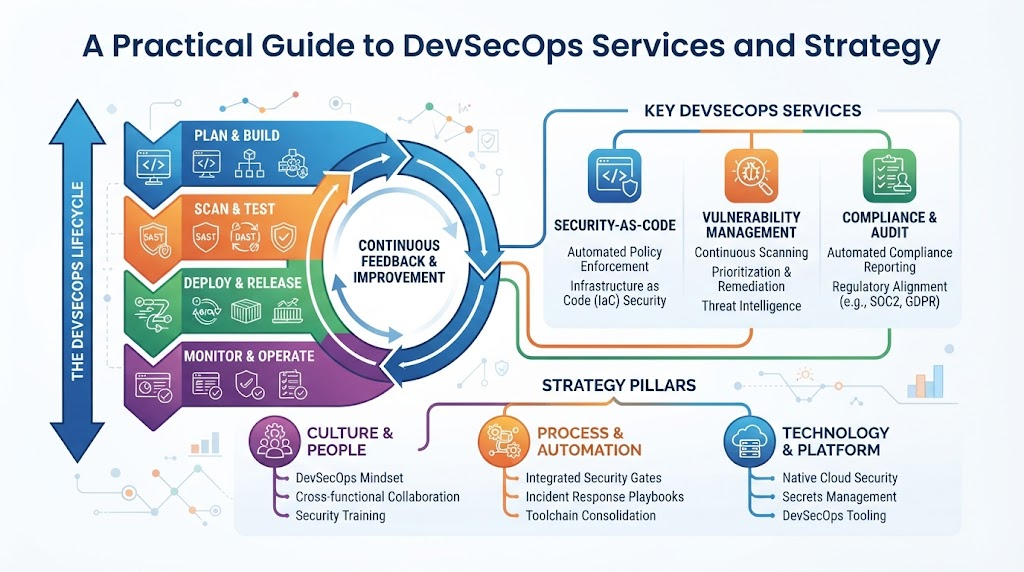
DevSecOps means bringing security into every part of the software development and delivery process. Traditional security usually involved a dedicated team checking code right before it launched, which often caused delays and friction. DevSecOps changes this approach by making security a shared responsibility across developers, operations, and security teams.
Automation plays a major role in this model. Instead of manual checks, automated security tools scan code, configuration files, and cloud environments continuously as new features are built. This ensures that security issues are caught and fixed early, saving time and reducing risk.
DevSecOps Consulting Services for Better Security Strategy
Building a secure software delivery pipeline requires a clear plan. DevSecOps Consulting Services help organizations design and improve their security strategy from the ground up. Consultants analyze the current security environment and help define a practical roadmap that fits the business goals.
Key areas covered during consulting include security architecture, CI/CD pipeline security planning, and tool selection. Experts also help design security policies, governance frameworks, and compliance considerations. This guidance ensures that the organization builds a long-term security improvement plan that scales with business growth.
DevSecOps Assessment Services for Identifying Security Gaps
Before making major changes, organizations need to know where they stand. DevSecOps Assessment Services help businesses evaluate their current development processes, tools, and security controls. This evaluation looks closely at CI/CD pipelines, cloud infrastructure, and container environments.
Assessments also review vulnerability management practices, access controls, and security automation. By identifying existing gaps and prioritizing improvements, businesses can focus their resources on the areas that need the most attention. This clear improvement roadmap prevents wasted effort and targets critical security weaknesses first.
DevSecOps Implementation Services for Secure Software Delivery
Once a strategy and assessment are in place, businesses need to put their plans into action. DevSecOps Implementation Services help organizations integrate security controls directly into their existing software delivery workflows step by step.
Implementation covers setting up automated security testing, securing cloud infrastructure, and protecting container environments. It also involves configuring monitoring tools and establishing security policies within pipelines. The goal is to make security a natural part of daily development operations without disrupting engineering productivity.
DevSecOps Managed Services for Continuous Security
Implementing DevSecOps is only the first step. Maintaining security over time requires continuous effort and monitoring. DevSecOps Managed Services provide ongoing support for organizations that want external experts to handle day-to-day security operations.
Managed services include continuous security monitoring, vulnerability management, and pipeline oversight. Providers also assist with cloud security support, container monitoring, and regular security reporting. This ongoing support significantly reduces the workload on internal teams, allowing them to focus on building great products.
DevSecOps Training for Security-Aware Teams
Tools and automation alone cannot create a successful security culture. DevSecOps Training ensures that team members understand how to write secure code and spot potential risks early. Training programs cover secure coding awareness, CI/CD security, and basic security testing.
Teams also learn about cloud and container security, vulnerability management, and security automation. When developers understand their security responsibilities, they become the first line of defense rather than an afterthought in the security process.
Corporate DevSecOps Training for Enterprise Teams
Larger organizations need a coordinated approach to skill development across multiple departments. Corporate DevSecOps Training helps train entire engineering, DevOps, and security teams together.
This training covers secure development practices, security automation, and cloud-native security for enterprise environments. Through practical, hands-on learning, organizations can build a strong, organization-wide security culture. Engineering managers and technical decision-makers also gain valuable awareness to guide future projects securely.
Cloud Security Consulting Services for Modern Infrastructure
Modern applications rely heavily on cloud environments, making cloud security a critical part of any DevSecOps strategy. Cloud Security Consulting Services help businesses secure their cloud infrastructure against accidental misconfigurations and unauthorized access.
Consulting covers identity and access management, secrets management, network security, and data protection. Experts also review Infrastructure-as-Code templates and set up continuous cloud monitoring. These practices help businesses identify and reduce risks before attackers can exploit them.
Kubernetes Security Consulting Services for Containerized Applications
Containerized applications and Kubernetes clusters require specialized security measures. Kubernetes Security Consulting Services help teams protect their container platforms throughout the entire application lifecycle.
Services cover Kubernetes cluster security, role-based access control, container image scanning, and network policies. Experts also help configure admission controls, runtime security monitoring, and proper logging. This continuous attention ensures that containerized workloads remain safe from runtime threats and misconfigurations.
Software Supply Chain Security Services
Modern software relies heavily on open-source packages, third-party libraries, and external build tools. Software Supply Chain Security Services help organizations gain visibility and control over all components used in their applications.
These services focus on identifying vulnerable or malicious dependencies, securing container images, and protecting build systems. Teams use Software Bill of Materials (SBOMs) and automated dependency management to verify software integrity and prevent supply chain attacks before code reaches production.
Penetration Testing Services for Stronger Application Security
Automated security tools are essential, but they cannot find every complex vulnerability. Penetration Testing Services provide a human-led evaluation of applications, APIs, and infrastructure to uncover deep-seated security flaws.
Ethical hackers simulate real-world attacks against web applications, cloud environments, and internal networks. This process helps validate existing security controls, prioritize risks based on real exploitability, and guide remediation efforts. Automated DevSecOps tools and penetration testing work together to provide comprehensive security validation.
How DevSecOps Services Work Together
A successful security strategy combines multiple services into a smooth, continuous workflow. Each stage builds upon the previous one to create a strong security posture.
- Assessment: Identifies current security gaps and establishes a baseline.
- Consulting: Defines the long-term security strategy and architecture.
- Implementation: Integrates automated security controls into workflows.
- Training: Equips internal teams with essential security skills.
- Continuous Management: Maintains ongoing security oversight and monitoring.
- Testing: Validates defenses through penetration testing and advanced checks.
- Improvement: Refines practices continuously based on new threats and business needs.
DevSecOps Service Comparison Table
| Service | Main Focus | Business Benefit |
| DevSecOps Consulting Services | Security strategy and planning | Better security decisions |
| DevSecOps Assessment Services | Finding security and process gaps | Clear improvement roadmap |
| DevSecOps Implementation Services | Integrating security into delivery | More secure software releases |
| DevSecOps Managed Services | Ongoing security support | Reduced operational workload |
| DevSecOps Training | Building team skills | Stronger security awareness |
| Cloud Security Consulting Services | Securing cloud environments | Reduced cloud security risks |
| Kubernetes Security Consulting Services | Securing container platforms | Safer cloud-native applications |
| Software Supply Chain Security Services | Protecting software components | Reduced supply chain risk |
| Penetration Testing Services | Finding exploitable weaknesses | Stronger security validation |
Common DevSecOps Challenges Businesses Face
Organizations often encounter several obstacles when trying to secure their software delivery pipelines. Security is frequently added too late, creating friction between development and security teams. Many companies adopt too many security tools, which generates a large number of false alerts and overwhelms engineers.
Other common challenges include a lack of internal security skills, poor CI/CD integration, and cloud misconfigurations. Container vulnerabilities and hidden dependency risks also threaten modern applications. A structured DevSecOps approach helps address these problems by automating checks, clarifying responsibilities, and introducing continuous monitoring.
Benefits of Professional DevSecOps Services
Working with experienced professionals brings numerous advantages to software delivery teams and business leaders alike.
- Earlier detection of security problems before code reaches production.
- Faster vulnerability remediation through automated workflows.
- More secure software releases that protect customer data.
- Better cloud and container security across all environments.
- Reduced software supply chain risks through dependency tracking.
- Improved security awareness among developers and operations staff.
- Improved compliance with industry security standards.
- Reduced manual security work through intelligent automation.
- Better collaboration between development, operations, and security teams.
How DevSecOpsNow.com Helps Organizations
Navigating the complexities of modern software security requires practical guidance and reliable expertise. DevSecOpsNow.com provides specialized support designed to help organizations build secure, efficient software delivery pipelines.
The platform offers comprehensive DevSecOps consulting, implementation assistance, and ongoing managed support. Businesses can also utilize assessment services to evaluate their current security posture and identify critical gaps.
For team development, DevSecOpsNow.com offers targeted training and corporate training programs. Furthermore, the platform covers essential technical areas including cloud security, Kubernetes protection, software supply chain security, and penetration testing. These services help organizations establish a resilient security strategy tailored to their specific business needs.
How to Choose the Right DevSecOps Service Provider
Selecting the right partner is a critical decision for any organization looking to improve its security posture. Decision-makers should evaluate providers based on practical factors rather than marketing claims.
- Look for proven technical expertise in modern CI/CD pipelines.
- Ensure the provider has real-world experience across cloud and container environments.
- Verify their capabilities in Kubernetes security and software supply chain protection.
- Check their approach to security assessments and implementation methodologies.
- Assess their ability to offer ongoing managed support and training.
- Confirm clear communication and an understanding of specific business requirements.
DevSecOps Service Comparison: Consulting vs Implementation vs Managed Services
| Service Type | Best For | Main Purpose |
| Consulting | Organizations planning DevSecOps | Strategy and guidance |
| Assessment | Organizations identifying security gaps | Finding weaknesses |
| Implementation | Organizations adopting DevSecOps | Building security into workflows |
| Managed Services | Organizations needing ongoing support | Continuous security management |
| Training | Teams building security skills | Knowledge and awareness |
Future of DevSecOps
The world of software security continues to evolve rapidly. Future developments in DevSecOps will likely focus heavily on AI-assisted security analysis and automated remediation. As cloud-native technologies expand, Kubernetes security and software supply chain protection will remain top priorities.
Organizations will increasingly adopt Software Bill of Materials (SBOMs), policy-as-code frameworks, and continuous compliance checks. Furthermore, integrating security closely with platform engineering will help developers build secure applications faster and with less friction.
Frequently Asked Questions
- What are DevSecOps Consulting Services?Answer: These services help organizations plan and design their security strategy, choose the right tools, and build a roadmap for secure software delivery.
- Why are DevSecOps Assessment Services important?Answer: They evaluate current development processes and infrastructure to find security gaps, helping businesses prioritize fixes effectively.
- How do DevSecOps Implementation Services help businesses?Answer: They help integrate automated security testing and controls directly into existing development and deployment pipelines.
- What are DevSecOps Managed Services?Answer: They provide ongoing, external support for continuous security monitoring, vulnerability management, and pipeline oversight.
- Why is DevSecOps Training important for technical teams?Answer: It teaches developers secure coding practices and helps teams spot and fix vulnerabilities early in the development cycle.
- What is the value of Corporate DevSecOps Training?Answer: It aligns entire engineering, operations, and security departments around common security practices and fosters a strong security culture.
- Why do businesses need Cloud Security Consulting Services?Answer: They help prevent cloud misconfigurations, secure identity management, and protect infrastructure-as-code templates against risks.
- Why are Kubernetes Security Consulting Services important?Answer: They ensure that container clusters, access controls, and runtime workloads are properly secured throughout the application lifecycle.
- What are Software Supply Chain Security Services?Answer: They provide visibility into open-source dependencies and build artifacts to prevent malicious packages from entering production systems.
- How do Penetration Testing Services support DevSecOps?Answer: They use ethical hacking techniques to uncover deep vulnerabilities that automated tools might miss, validating overall security controls.
Final Thoughts
Integrating security into software development is no longer optional for modern organizations. Waiting until the end of the development cycle leads to unnecessary risks, delays, and higher costs. By embedding security into every stage of development and operations, businesses can release reliable software with confidence. Leveraging professional consulting, assessment, implementation, training, and managed services simplifies this transition significantly. With dedicated support from platforms like DevSecOpsNow.com, organizations can strengthen their cloud, Kubernetes, and software supply chain security effectively. Building a strong security culture protects applications, customers, and long-term business value.