
Introduction
In the modern landscape of distributed systems, the Certified Site Reliability Manager credential stands as a primary benchmark for professionals aiming to bridge the gap between software development and stable infrastructure operations. This guide is built for engineers, system administrators, and technical leaders who are looking to formalize their expertise in maintaining high-availability services in a volatile digital world. Whether you are navigating the complexities of cloud-native environments or working within established sreschool frameworks, understanding how to manage reliability is a critical skill for career longevity. We aim to provide a clear, honest roadmap for those seeking to integrate aiopsschool methodologies or broader SRE practices to improve their operational decision-making and overall technical value.
What is the Certified Site Reliability Manager?
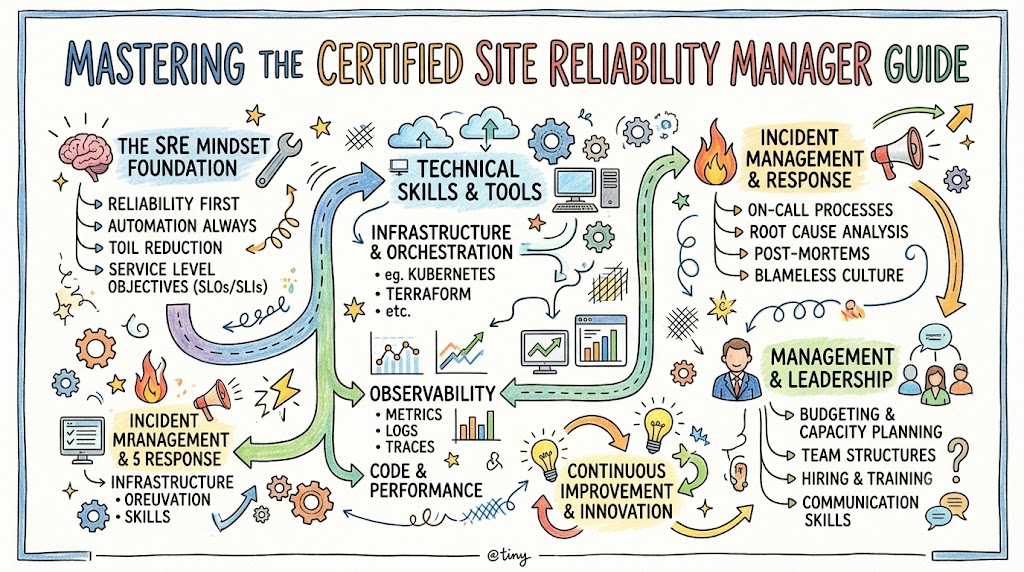
The Certified Site Reliability Manager represents a structured, mature approach to managing service reliability, incident response, and capacity planning. It exists to help engineering teams move away from reactive firefighting and toward proactive, data-driven system management. This certification emphasizes real-world application, teaching professionals how to define Service Level Objectives, manage error budgets, and cultivate a blameless culture within technical organizations. By aligning with enterprise-grade workflows, it ensures that reliability is treated as a core feature of software delivery rather than an afterthought, allowing teams to scale effectively without sacrificing system health.
Who Should Pursue Certified Site Reliability Manager?
This path is ideally suited for software engineers who are transitioning into reliability roles and systems administrators looking to modernize their skillset for the cloud era. It is equally valuable for platform engineers responsible for infrastructure stability and engineering managers who need to translate technical reliability metrics into business value. Professionals in India and across global markets find this certification essential as organizations move toward complex, microservices-based architectures. It caters to those who need to balance the rapid pace of feature development with the uncompromising requirement for system uptime and performance, ensuring that everyone from the developer to the operations lead speaks the same language.
Why Certified Site Reliability Manager
The demand for reliability expertise continues to grow as systems become more distributed and interconnected. Earning this certification allows professionals to remain relevant by focusing on universal principles of resilience that transcend specific toolsets or shifting industry trends. It offers a tangible return on investment by validating skills that are directly applicable to reducing downtime and operational costs in a production environment. For an engineer, it serves as proof of the ability to handle the complexities of modern, high-traffic systems, ensuring long-term career stability and growth that is independent of any single software product.
Certified Site Reliability Manager Certification Overview
The program is delivered via the official and is hosted on sreschool. It covers essential reliability management pillars through a mix of theoretical knowledge and practical assessment of system behavior. The certification structure is designed to reflect the actual responsibilities of a manager in a high-stakes engineering environment where downtime is not an option. Assessments are heavily focused on real-world problem-solving, ensuring that those who earn the credential can apply management strategies to complex infrastructure challenges effectively and calmly.
Certified Site Reliability Manager Certification Tracks & Levels
The certification is organized into distinct levels that accommodate different stages of professional development, from foundational understanding to advanced leadership. Specialization tracks are available to ensure that professionals can focus on the specific domains that match their day-to-day responsibilities in the field. These tracks help engineers and managers align their training with their specific career goals, whether that involves deep technical oversight or broader organizational strategy and culture building. Progression through these levels is intended to mirror the natural growth of a reliability-focused career, moving from task execution to strategic influence.
Complete Certified Site Reliability Manager Certification Table
| Track | Level | Who it’s for | Prerequisites | Skills Covered | Recommended Order |
| Core Reliability | Foundation | Junior Engineers | Basic Linux/Cloud knowledge | SLIs, SLOs, Error Budgets | 1 |
| Operational Management | Professional | SREs/SysAdmins | Foundation Certification | Incident Management, Monitoring | 2 |
| Strategic Leadership | Advanced | Engineering Managers | Professional Certification | Culture, Strategy, Budgeting | 3 |
Detailed Guide for Each Certified Site Reliability Manager Certification
Certified Site Reliability Manager – Foundation
What it is
This certification validates a foundational understanding of the core principles of reliability engineering, including basic metrics and service level management practices.
Who should take it
Entry-level engineers or system administrators who are beginning their journey into reliability and platform operations and want a solid knowledge base.
Skills you’ll gain
- Understanding the fundamental difference between SLIs and SLOs.
- Basics of incident documentation and conducting post-mortem analysis.
- Introduction to error budget management and why it matters.
Real-world projects you should be able to do
- Defining simple service level indicators for a production web application.
- Creating a basic incident report template for an engineering team.
- Calculating error budgets based on provided service uptime data.
Preparation plan
- 7-14 days: Review core concepts of site reliability and basic metrics definitions.
- 30 days: Practice mapping real-world service metrics to defined SLOs.
- 60 days: Review case studies and prepare for assessment scenarios by solving problems.
Common mistakes
- Focusing too much on specific tooling rather than the underlying reliability principles.
- Misunderstanding the mathematical relationship between error budgets and release velocity.
Best next certification after this
- Same-track option: Certified Site Reliability Manager Professional
- Cross-track option: DevOps Foundation
- Leadership option: Team Lead Essentials
Choose Your Learning Path
DevOps Path
This path focuses on the integration of reliability into the development lifecycle. Engineers learn how to automate testing and deployment pipelines to ensure that reliability is maintained during rapid releases. It is essential for those looking to bridge the gap between development and operations.
DevSecOps Path
This path incorporates security into the reliability management process. Professionals learn how to manage risks effectively without compromising the speed or stability of the production environment. It is ideal for engineers responsible for secure and reliable software delivery.
SRE Path
This is the primary path for those dedicated to site reliability. It emphasizes high-level system design, complex incident management, and long-term infrastructure health. It is the core focus for those aiming for specialized reliability roles.
AIOps / MLOps Path
This path focuses on using intelligent automation to manage system reliability. It teaches engineers how to apply machine learning and data analysis to predict and prevent system failures. It is perfect for those working with large-scale data systems.
MLOps Path
This specific focus area explores the reliability requirements of machine learning pipelines. It addresses the unique challenges of training, deploying, and monitoring models in production environments. Professionals gain skills in ensuring model consistency and performance.
DataOps Path
This path deals with the reliability of data pipelines and storage systems. It focuses on ensuring data quality, availability, and consistency across distributed databases. It is suited for data engineers tasked with maintaining reliable data infrastructure.
FinOps Path
This path teaches how to manage cloud costs while maintaining reliability. Professionals learn to balance budget constraints with performance requirements, ensuring that infrastructure remains cost-effective as it scales.
Role → Recommended Certified Site Reliability Manager Certifications
| Role | Recommended Certifications |
| DevOps Engineer | Certified Site Reliability Manager Foundation |
| SRE | Certified Site Reliability Manager Professional |
| Platform Engineer | Certified Site Reliability Manager Professional |
| Cloud Engineer | Certified Site Reliability Manager Foundation |
| Security Engineer | Certified Site Reliability Manager Professional |
| Data Engineer | Certified Site Reliability Manager Foundation |
| FinOps Practitioner | Certified Site Reliability Manager Foundation |
| Engineering Manager | Certified Site Reliability Manager Advanced |
Next Certifications to Take After Certified Site Reliability Manager
Same Track Progression
Once the core certification is complete, professionals should focus on advanced reliability workshops and master-level certifications. This allows for deeper specialization in complex system design, disaster recovery planning, and large-scale incident command, which are vital for senior roles.
Cross-Track Expansion
Broadening skills by moving into DevOps or DataOps certifications can provide a more holistic view of the engineering ecosystem. This is highly recommended for engineers who want to influence reliability across different areas of the business and become more versatile.
Leadership & Management Track
For those aiming for management, transition to leadership certifications focusing on team management, strategy, and organizational culture. This helps in moving from individual contributor reliability roles to strategic management positions where you oversee entire departments.
Training & Certification Support Providers for Certified Site Reliability Manager
DevOpsSchool is a key provider offering deep technical insights and practical training modules tailored for modern engineering teams looking to master site reliability.
Cotocus specializes in hands-on learning experiences, providing guided labs and real-world simulations that help professionals prepare for certification exams effectively.
Scmgalaxy focuses on the intersection of source control management and reliability, providing robust educational resources for infrastructure-focused engineers.
BestDevOps offers curated learning paths and structured mentorship programs for those aiming to advance their careers in reliability and platform engineering.
devsecopsschool provides specialized training that integrates security practices with reliability engineering, essential for secure software production environments.
sreschool is the primary authority for this certification, providing the core curriculum and official assessment framework for all reliability management programs.
aiopsschool focuses on the application of artificial intelligence in operational environments, helping engineers learn how to automate reliability tasks.
dataopsschool offers expertise in the reliability of data pipelines and large-scale data storage solutions for modern enterprise needs.
finopsschool provides training on the financial aspects of infrastructure management, ensuring reliability goals are met within budget constraints.
Frequently Asked Questions (General)
- What is the difficulty level of this certification?
The difficulty is balanced to test both conceptual understanding and the practical application of reliability engineering in real work. - How much time is required to prepare?
Most professionals dedicate between 30 to 60 days of consistent study to feel fully prepared for the final assessment. - Are there any specific prerequisites?
A background in systems administration or software development is highly recommended to grasp the core concepts effectively. - What is the ROI of this certification?
The ROI is realized through improved operational efficiency, reduced incident frequency, and increased professional marketability in the industry. - Can this certification be taken by beginners?
Yes, the foundational level is specifically designed to accommodate those just starting their reliability journey. - How does this certification differ from others?
It prioritizes real-world, production-focused management skills over purely theoretical or academic knowledge. - Is it suitable for non-technical managers?
While technical in nature, it provides valuable insights for managers to understand the operational trade-offs their teams face daily. - How often should I update my knowledge?
Given the pace of technology, reviewing new methodologies and practices every few months is highly advisable to stay ahead. - Does this certification help with career advancement?
Yes, it validates high-level expertise that is sought after for senior engineering and management roles in global firms. - Is the assessment fully theoretical?
No, it includes scenario-based questions that require applying reliability principles to practical, common work situations. - Can I choose my own learning path?
Absolutely, the certification is flexible, allowing you to tailor your focus based on your current role and long-term goals. - Are there practice tests available?
Yes, most authorized training providers offer practice assessments to help candidates evaluate their readiness before the final exam.
FAQs on Certified Site Reliability Manager
- What specifically does the certification cover?
It covers SLOs, SLIs, error budgets, incident management, and the culture of reliability in production environments. - How does this help in a DevOps role?
It provides the necessary framework to maintain service stability alongside rapid deployment cycles inherent in DevOps. - Does it include training on monitoring tools?
It focuses on the strategy of monitoring and alerting rather than the specific tool implementation, which can change. - Is it applicable to global companies?
Yes, the principles taught are universal and widely adopted by top-tier global technology firms today. - How does this change my daily workflow?
It encourages a more data-driven approach to resolving incidents and prioritizing infrastructure improvements. - Can I take this exam online?
Yes, the certification is designed to be accessible globally through secure online assessment platforms. - Is there a lab requirement for the exam?
The exam focuses on application-based scenarios rather than a live, hands-on lab environment. - Does it emphasize culture?
Yes, fostering a blameless culture is a core component of the management side of the certification process.
Final Thoughts: Is Certified Site Reliability Manager Worth It?
Ultimately, this certification is a strategic investment in your professional future. It does not just provide a certificate; it provides a framework for thinking that helps you solve complex, frustrating problems in production. For any engineer or manager dealing with high-availability services, the knowledge gained is practical, applicable, and highly valued in the current market. If you are serious about advancing your career in reliability or platform engineering, the time spent mastering these principles will yield significant benefits in your daily work and long-term career growth. Focus on understanding the “why” and “how” behind the practices, and the value will become clear in every project you manage from that point forward.
Excellent guide! The article explains the Certified Site Reliability Manager certification clearly and highlights the key skills needed to improve system reliability and performance.