
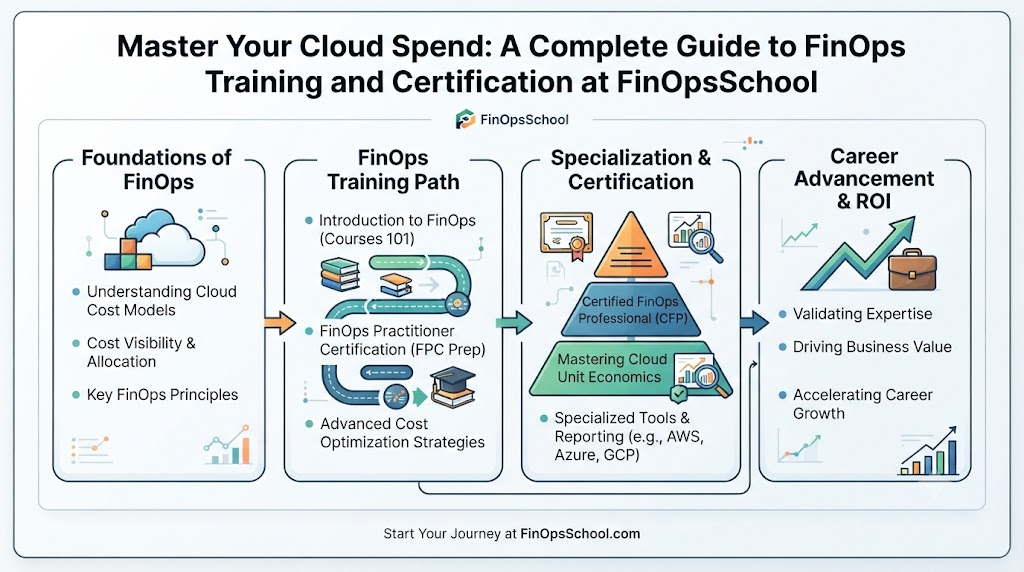
Introduction
Cloud computing has changed how companies build and run software applications. While the cloud offers great speed and flexibility, it often brings a big challenge: surprise cloud bills. Many organizations struggle to track where their money goes in the cloud. This is where FinOps comes in as a vital practice to bring financial accountability to cloud spending. FinOpsSchool.com provides dedicated learning pathways for individuals and teams wanting to master these financial and technical skills.
What is FinOps?
FinOps is short for cloud financial operations. It is a cultural practice and operational framework that brings finance, technology, and business teams together. Instead of treating cloud costs as an afterthought, FinOps helps organizations manage their cloud investments wisely.
Cloud environments are dynamic, meaning resources spin up and down constantly. Traditional budgeting methods do not work well for this fast-paced model. FinOps bridges the gap between engineering teams who build systems and finance teams who manage budgets. By giving everyone clear visibility into usage data, FinOps helps companies make smart spending decisions without slowing down innovation.
Why FinOps Skills Are Important
Organizations are moving more workloads to the cloud every single day. Along with this growth comes the urgent need for cloud cost visibility. Many companies face serious challenges with cost control because engineers focus heavily on performance while finance teams focus strictly on budgets. Without proper communication, cloud bills can grow out of control.
Learning FinOps helps teams improve resource utilization and establish clear cost accountability. Professionals who understand cloud economics become valuable assets to their employers. They help bridge the communication gap between technical units and financial departments, making cloud usage both efficient and sustainable.
FinOps Training for Practical Skill Development
Building real-world competency requires more than reading theory. Quality FinOps Training teaches learners the fundamental principles of cloud financial management from the ground up. Students learn how to track cloud expenses, allocate shared costs to specific departments, and build accurate spending forecasts.
Practical programs also cover cloud usage optimization and cost governance. Learners discover how to build a collaborative culture where everyone takes responsibility for the cloud resources they consume. This hands-on approach ensures that graduates can return to their workplaces and immediately apply what they have learned.
FinOps Certification for Professional Growth
Earning a FinOps Certification is a great way to validate your knowledge and understanding of cloud financial management principles. Certification demonstrates to current and prospective employers that you have mastered essential cost management concepts.
Structured learning paths provide professional credibility and help participants organize their studies effectively. While certification does not guarantee a job or promotion, it helps professionals stand out in a competitive job market by proving their dedication to continuous learning and specialized skill development.
FinOps Course for Structured Learning
A well-designed FinOps Course takes students through a step-by-step journey covering all major aspects of cloud economics. Learners explore cost visibility, allocation, forecasting, and optimization in an organized format.
Good courses also teach governance, reporting, and methods for fostering collaboration between engineering and finance groups. By following a structured curriculum, students avoid feeling overwhelmed by complex billing data and build their confidence gradually.
FinOps Certification Training with Practical Learning
Preparing for an exam should always involve real-world scenarios. Comprehensive FinOps Certification Training combines expert instructor guidance with practical exercises and hands-on case studies.
Students review real cloud cost challenges and learn how to solve them using standard industry practices. This methodology helps learners grasp difficult FinOps processes and prepares them to handle actual financial accountability tasks inside modern tech companies.
Corporate FinOps Training for Organizations
Companies often struggle because their engineering and finance teams speak entirely different languages. Corporate FinOps Training solves this problem by offering customized team learning experiences designed to build organization-wide cloud cost awareness.
When entire technology and finance departments learn together, they establish a shared understanding of cost governance. This team-level accountability helps organizations improve their spending visibility and adopt sustainable FinOps habits across all projects.
FinOps Online Training for Flexible Learning
Modern professionals often need to balance work commitments with continuing education. FinOps Online Training provides the flexibility to learn remotely through structured online sessions and digital resources.
Remote learning allows students from various locations to interact with instructors, complete practical assignments, and access recorded lessons at their own pace. This format makes professional development accessible to a much broader global audience.
FinOps Training in India for Professionals
With rapid digital transformation across the region, cloud adoption in India has grown tremendously. As a result, technology professionals across the country are actively seeking ways to manage cloud expenses more effectively.
FinOps Training in India provides local tech talent with structured online and instructor-led learning options. This helps engineers, managers, and financial analysts build relevant skills to support the growing demand for efficient cloud management practices.
FinOps Practitioner Training
A FinOps Practitioner plays a central role in driving organizational cost culture. FinOps Practitioner Training focuses on teaching the core principles of cost visibility, allocation, and cross-functional collaboration.
Practitioners learn how to build accurate cost reports, create forecasts, and guide teams through the full FinOps lifecycle. The curriculum emphasizes effective communication between engineering groups, finance departments, and business leaders.
FinOps Engineer Training
Engineers who build and maintain cloud infrastructure need specialized technical cost skills. FinOps Engineer Training helps technical staff integrate cost awareness directly into their architecture designs.
Learners discover how to use automation, monitor Kubernetes cluster spending, analyze cloud usage patterns, and optimize resources without hurting system performance. This training empowers engineers to build cost-efficient infrastructure from day one.
Cloud Cost Optimization Training
Many people mistakenly believe that optimizing cloud costs simply means cutting budgets ruthlessly. Real Cloud Cost Optimization Training teaches a balanced approach that weighs expenses against system performance, reliability, and business value.
Learners discover how to identify unnecessary spending, rightsize over-provisioned resources, and set up continuous monitoring. The goal is to maximize the value of every dollar spent in the cloud rather than just reducing the bottom line.
Important FinOps Skills and Concepts
Successful cloud financial management relies on a specific set of core competencies and practices:
- Cloud Cost Visibility: Understanding exactly where and how cloud money is being spent across different projects.
- Cost Allocation: Assigning shared cloud expenses accurately to the correct business units or products.
- Budgeting and Forecasting: Setting realistic spending limits and predicting future cloud bills based on usage trends.
- Resource Rightsizing: Matching cloud hardware size to actual workload demands to eliminate waste.
- Cost Anomaly Detection: Spotting unexpected spending spikes quickly before they turn into expensive surprises.
- Tagging and Labeling: Organizing cloud assets properly to make reporting and tracking much easier.
- Unit Economics: Connecting cloud expenses directly to business metrics, such as cost per customer or transaction.
- Collaboration: Building strong working relationships between technical builders and financial planners.
FinOps Tools and Technologies
To manage cloud finances effectively, teams rely on various software categories and utility platforms. While tools alone do not solve cost problems, they provide the necessary data for smart decision-making:
- Native Cloud Billing Tools: Services like AWS Cost Explorer, AWS Budgets, Microsoft Cost Management, and Google Cloud Cost Management help track baseline spending.
- Kubernetes Cost Monitoring Tools: Specialized utilities that break down container and cluster expenses across shared environments.
- Cost Reporting Platforms: Dashboards that aggregate financial data across multiple cloud providers into single views.
- Automation and Anomaly Tools: Programs that alert teams to sudden cost jumps or automate basic cleanup tasks.
FinOps Learning Path Comparison Table
| Learning Option | Main Focus | Main Benefit |
| FinOps Training | FinOps knowledge and practical skills | Build a strong foundation |
| FinOps Certification | Knowledge validation | Demonstrate FinOps understanding |
| FinOps Course | Structured learning | Learn concepts in an organized way |
| Corporate FinOps Training | Team and organizational skills | Improve cloud cost awareness |
| FinOps Online Training | Flexible learning | Learn remotely |
| FinOps Practitioner Training | FinOps principles and collaboration | Build practitioner-level knowledge |
| FinOps Engineer Training | Engineering and cloud cost skills | Improve cost-aware infrastructure practices |
| Cloud Cost Optimization Training | Cloud spending and resource efficiency | Improve cloud cost management |
FinOps Career Opportunities
Mastering cloud financial management opens up exciting career paths for professionals from both technical and financial backgrounds. Common job titles in this field include:
- FinOps Practitioner: Focuses on processes, cost visibility, and team collaboration.
- FinOps Engineer: Focuses on technical optimization, automation, and infrastructure efficiency.
- Cloud Cost Analyst: Specializes in auditing bills, tracking budgets, and generating financial reports.
- Cloud Financial Management Professional: Bridges high-level business strategy with cloud spending data.
- Cloud Architect with FinOps Skills: Designs cost-efficient cloud systems from the ground up.
- FinOps Consultant: Advises multiple organizations on best practices for cloud cost control.
How FinOpsSchool.com Helps Learners
FinOpsSchool.com offers dedicated resources for individuals and organizations embarking on their cloud financial journey. The platform supports learners through structured training programs, certification preparation materials, and practical skill-building exercises. By focusing on real-world cloud cost challenges, FinOpsSchool.com helps professionals understand complex billing dynamics and build lasting operational habits.
Common Mistakes While Learning FinOps
Many beginners stumble when they first start exploring cloud cost management. Here are a few common pitfalls and how to avoid them:
- Learning Only Theory: Reading books without practicing with real data makes it hard to apply concepts. Solution: Always combine study with hands-on exercises and real billing scenarios.
- Focusing Solely on Cost Cutting: Slashing budgets blindly can hurt application performance. Solution: Balance cost savings with reliability and business value.
- Ignoring Finance Teams: Technicians often try to solve bills in isolation. Solution: Involve finance professionals early to align technical changes with business goals.
- Treating FinOps as a One-Time Task: Cloud environments change daily, so cost management requires continuous effort. Solution: Build regular review cycles into your weekly operational routine.
How to Choose the Right FinOps Training Program
Before committing to a learning program, take time to evaluate your options carefully. Consider the following factors to ensure you make a smart choice:
- Review the course outline to ensure it covers fundamental principles as well as advanced topics.
- Look for programs that include practical exercises and hands-on lab work.
- Check whether the curriculum addresses the specific cloud platforms your organization uses.
- Look for experienced instructors who have real-world industry background.
- Ensure the course format fits your personal schedule and learning preferences.
Frequently Asked Questions
1. What is FinOps Training?
Answer: FinOps training is a structured educational program that teaches professionals how to manage, monitor, and optimize cloud spending through better financial and technical collaboration.
2. Why is FinOps Certification useful for professionals?
Answer: FinOps certification validates your knowledge of cloud financial management principles, providing professional credibility and proof of your expertise to employers.
3. What is included in a FinOps Course?
Answer: A standard FinOps course covers cost visibility, allocation, forecasting, resource optimization, governance, and methods for bridging engineering and finance teams.
4. Who should take FinOps Certification Training?
Answer: Cloud engineers, DevOps practitioners, finance professionals, IT managers, and cloud architects can all benefit from certification training to improve their cost management skills.
5. What are the benefits of Corporate FinOps Training?
Answer: Corporate training aligns entire technical and financial teams, improving organization-wide cost awareness, accountability, and cloud governance.
6. What are the benefits of FinOps Online Training?
Answer: Online training offers remote access, flexible schedules, interactive sessions, and the ability to learn from anywhere without disrupting your daily work routine.
7. How can FinOps Training in India help professionals?
Answer: It equips local technology professionals and organizations with the skills needed to manage growing cloud adoption efficiently and handle regional market demands.
8. What is FinOps Practitioner Training?
Answer: Practitioner training focuses on core FinOps principles, cost allocation, stakeholder collaboration, and establishing a healthy cost-conscious culture.
9. What skills are covered in FinOps Engineer Training?
Answer: Engineer training covers technical cloud infrastructure cost awareness, container spending analysis, resource automation, and cost-efficient architecture design.
10. How does Cloud Cost Optimization Training help organizations?
Answer: It teaches teams how to eliminate cloud waste, rightsize resources, and balance expenses with performance and business value.
Final Thoughts
Managing cloud expenses is no longer optional for modern technology teams. As cloud adoption continues to expand, organizations need skilled professionals who can balance innovation with financial accountability. By investing time in structured education, learners can master the principles of cloud financial management. Exploring resources and programs at FinOpsSchool.com is an effective way to build these practical skills, earn valuable credentials, and support sustainable cloud growth.