
Introduction
In the rapidly evolving landscape of modern software delivery, the role of an Certified MLOps Engineer has transitioned from a specialized niche to a fundamental pillar of enterprise success. As organizations shift toward intelligent, automated systems, the ability to bridge the gap between machine learning models and robust production infrastructure is paramount. This guide is designed for software engineers, data professionals, and platform architects who recognize that theoretical knowledge alone is insufficient for high-stakes environments. Hosted by aiopsschool, this program provides the practical framework necessary to navigate the complexities of model deployment, monitoring, and scaling. We aim to help you make informed decisions regarding your career trajectory in the cloud-native era.
What is the Certified MLOps Engineer?
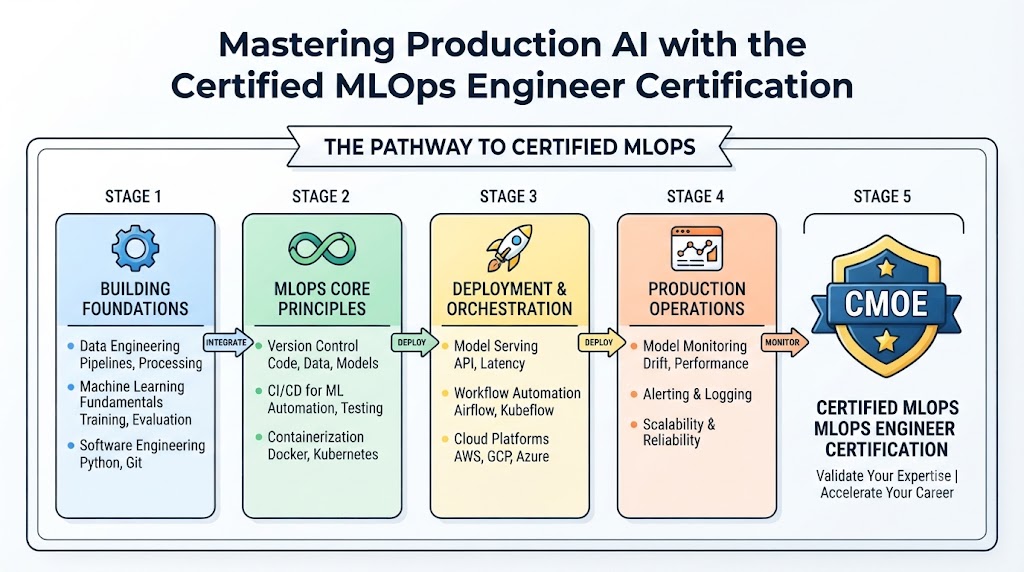
The Certified MLOps Engineer designation represents a commitment to mastering the operationalization of machine learning workflows. It is not merely a theoretical credential; rather, it is a production-focused validation that proves an engineer can handle the end-to-end lifecycle of ML models. This encompasses everything from data versioning and automated pipeline construction to drift detection and infrastructure reliability. It exists to standardize the skill set required to maintain stability in complex AI-driven systems where traditional software engineering principles meet data science requirements. By focusing on real-world enterprise practices, it ensures that engineers can deliver value continuously without compromising on system integrity.
Who Should Pursue Certified MLOps Engineer?
This certification is intended for professionals who are already familiar with the basics of software development or data science and wish to solidify their expertise in production environments. Data engineers who want to understand the deployment side, DevOps engineers looking to pivot into AI infrastructure, and SREs responsible for the reliability of machine learning models will find this path essential. It is also highly relevant for technical managers who need to speak the language of modern AI delivery to lead their teams effectively. Whether you are working in a fast-paced startup or a large-scale enterprise, the skills validated here are globally applicable and highly sought after in the current engineering job market.
Why Certified MLOps Engineer
As businesses increasingly rely on predictive analytics and automated decision-making, the demand for professionals who can maintain these systems is growing exponentially. This certification provides long-term value by teaching universal architectural principles rather than just vendor-specific tools, ensuring your knowledge remains relevant even as technologies evolve. It serves as a benchmark for competency in an industry that is often crowded with surface-level tutorials. By achieving this status, you demonstrate a deep understanding of operational rigor, which translates to a higher return on career investment and opens doors to senior-level roles in platform engineering and AI operations.
Certified MLOps Engineer Certification Overview
The program is delivered via the official portal at and is hosted on. It is structured to provide a comprehensive learning experience that balances conceptual understanding with hands-on labs and real-world scenarios. Candidates are assessed on their ability to design, implement, and troubleshoot MLOps pipelines in environments that mimic real enterprise constraints. The program ownership ensures that the curriculum is consistently updated to reflect current industry standards, providing candidates with a reliable, structured path for professional growth and skill validation.
Certified MLOps Engineer Certification Tracks & Levels
The certification framework is tiered to support engineers at every stage of their professional journey. Foundation levels focus on essential terminology and basic pipeline orchestration, ensuring that newcomers have a firm grasp of the core concepts. Professional levels dive deeper into complex integrations, such as security for ML models and advanced monitoring techniques. The advanced tracks are designed for lead engineers and architects who are responsible for designing resilient systems from the ground up. This progression allows you to align your certification efforts directly with your current experience and your long-term career aspirations within the organization.
Complete Certified MLOps Engineer Certification Table
| Track | Level | Who it’s for | Prerequisites | Skills Covered | Recommended Order |
| MLOps Essentials | Foundation | Aspiring Engineers | Basic Coding | Pipeline Logic | 1 |
| MLOps Pipeline | Professional | Experienced Devs | Foundation Cert | CI/CD for ML | 2 |
| MLOps Architecture | Advanced | Lead Engineers | Professional Cert | System Design | 3 |
Detailed Guide for Each Certified MLOps Engineer Certification
Certified MLOps Engineer – Foundation
What it is This certification validates a candidate’s fundamental understanding of the ML lifecycle and the basic principles of continuous integration for machine learning models.
Who should take it It is perfect for junior software engineers, recent graduates, or data analysts transitioning into engineering roles who need a strong base.
Skills you’ll gain
- Understanding of model versioning
- Basics of automated testing
- Introduction to environment management
- Familiarity with deployment stages
Real-world projects you should be able to do
- Setting up a basic automated training pipeline
- Configuring a local model registry
- Writing simple unit tests for data transformation
Preparation plan
- 7–14 days: Focus on core theory and identifying key tools used in the MLOps ecosystem.
- 30 days: Engage in building small projects that involve end-to-end model workflows.
- 60 days: Review advanced architectural documentation and practice troubleshooting common pipeline failures.
Common mistakes Focusing too much on the data science theory rather than the operational deployment logic.
Best next certification after this
- Same-track option: Professional Certified MLOps Engineer.
- Cross-track option: Certified DevOps Engineer.
- Leadership option: Technical Team Lead.
Choose Your Learning Path
DevOps Path
Focuses on the automation of software delivery and infrastructure management. This path is essential for those who want to ensure that machine learning models are deployed with the same reliability as traditional software services.
DevSecOps Path
Integrates security practices into the MLOps lifecycle to protect models from adversarial attacks. It covers vulnerability management and compliance in AI systems, which is becoming a critical requirement for enterprise organizations.
SRE Path
Prioritizes the reliability and performance of ML systems in production. This path covers error budgeting, incident management, and how to maintain high availability for AI-driven services.
AIOps Path
Concentrates on applying machine learning to IT operations. This is a specialized field where you learn to build systems that automate the management of other infrastructure components.
MLOps Path
Focuses specifically on the lifecycle of ML models, including training, deployment, and monitoring. This is the core path for those aiming to become dedicated MLOps engineers.
DataOps Path
Emphasizes the management of data quality and the efficiency of data pipelines. It provides the necessary foundation for ensuring that the inputs to ML models are accurate and timely.
FinOps Path
Teaches how to optimize the cost of running large-scale machine learning infrastructure. It is essential for engineers who need to balance performance requirements with strict cloud budget constraints.
Role → Recommended Certified MLOps Engineer Certifications
| Role | Recommended Certifications |
| DevOps Engineer | Certified MLOps Engineer Foundation |
| SRE | Certified MLOps Engineer Professional |
| Platform Engineer | Certified MLOps Engineer Architecture |
| Cloud Engineer | Certified MLOps Engineer Foundation |
| Security Engineer | Certified MLOps Engineer Professional |
| Data Engineer | Certified MLOps Engineer Foundation |
| FinOps Practitioner | Certified MLOps Engineer Professional |
| Engineering Manager | Certified MLOps Engineer Architecture |
Next Certifications to Take After Certified MLOps Engineer
Same Track Progression
Deepen your expertise by pursuing advanced certifications that focus on complex multi-region deployments, cost optimization for large-scale AI, and advanced model security. This ensures you remain a subject matter expert in your chosen domain.
Cross-Track Expansion
Broaden your skill set by acquiring certifications in related fields such as cloud security, infrastructure as code, or data governance. This multifaceted approach makes you an invaluable asset to cross-functional teams.
Leadership & Management Track
Transition toward leadership by focusing on certifications that cover technical strategy, project management for engineering teams, and organizational change management. This path is essential for moving into senior management or director-level roles.
Training & Certification Support Providers for Certified MLOps Engineer
DevOpsSchool Offers comprehensive training programs that emphasize hands-on lab experience and real-world scenarios. Their curriculum is designed to bridge the gap between theoretical learning and practical engineering application in modern enterprise environments.
Cotocus Provides in-depth coaching for engineers looking to master the technical nuances of modern software delivery. Their approach is highly interactive, focusing on individual skill development and career-specific certification preparation.
Scmgalaxy Specializes in configuration management and automation training. They provide extensive resources for engineers who need to understand the underlying mechanics of modern deployment pipelines and infrastructure orchestration.
BestDevOps Focuses on the convergence of various operational disciplines, providing a holistic view of the cloud-native ecosystem. Their training is highly regarded for its focus on industry best practices and operational efficiency.
devsecopsschool Dedicated to the intersection of security and development. They provide specialized certification training for engineers who need to ensure that their production pipelines are resilient against modern digital threats.
sreschool Focuses on site reliability engineering, providing deep dives into incident management, observability, and system performance optimization. Their training is essential for engineers managing high-traffic production environments.
aiopsschool The primary provider for machine learning operations certifications, offering structured paths that range from foundation to advanced architectural mastery. They focus on maintaining operational excellence in AI systems.
dataopsschool Provides focused training on managing high-volume data pipelines. They emphasize the integration of data engineering practices with automated infrastructure to improve overall system performance and data reliability.
finopsschool Specializes in cloud financial management. They teach engineers how to build and maintain infrastructure while maintaining strict adherence to cloud budget goals and operational cost efficiency.
Frequently Asked Questions (General)
- How long does it typically take to prepare for these certifications? The duration varies based on your existing knowledge, but most professionals dedicate between four to eight weeks for focused study and lab practice to succeed.
- Are there any prerequisites I should have before starting? While some entry-level tracks are open, having a basic understanding of cloud platforms and version control systems is highly recommended for a smoother learning experience.
- What is the return on investment for these certifications? These certifications often lead to salary increases, better job security, and access to more challenging technical roles by validating your expertise to potential employers.
- Can these certifications be taken while working full-time? Yes, most certification paths are designed to be flexible, allowing working professionals to balance their studies with their existing job responsibilities effectively.
- Is there a specific sequence I should follow for these certifications? It is generally recommended to start with foundational tracks before moving to professional and advanced levels to ensure you have a solid understanding of core principles.
- How often are the certification exams updated? The content is regularly reviewed and updated by subject matter experts to ensure that the material remains aligned with current industry trends and best practices.
- Do these certifications cover specific cloud providers? The curriculum focuses on universal principles that are applicable across multiple cloud environments, though labs may use specific tools to demonstrate these concepts in practice.
- Are these certifications recognized globally? Yes, these certifications are designed to meet international engineering standards and are recognized by organizations across the world for their practical rigor.
- What happens if I fail an exam? Most certification programs offer multiple attempts to pass, providing you with feedback on your performance so you can focus on areas that require further improvement.
- How do I prove my certification to employers? Upon successful completion, you receive a verifiable digital badge and certificate that can be shared on professional social media profiles and integrated into your resume.
- Are the training materials included with the exam fee? This depends on the specific provider, but most comprehensive programs bundle training, practice labs, and the exam fee into a single enrollment package.
- Can these certifications help me transition into a different tech role? Absolutely, by providing you with a structured way to learn new skill sets, these certifications can be a powerful tool for pivoting your career into a new domain.
FAQs on Certified MLOps Engineer
- What is the main focus of the Certified MLOps Engineer exam? The exam focuses on validating your ability to build, deploy, and monitor production-grade machine learning pipelines within an enterprise setting.
- Does this certification cover deep learning or classical machine learning? It covers the operational lifecycle of both, focusing on the infrastructure and deployment patterns rather than the specific mathematical models being used.
- Is hands-on experience required to pass the exam? Practical lab work is highly recommended as the exam includes scenario-based questions that test your ability to troubleshoot real-world deployment challenges.
- How does this certification differ from a data science certification? While data science certifications focus on model development, this certification focuses on the engineering and operational aspects of keeping those models running reliably.
- Will I learn about model monitoring and drift detection? Yes, monitoring, performance tracking, and drift detection are core components of the curriculum as they are critical for maintaining model health in production.
- Are there lab-based exams or just multiple-choice questions? The assessment approach typically combines knowledge-based questions with practical, scenario-driven tasks to ensure a comprehensive evaluation of your skills.
- How does this certification improve my MLOps workflows? It teaches you standardized practices that minimize manual errors, improve deployment speed, and ensure that your pipelines are scalable and maintainable.
- Is this certification suitable for a lead role? Yes, it covers architectural design patterns that are essential for lead engineers responsible for overseeing the entire lifecycle of ML systems within a company.
Final Thoughts: Is Certified MLOps Engineer Worth It?
In my two decades of experience, I have seen many engineers struggle because they focused only on code and ignored the operational realities of production environments. Pursuing the Certified MLOps Engineer designation is a significant step toward mastering those operational realities. It is a rigorous path, but the knowledge you gain will distinguish you as an engineer who can build resilient, intelligent systems that actually deliver business value. If you are serious about advancing your career in the cloud-native and AI-driven landscape, this certification provides the practical foundation and professional validation you need to succeed. Do it for the skills, and the career advancement will follow.