
Introduction
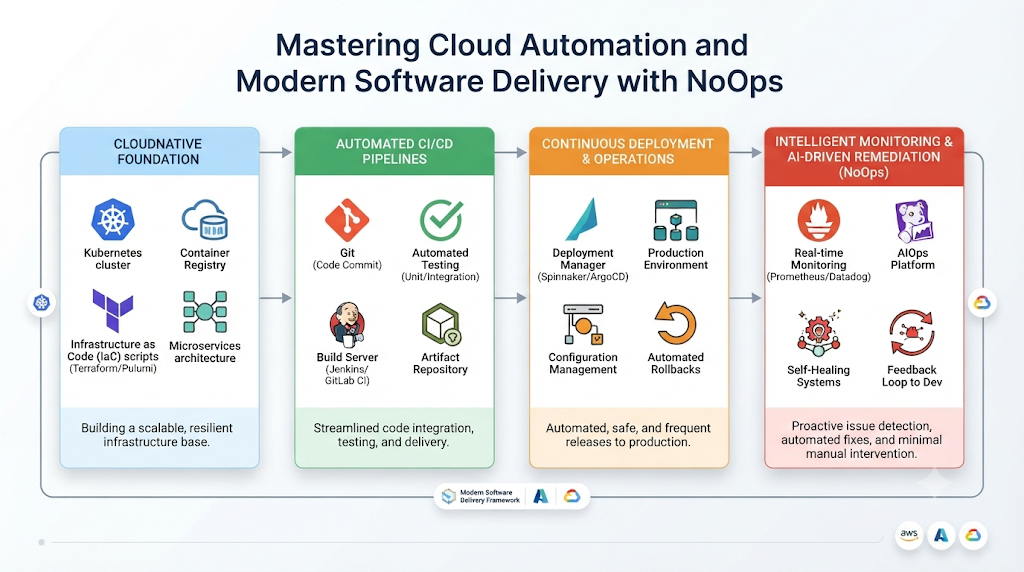
NoOps stands for “No Operations.” It is an advanced IT approach where cloud infrastructure management is fully automated. In a NoOps environment, software developers push code without worrying about manual server provisioning or patching. Cloud platforms and automated pipelines handle infrastructure tasks behind the scenes.
This model does not mean operations work disappears entirely. Instead, operations tasks shift from manual configuration to building and maintaining automation systems. Teams focus on writing code, setting policies, and improving developer workflows. The goal is to remove repetitive tasks so software delivery becomes fast, smooth, and reliable.
Core Principles of Modern Cloud Automation
Modern cloud automation relies on core principles that remove manual bottlenecks. Infrastructure as Code lets engineers define servers and networks using configuration files. This ensures environments stay consistent across development, testing, and production stages.
Automation also improves deployment pipelines. Code changes move from testing to production automatically when all quality checks pass. Monitoring systems watch performance in real time and alert teams to issues instantly. Self-healing mechanisms can restart failed services without human intervention. These principles form the backbone of modern cloud-native architectures.
NoOps vs DevOps: Understanding the Differences
Teams often wonder how NoOps relates to existing practices. To understand the differences, we look at NoOps vs DevOps. DevOps bridges the gap between software development and IT operations through collaboration and shared responsibility. Operations teams and developers work together closely to build deployment pipelines.
NoOps takes automation a step further. It aims to remove traditional operational ticket queues and manual interventions almost entirely. While DevOps focuses on collaboration and shared processes, NoOps relies on extreme automation and platform engineering. Organizations choose their approach based on team maturity and system complexity.
| Comparison Area | DevOps Approach | NoOps Approach |
|---|---|---|
| Primary Focus | Collaboration between dev and ops teams | Full automation of infrastructure and operations |
| Deployment Style | Automated pipelines with manual gate approvals | Fully automated pipelines from commit to production |
| Operational Tasks | Shared monitoring, incident response, and patching | Automated remediation, self-healing, and platform tools |
| Team Structure | Integrated cross-functional teams | Developers supported by centralized platform engineers |
Essential NoOps Automation Tools
Implementing modern automation requires the right technology stack. Teams rely on various NoOps automation tools to provision, deploy, and monitor cloud systems. Terraform helps engineers create and manage cloud infrastructure using declarative configuration files. Kubernetes and Docker manage containerized applications smoothly across different environments.
GitOps tools store infrastructure and application code in Git repositories. When engineers update the repository, the system updates the live environment automatically. CI/CD platforms like GitHub Actions or GitLab CI run automated testing and deployment steps. Monitoring tools collect system metrics and trigger automated alerts or scripts.
| Automation Category | Popular Tool Examples | Primary Function |
|---|---|---|
| Infrastructure as Code | Terraform, OpenTofu | Provision and manage cloud resources programmatically |
| Container Orchestration | Kubernetes, Docker | Deploy, scale, and manage containerized applications |
| Continuous Delivery | ArgoCD, Flux, GitHub Actions | Automate build, test, and deployment workflows |
| Observability | Prometheus, Grafana, Datadog | Monitor system health and track performance metrics |
Building Skills Through Structured Training
As automation grows, professionals need new skills to stay competitive. Developing these skills requires structured education and hands-on practice. A well-designed NoOps training course helps engineers master cloud platforms, scripting, and infrastructure automation. Learners study container management, CI/CD pipelines, and observability practices.
Professionals also learn how to design secure and scalable cloud environments. Practical labs give learners real-world experience with modern tools. These educational programs help developers and system administrators transition into advanced automation roles. Organizations often sponsor training to improve internal delivery speeds.
Certifications for Career Growth
Certifications validate technical skills and show expertise to employers. Professionals can pursue a recognized NoOps certification to prove their knowledge of cloud automation and modern delivery models. These programs cover infrastructure management, security automation, and platform engineering principles.
Different roles require targeted certifications. A specialized NoOps engineer certification focuses on hands-on tool usage, pipeline creation, and infrastructure management. Architects pursue advanced learning paths to design large-scale automated systems. Managers seek credentials to understand how automation impacts business workflows and team productivity.
Career Paths and Professional Roles
The shift toward automation creates new job titles in the IT industry. Professionals who master these practices find exciting career opportunities. A NoOps engineer builds and maintains the underlying automation pipelines that developers use daily. They ensure cloud resources scale smoothly and securely.
Architects design complex cloud-native systems that require minimal human intervention. Managers oversee automation strategies and align technology goals with business objectives. Professionals in these roles combine software development knowledge with cloud infrastructure expertise. Strong problem-solving skills and a passion for automation drive success in these positions.
Enterprise Adoption and Professional Services
Many organizations want to adopt modern automation but lack internal experience. Companies often seek outside help to accelerate their cloud transformation journeys. Expert consultants evaluate existing workflows and design tailored automation strategies.
Organizations look to hire NoOps freelancers for specialized short-term projects. Freelancers help implement Infrastructure as Code, set up GitOps workflows, or improve monitoring systems. Engaging external experts helps businesses modernize faster without overburdening internal teams.
Organizations benefit greatly from professional guidance during cloud transformation. Specialized NoOps consulting services help businesses assess readiness, design resilient architectures, and implement security automation. Consultants ensure that migration projects follow industry best practices and deliver measurable operational improvements.
Frequently Asked Questions
What is NoOps and how does it work? NoOps is an IT approach where infrastructure management and deployment tasks are fully automated. It works by using cloud platforms, Infrastructure as Code, and automated pipelines so developers can push code without manual server provisioning.
How does NoOps differ from traditional IT operations? Traditional IT operations rely on manual server setup, ticket queues, and human intervention for deployments. NoOps replaces these manual tasks with automated provisioning, self-healing systems, and continuous delivery workflows.
Do operations professionals become unnecessary in NoOps? Operations professionals do not disappear in a NoOps environment. Their roles shift from manual troubleshooting and patching to building platform tools, setting governance policies, and maintaining automation systems.
What skills are needed to become a NoOps engineer? Engineers need strong knowledge of cloud computing, Infrastructure as Code, container orchestration, CI/CD pipelines, and monitoring tools. Proficiency in scripting languages and security best practices is also essential.
How can professionals prepare for NoOps roles? Professionals can prepare by taking a specialized NoOps training course and earning a recognized NoOps certification. Hands-on practice with modern automation tools and cloud platforms builds practical competence.
What is the role of an architect in NoOps environments? An architect designs resilient, secure, and scalable cloud-native systems. They ensure that automated pipelines and infrastructure components integrate smoothly across the entire organization.
Why do businesses hire external consultants for automation? Businesses hire external experts to gain specialized knowledge and accelerate cloud transformation. Consultants help assess readiness, implement complex tools, and train internal teams on best practices.
What factors should companies consider when hiring freelancers? Companies should look at relevant technical experience, cloud platform knowledge, and past automation project success. Clear communication skills and a solid understanding of security are also vital.
Are there specialized certifications for IT managers? Yes, specialized certification paths exist for leaders and managers. These credentials help management understand automation strategy, operational efficiency, and platform governance.
How does NoOpsSchool support modern IT learning? NoOpsSchool provides specialized learning resources, professional training, and certification programs. It helps individuals and organizations master cloud infrastructure automation and modern software delivery practices.
Conclusion
Cloud automation and modern delivery models continue to transform the IT industry. Organizations that embrace automation reduce manual errors and release software faster. Professionals who build skills in cloud technologies and automation tools position themselves for exciting career opportunities.
NoOpsSchool supports this journey by offering specialized education, certification paths, and consulting resources. Whether you want to learn modern automation, earn a NoOps architect training credential, or transform enterprise operations, continuous learning is the key to success. Embrace modern automation practices today and build a resilient future for your organization.