
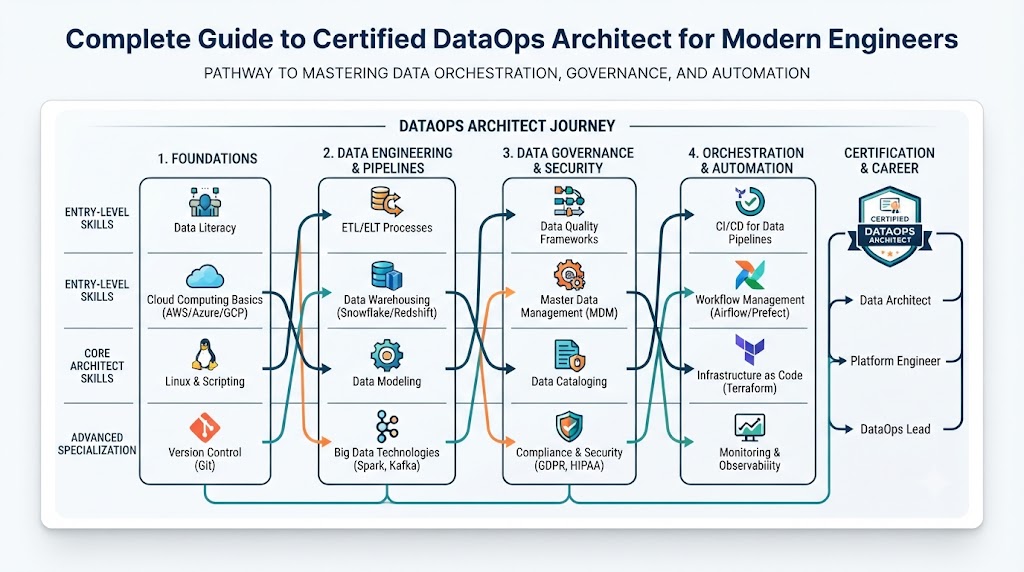
Introduction
Modern enterprise architectures process massive volumes of streaming and batch data, making reliable pipelines critical for success. This guide explores the Certified DataOps Architect credential hosted on DataOpsSchool to help you navigate your career path. Designed for engineers and technical leaders, it evaluates the core principles, practical value, and preparation strategies required to excel in the data engineering landscape.
What is the Certified DataOps Architect?
The Certified DataOps Architect represents a rigorous validation of advanced data pipeline orchestration, automation, and governance practices. It exists to bridge the gap between traditional data warehousing and agile software engineering principles through automated testing and continuous delivery. This program emphasizes real-world, production-focused learning over abstract theory by utilizing hands-on implementation labs. It aligns directly with modern enterprise data workflows, ensuring data quality, lineage, and observability across hybrid cloud environments.
Who Should Pursue Certified DataOps Architect?
This certification benefits data engineers, platform architects, infrastructure specialists, and analytics managers seeking enterprise-grade validation. Beginners with solid foundational coding skills, experienced engineers managing complex ETL workflows, and technical leaders can all leverage this credential. It holds high relevance across the global tech sector and within the rapidly expanding data-driven ecosystem in India. Professionals looking to standardize reliable data release cycles will find immediate value in this curriculum.
Why Certified DataOps Architect
Enterprise adoption of automated data workflows continues to surge as organizations demand faster, higher-quality analytical insights. This certification provides long-term career value because its core principles outlast specific software tools or cloud vendors. It offers an exceptional return on time and career investment by preparing practitioners for senior technical architecture roles. Certified professionals remain resilient against tool churn by mastering foundational automation, monitoring, and pipeline reliability frameworks.
Certified DataOps Architect Certification Overview
The program is delivered via Certified DataOps Architect and hosted on DataOpsSchool. The certification assessment approach combines rigorous practical labs with scenario-based theoretical evaluations to test real-world readiness. Ownership of the curriculum rests with industry practitioners who continuously update the material to reflect current industry demands. The structural design ensures that candidates can demonstrate absolute competence in building scalable, secure, and observable data environments.
Certified DataOps Architect Certification Tracks & Levels
The certification structure spans foundation, professional, and advanced tiers to accommodate varied levels of industry experience. Specialization tracks branch into pipeline automation, data observability, and enterprise governance domains. These progressive levels align seamlessly with career progression from execution-focused engineering to high-level system architecture. Candidates can choose entry points based on their current expertise and scale up their skills systematically.
Complete Certified DataOps Architect Certification Table
| Track | Level | Who it’s for | Prerequisites | Skills Covered | Recommended Order |
| Foundation | Beginner | Junior Data Engineers | Basic SQL and Python | Pipeline basics, Git, CI/CD intro | 1 |
| Professional | Intermediate | Data & Platform Engineers | 2+ years data experience | Orchestration, containerization, testing | 2 |
| Advanced | Expert | Lead Architects & Managers | Professional level certification | Enterprise governance, multi-cloud ops, scale | 3 |
Detailed Guide for Each Certified DataOps Architect Certification
Certified DataOps Architect – Foundation Level
What it is
This entry-level credential validates foundational knowledge of agile data pipeline principles and basic version control.
Who should take it
Junior software developers, recent graduates, and data analysts transitioning into automated data engineering roles.
Skills you’ll gain
- Basic version control workflows for data code
- Introduction to continuous integration principles
- Fundamental understanding of pipeline testing
- Basic data quality monitoring concepts
Real-world projects you should be able to do
- Build a simple automated batch data pipeline using Git
- Implement basic unit tests for data transformation scripts
- Set up simple logging and alerting for pipeline failures
Preparation plan
- Spend 7 to 14 days reviewing core version control and basic pipeline concepts.
- Dedicate 30 days to completing hands-on setup exercises and introductory labs.
- Utilize a 60-day review period for deeper conceptual reinforcement if transitioning from non-technical backgrounds.
Common mistakes
- Treating data code like traditional documentation rather than production software.
- Neglecting version control best practices for schema changes.
Best next certification after this
- Same-track option: Certified DataOps Architect Professional Level
- Cross-track option: Certified DevOps Foundation
- Leadership option: Agile Project Management for Data
Certified DataOps Architect – Professional Level
What it is
This mid-tier certification validates the ability to design, automate, and monitor production-grade data pipelines.
Who should take it
Working data engineers, DevOps specialists, and analytics engineers with hands-on pipeline management experience.
Skills you’ll gain
- Advanced pipeline orchestration and scheduling
- Automated data quality validation frameworks
- Containerization of data processing jobs
- End-to-end pipeline observability and logging
Real-world projects you should be able to do
- Deploy a containerized ETL pipeline with automated testing
- Implement comprehensive data quality checks pre- and post-load
- Configure centralized monitoring dashboards for data latency and errors
Preparation plan
- Dedicate 14 days to intensive study of orchestration tools and container concepts.
- Spend 30 days building complex multi-stage data pipelines in a test environment.
- Use a 60-day structured study plan for balancing full-time work with lab practice.
Common mistakes
- Failing to implement automated testing for data schema drifts.
- Over-complicating orchestration layers without adequate monitoring.
Best next certification after this
- Same-track option: Certified DataOps Architect Advanced Level
- Cross-track option: Certified MLOps Engineer
- Leadership option: Data Engineering Manager Track
Certified DataOps Architect – Advanced Level
What it is
This expert-tier certification validates enterprise-scale data architecture, governance, and multi-cloud operational mastery.
Who should take it
Senior data architects, principal engineers, and platform leads designing enterprise data ecosystems.
Skills you’ll gain
- Multi-cloud data architecture and synchronization
- Advanced enterprise data governance and security
- Cost optimization for large-scale data platforms
- Enterprise-wide observability and incident response
Real-world projects you should be able to do
- Design a fault-tolerant multi-cloud data integration platform
- Establish enterprise-wide data governance and compliance tracking
- Optimize resource allocation and cost for large data processing clusters
Preparation plan
- Allocate 14 days to advanced architecture pattern reviews and case studies.
- Spend 30 days designing enterprise-scale mock topologies and migration strategies.
- Follow a 60-day deep-dive strategy into governance, security, and multi-cloud frameworks.
Common mistakes
- Designing overly rigid architectures that resist agile adjustments.
- Ignoring cost implications of unoptimized cloud data storage and compute.
Best next certification after this
- Same-track option: Enterprise Data Strategy Expert
- Cross-track option: Certified FinOps Professional
- Leadership option: Chief Data Officer Leadership Program
Choose Your Learning Path
DevOps Path
The DevOps path focuses on core infrastructure automation, continuous integration, and release management across environments. Professionals build robust delivery pipelines that support rapid and reliable software deployments. Mastering this track ensures strong foundational knowledge in containerization, configuration management, and system reliability. It serves as an essential stepping stone for engineers transitioning into specialized platform and data architecture domains.
DevSecOps Path
The DevSecOps path integrates security practices directly into every stage of the software and data development lifecycle. Practitioners learn to automate vulnerability scanning, compliance checks, and access controls within automated pipelines. This track emphasizes shifting security left to catch vulnerabilities before production deployment. Engineers completing this path become adept at safeguarding enterprise data and infrastructure against evolving cyber threats.
SRE Path
The SRE path centers on system availability, performance optimization, and incident management through software engineering solutions. Learners explore concepts like service level objectives, error budgets, and automated root cause analysis. This track equips professionals to maintain resilient, highly scalable enterprise systems under heavy production loads. It targets engineers passionate about large-scale system stability and operational efficiency.
AIOps / MLOps Path
The AIOps and MLOps path bridges the gap between data science experimentation and production-grade machine learning deployment. Practitioners master model versioning, continuous training pipelines, and automated inference monitoring. This track ensures that machine learning models perform reliably and scale effectively in real-world production environments. It is ideal for engineers managing intelligent systems and automated operational analytics.
DataOps Path
The DataOps path applies agile and DevOps principles specifically to data analytics and engineering workflows. Learners focus on automating data integration, quality testing, and pipeline observability. This track accelerates the delivery of high-quality data insights to business stakeholders while maintaining strict governance. It is tailored for professionals dedicated to optimizing the entire data lifecycle.
FinOps Path
The FinOps path introduces financial accountability and cost optimization into cloud-native and data-driven environments. Professionals learn to analyze cloud expenditure, allocate costs accurately, and eliminate operational waste. This track empowers engineers and finance teams to collaborate on maximizing business value from cloud investments. It provides crucial skills for managing large-scale infrastructure budgets efficiently.
Role → Recommended Certifications
| Role | Recommended Certifications |
| DevOps Engineer | Certified DevOps Professional, Certified DataOps Architect Foundation |
| SRE | Certified SRE Practitioner, Certified DataOps Architect Professional |
| Platform Engineer | Certified Platform Architect, Certified DataOps Architect Professional |
| Cloud Engineer | Certified Cloud Specialist, Certified DataOps Architect Foundation |
| Security Engineer | Certified DevSecOps Engineer, Certified Data Governance Specialist |
| Data Engineer | Certified DataOps Architect Professional, Certified DataOps Architect Advanced |
| FinOps Practitioner | Certified FinOps Professional, Certified DataOps Architect Foundation |
| Engineering Manager | Agile Leadership Program, Certified DataOps Architect Advanced |
Next Certifications to Take After Certified DataOps Architect
Same Track Progression
Progressing within the same track involves pursuing advanced specializations like multi-cloud governance and enterprise scale architectures. Professionals deepen their expertise in complex data orchestration frameworks and large-scale cost optimization. This deep specialization enables senior engineers to tackle enterprise-level challenges with absolute confidence. It positions practitioners for principal engineering and high-level architectural consultancy roles.
Cross-Track Expansion
Cross-track expansion broadens technical capabilities by exploring adjacent domains such as machine learning operations or cloud security. Practitioners combine data pipeline expertise with artificial intelligence delivery or financial management practices. This multidisciplinary skill set makes engineers highly versatile and valuable across diverse enterprise departments. It fosters holistic thinking required for comprehensive digital transformation initiatives.
Leadership & Management Track
Transitioning to leadership involves moving from hands-on implementation to strategic technical management and team mentorship. Leaders learn to align data infrastructure goals with broader enterprise business objectives and financial budgets. This track prepares senior professionals for roles such as director of engineering or vice president of technology. It emphasizes organizational scaling, talent development, and cross-functional communication.
Training & Certification Support Providers for Certified DataOps Architect
DevOpsSchool provides comprehensive training programs, expert-led workshops, and structured learning pathways tailored for modern engineering professionals worldwide. Their curriculum focuses on bridging theoretical knowledge with practical, hands-on production experience.
Cotocus offers specialized technical coaching, corporate training solutions, and certification preparation bootcamps for enterprise engineering teams. They emphasize real-world scenario training to ensure candidates master complex operational challenges.
Scmgalaxy serves as a premier knowledge-sharing platform and training provider offering extensive resources on software configuration management and automation. The community-driven approach helps engineers stay updated with emerging industry standards.
BestDevOps delivers targeted educational resources, professional coaching, and certification guidance across diverse cloud-native and automation domains. Their programs are designed to accelerate career growth for working technical professionals.
devsecopsschool.com specializes in security-first engineering education, focusing on vulnerability management, compliance automation, and secure pipeline deployment. Their courses empower engineers to integrate security seamlessly into automated workflows.
sreschool.com offers dedicated training tracks centered on site reliability engineering, observability, incident management, and scalable system design. Their expert instructors guide learners through practical resilience engineering scenarios.
aiopsschool.com provides focused education on artificial intelligence operations, machine learning lifecycle management, and intelligent automation frameworks. They help engineers deploy robust AI models into production environments successfully.
dataopsschool.com acts as the primary hub for data pipeline automation, data governance, and analytics engineering certifications. Their structured programs ensure mastery over modern enterprise data workflows.
finopsschool.com delivers specialized training on cloud financial management, cost allocation, and resource optimization strategies. Their courses enable technical teams to align cloud spending with business value effectively.
Frequently Asked Questions
1. What is the overall difficulty level of the certification?
The difficulty ranges from moderate to advanced depending on the specific tier you choose to pursue.
2. How much preparation time is generally required?
Most candidates require between four to eight weeks of dedicated study and hands-on lab practice.
3. Are there strict prerequisites before enrolling?
Basic familiarity with SQL, Python, and version control systems is strongly recommended for success.
4. What is the return on investment for this credential?
Certified professionals often experience accelerated career growth, higher salary potential, and enhanced job security.
5. How should I sequence my learning path?
Begin with the foundation tier, progress to professional after gaining practical experience, and target advanced later.
6. Is the certification recognized globally?
Yes, the credential holds strong industry recognition across global markets and enterprise organizations.
7. Does the exam include practical hands-on labs?
Assessments feature scenario-based evaluations and practical tasks to test real-world problem-solving skills.
8. How often is the curriculum updated?
Content undergoes regular reviews to ensure alignment with current cloud-native and industry standards.
9. Can beginners with no data experience take this?
Beginners can start with the foundation level, provided they are willing to put in extra study time.
10. What kind of career support is provided?
Training providers often offer career guidance, resume reviews, and access to exclusive professional networks.
11. How do these skills impact daily engineering tasks?
They streamline workflow automation, reduce pipeline failures, and improve overall data reliability.
12. Is continuous recertification required?
Periodic updates or continuing education credits may be required to maintain active certified status.
FAQs on Certified DataOps Architect
1. What core tools are covered in the curriculum?
The program covers leading orchestration engines, container platforms, and data quality frameworks.
2. How does this differ from traditional data engineering courses?
It focuses heavily on automation, continuous delivery, and operational reliability rather than just coding.
3. Will this help me transition into a platform engineering role?
Yes, the emphasis on pipeline automation and infrastructure aligns closely with platform engineering requirements.
4. Are coding tests part of the certification exam?
Examinations include practical coding and configuration scenarios to validate real-world competence.
5. How do I choose between professional and advanced levels?
Your choice depends on your years of hands-on experience and current architectural responsibilities.
6. What support is available if I fail an exam attempt?
Providers typically offer remediation guidance and opportunities to retake assessments after additional study.
7. Can teams undergo corporate training together?
Multiple support providers offer customized group training programs for enterprise engineering teams.
8. How does this certification address data governance?
It incorporates rigorous modules on compliance, lineage tracking, and automated access controls.
Final Thoughts: Is Certified DataOps Architect Worth It?
Investing time in this certification pays off for engineers dedicated to mastering modern data workflows. It provides a structured approach to learning production-grade automation without relying on marketing hype. Professionals who apply these principles will find themselves well-equipped to handle complex data challenges. Ultimately, the real value lies in the practical skills gained and applied directly to your daily engineering work.