
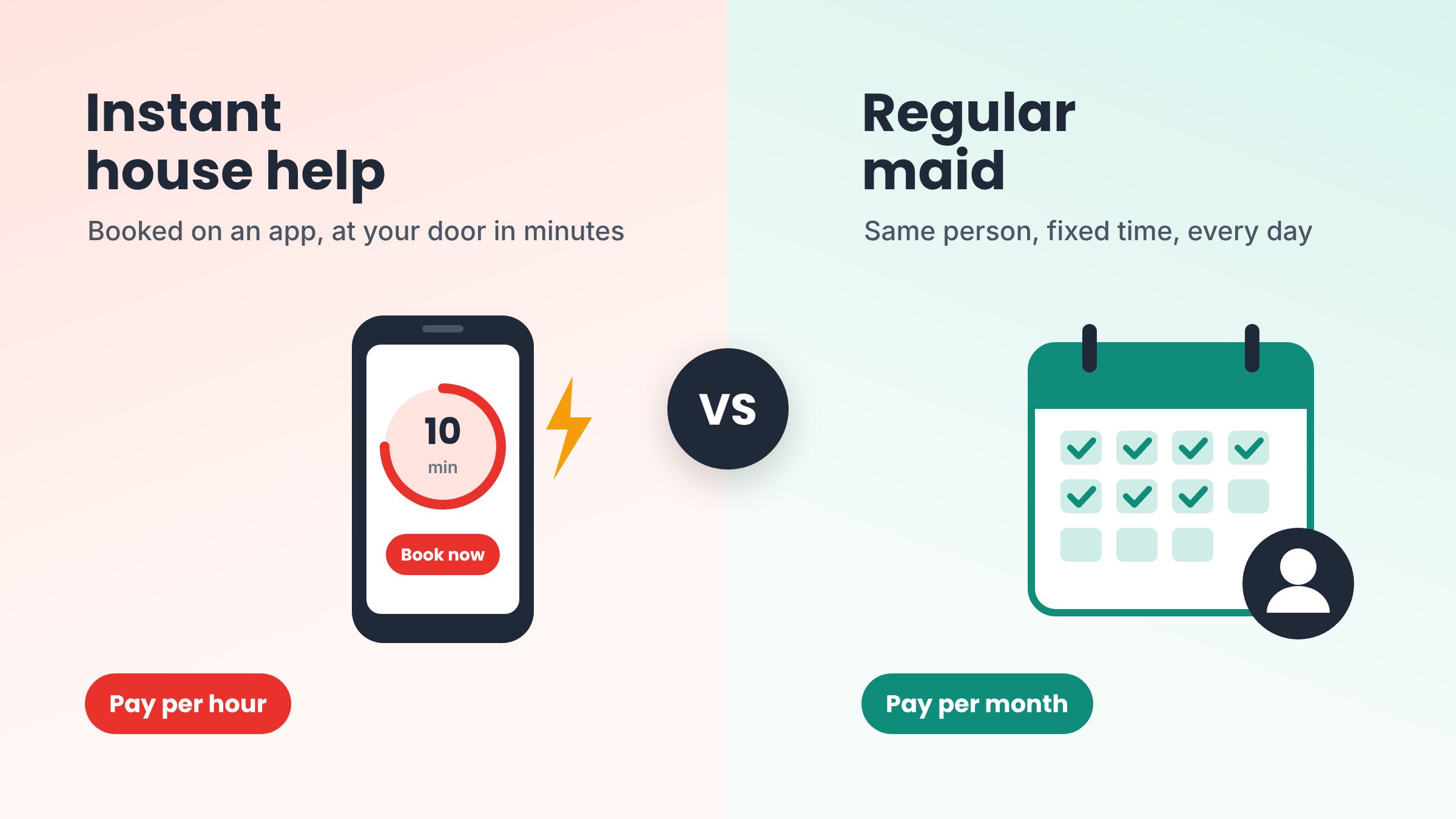
It’s 7:40 on a Tuesday morning. The sink is full, the floor hasn’t been mopped, and your didi has just sent a voice note saying she can’t come today. Two years ago, that meant doing the dishes yourself before leaving for office. Now, in large parts of Mumbai, Delhi NCR and Bengaluru, you can open an app and have instant house help at your door in about ten minutes.
That’s a big change in how Indian homes run, and it happened fast. The two biggest apps barely existed in 2024. By August 2026, each was doing more than a lakh jobs a day. Which leaves a lot of families wondering: is it time to stop paying a monthly maid and just book house help when you need it?
The honest answer is that it depends on how often you need help and what kind of help it is. Here’s how instant house help vs a regular maid actually compares, with real numbers.
What “house help in minutes” actually means
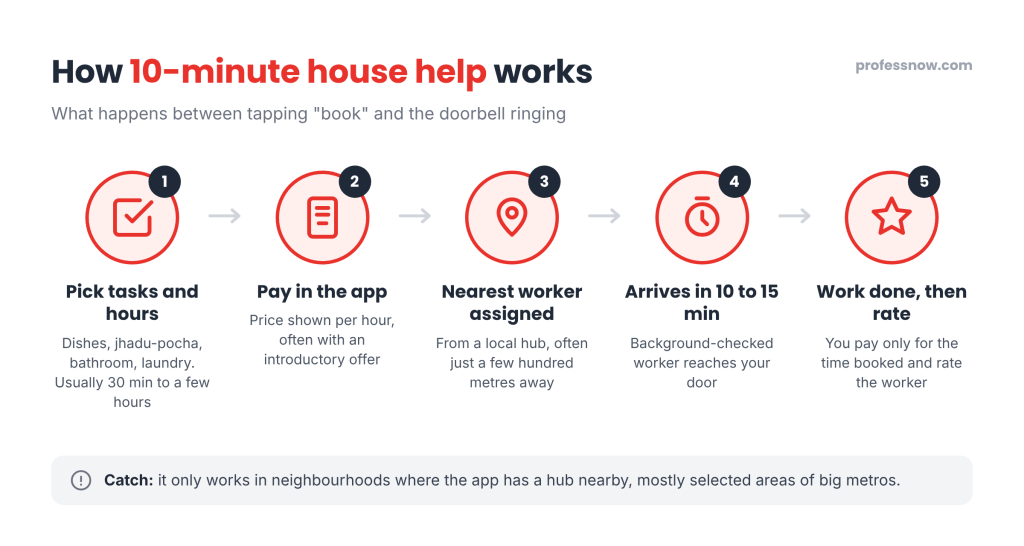
Three apps lead this space right now: Snabbit, Urban Company’s InstaHelp and Pronto. They all work roughly the same way. You choose the tasks and how long you need someone, usually anywhere from 30 minutes to a few hours, pay in the app, and a trained worker from a nearby hub walks over.
The speed isn’t magic. It comes from density. These companies only switch on in neighbourhoods where they have plenty of workers and customers packed close together. Snabbit says its workers travel about 247 metres between jobs on average, which is why the service might work in your sector of Gurugram but not in the one next door.
What they’ll do: dishes, jhadu-pocha, bathroom and kitchen cleaning, dusting, laundry and folding, and simple kitchen prep like chopping vegetables. A couple of apps have started testing home cooks in a few areas, but cooking isn’t the main offer yet.
And this is no longer a niche experiment. On 2 August 2026, Urban Company said InstaHelp had delivered over 1 lakh orders in a single day, and Snabbit reported 1.15 lakh jobs the same day (Inc42 has the numbers). Snabbit now runs in 10 cities.
Instant house help vs regular maid: the real cost
Most people get this comparison wrong because one is priced by the hour and the other by the month. So let’s put them on the same scale.
What instant help costs
On the big apps, an hour of help is usually listed somewhere between ₹99 and ₹250 (as of November 2026), depending on your city, the time of day and whatever offer is running. During this year’s price war, some neighbourhoods saw an hour go for as little as ₹29.
Keep in mind that investor money is paying for a lot of that discount. Urban Company has called InstaHelp its “most aggressive investment” and warned that losses will stay high for a while (Entrepreneur India). Snabbit says it still loses money on every job, although that loss has now come down to under ₹250 per job. Prices like these rarely last, so plan for them to go up.
What a regular maid costs
In the metros, a part-time maid for one task, say dishes or jhadu-pocha, typically charges ₹2,500 to ₹6,000 a month. Someone who handles the full set of daily chores is closer to ₹8,000 to ₹12,000. Smaller cities usually pay 20 to 40 percent less. Then add the things people forget to count: a Diwali bonus of roughly one month’s pay, the odd advance, and paid days off.
Same work, side by side
Say you need one hour of help every day, so about 30 hours a month:
- At ₹99 an hour on an app: about ₹2,970
- At ₹245 an hour, closer to the full listed price: about ₹7,350
- A regular part-time maid for the same work: roughly ₹3,000 to ₹6,000, plus the yearly bonus
Now flip it. If you only need help twice a week, eight one-hour bookings cost roughly ₹800 to ₹2,000 a month. Paying a monthly salary for that makes little sense.
So for occasional help, instant apps win on cost. For everyday help, a regular maid usually comes out cheaper once the discounts fade. Here’s the full picture beyond price:
| Instant house help | Regular maid | |
|---|---|---|
| How you pay | Per hour, per booking | Fixed monthly salary plus festival bonus |
| How fast | 10 to 15 minutes in covered areas | A fixed time slot you agree on |
| Same person every time | Usually not | Yes |
| Knows your home | No, you explain each time | Yes, after the first few weeks |
| Background check | Done by the platform | You arrange police verification |
| On leave days | Just book someone else | You manage without, or find cover |
| Cooking | Limited, only in a few areas | Common |
| Where it works | Selected neighbourhoods in big metros | Anywhere |
| Commitment | None | Advance, notice period and leave expected |
When instant house help is the smarter pick
- Your regular maid is on leave, unwell or has just quit.
- Guests are arriving in an hour, or the house needs a clean-up after a party.
- You live alone or in a small flat and don’t need someone every single day.
- Your work hours keep changing, so a fixed morning slot never fits.
- You don’t want the advance, notice period and festival bonus that come with monthly hiring.
The apps also say their workers are background-checked and rated after every job, which some people find reassuring when a stranger is coming into the house.
When a regular maid is still better
Consistency is the big one. Over a few weeks, a regular helper learns where the masala dabba goes, which kadhai shouldn’t be scrubbed with steel wool, and exactly how your mother likes the floor done. With an app, you may get a different person each time and spend the first ten minutes explaining your kitchen.
Quality can also be hit or miss. App reviews swing between “quick and efficient” and complaints that one bathroom took 40 minutes of a one-hour slot. With a regular person, you can fix that over time. With an app, you’re rolling the dice on every booking.
A regular maid also makes more sense when:
- You need daily cooking, not just cleaning.
- Young kids or elderly parents are at home and you want someone they know and trust.
- You live outside the neighbourhoods these apps cover, which is still most of India.
- You’d rather have a fixed monthly cost than prices that move with every offer.
The part most comparisons skip: the worker
Somebody is doing this work either way, and the deal is different for them too.
Some women do better on the apps. One Snabbit worker told AFP she makes around ₹45,000 a month, about three times what she earned working for regular households, and she likes choosing her own hours. Others would rather work for families they know, because walking into a new stranger’s home every hour doesn’t feel safe.
Labour groups have raised fair points too. App workers don’t get a pension or job security, and their pay depends on ratings and algorithm-driven incentives and penalties. One Gurgaon customer told the BBC her helper was fined ₹10 by the platform for arriving slightly late.
None of this means you should avoid either option. Just pay fairly and on time, and treat the person well, whether they come every morning or once a month.
Instant house help or a regular maid: how to decide
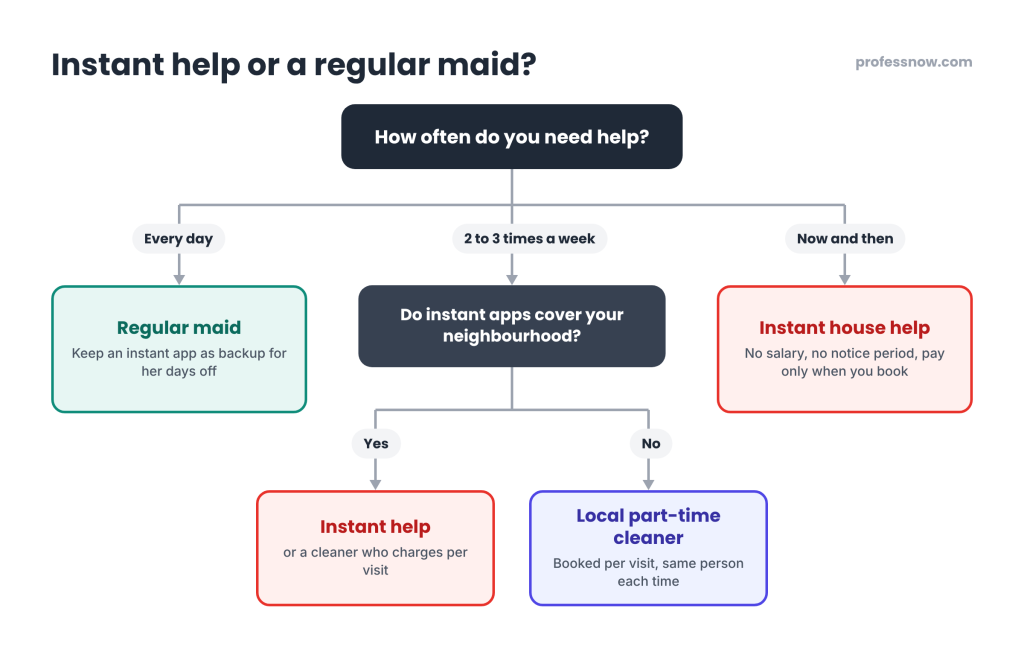
If you want a simple rule of thumb:
- Daily help, including cooking: hire a regular maid and keep an instant app as backup for her days off.
- Help two or three times a week: book instant help, or a part-time cleaner who charges per visit.
- Help only once in a while: instant help, easily.
- Not in a covered area: go with a regular helper or a local professional.
In practice, a lot of city families land on a mix: a regular person for the daily routine and an app for the days she’s away. For most homes right now, that combination is the most practical setup.
Hiring a regular helper without the usual headaches
If you go the regular route, a few simple habits prevent most problems later:
- Get police verification done. In most metros the city police offer domestic help verification, and many let you apply online.
- Keep a copy of their ID and an emergency contact number.
- Agree on tasks, timings, monthly leaves and the festival bonus before day one, ideally in writing.
- Start with a one or two-week trial.
- Pay by UPI so both of you have a clear record.
Finding a good, reliable person is usually the hardest part. On ProfessNow, you can search for home cleaners and housekeeping professionals in your city, check their profiles and book a first visit right through the platform. If the person is a good fit, you simply keep booking them. Our guide on what to check before hiring a local service provider goes deeper into vetting.
Frequently asked questions
Is instant house help safe in India?
The major apps say they run background checks and police verification on their workers and track quality through ratings. Still, be at home for the first few bookings and keep valuables out of sight, as you would with any new helper.
How much does instant house help cost?
Roughly ₹99 to ₹250 an hour on most apps as of late 2026, with offers sometimes going far lower. Prices change by city and time of day, and they’re likely to rise as the discounts end.
Can instant house help cook?
Mostly no. The apps focus on cleaning, dishes, laundry and kitchen prep. A few are testing home cooks in selected neighbourhoods.
Which cities have 10-minute house help?
Mainly the big metros, such as Mumbai, Delhi NCR, Bengaluru, Pune, Hyderabad and Kolkata, and only in certain areas within them. Enter your exact address in the app to check.
Is instant house help cheaper than a monthly maid?
For occasional use, yes. For an hour of help every day, a regular maid usually costs less once you compare against full app prices.