
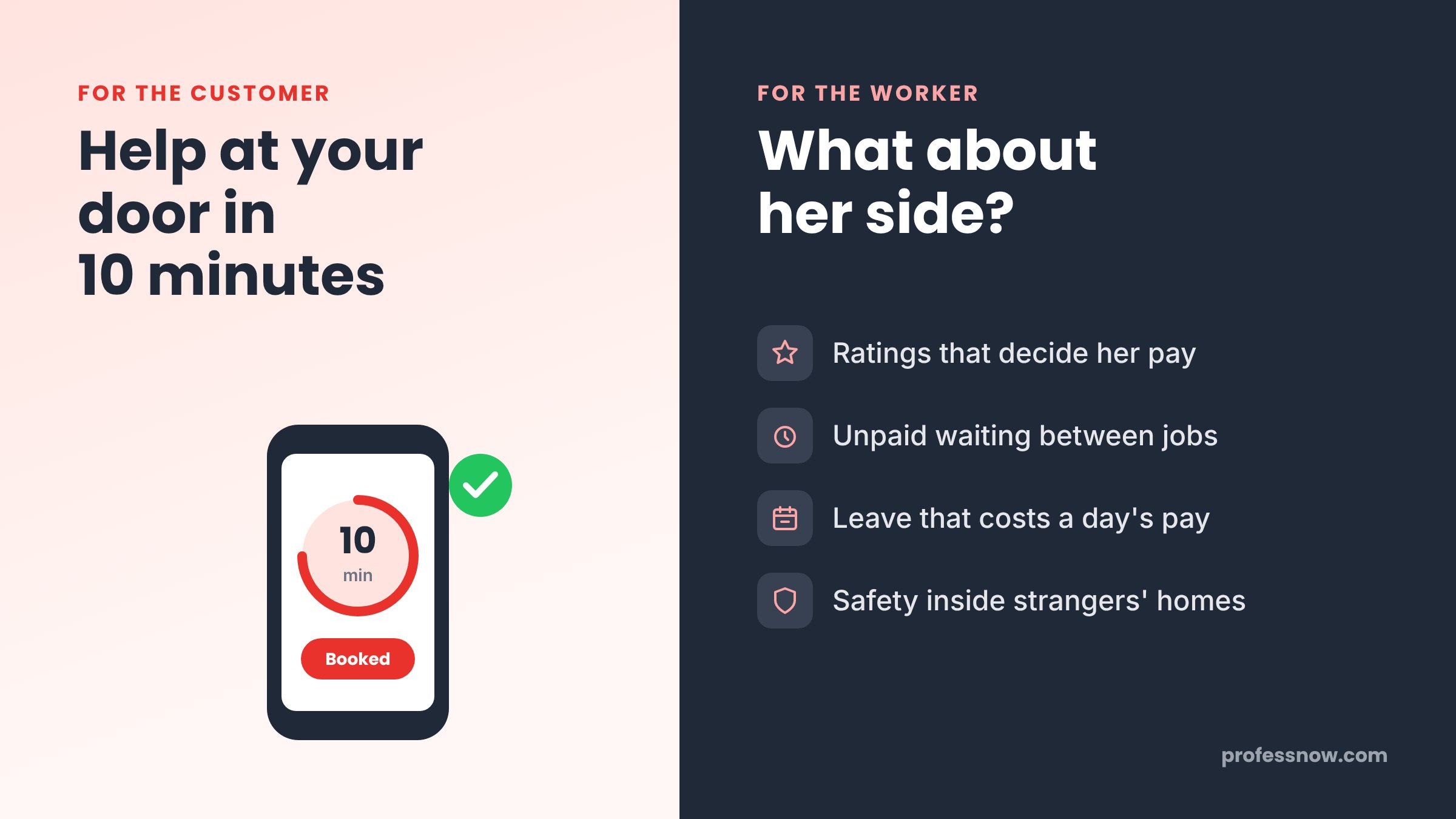
From the customer’s side, 10-minute house help is almost too easy. You tap a button, pay ₹99 or so, and a woman in a uniform rings the bell before the kettle has boiled. The dishes get done, the floor gets mopped, and she’s gone.
From her side, the story is a lot more complicated. Better money than the old system, yes, for many women. But also ratings that can cut her pay, leave that costs her a day’s earnings, hours of unpaid waiting, and the risk of walking into a stranger’s home eight or nine times a day.
If you’ve used Snabbit, Urban Company’s InstaHelp or Pronto, here’s what’s happening on the other side of the door, and what you can do to make it fairer.
Why so many women are signing up
Domestic work in India has always run on word of mouth. A didi works in four or five houses, each paying a fixed monthly amount that might not change for years. No written terms, no bonus guarantee, nothing if a family suddenly says they don’t need her anymore.
The apps offered something different. During their early recruitment drives, platforms went straight into slums and chawls with pamphlets promising ₹20,000 to ₹30,000 a month. For a lot of women, that was more than they had ever earned.
And for many, the money did go up. When Scroll interviewed about 35 women working on these apps in Mumbai in March 2026, they reported earning up to ₹22,000 a month on Snabbit for eight-hour days, about ₹21,000 on InstaHelp, and up to ₹24,000 on Pronto. Workers putting in 12-hour days said they could reach ₹32,000 to ₹40,000. One Snabbit worker from West Bengal put it simply: her income had “roughly doubled”.
Workers also like choosing their own hours, getting paid on a fixed cycle, and having bonuses for logging in early or working overtime. That part of the story is real, and it’s why the apps keep finding new workers.
What 10-minute house help workers say isn’t working
Pay that keeps changing
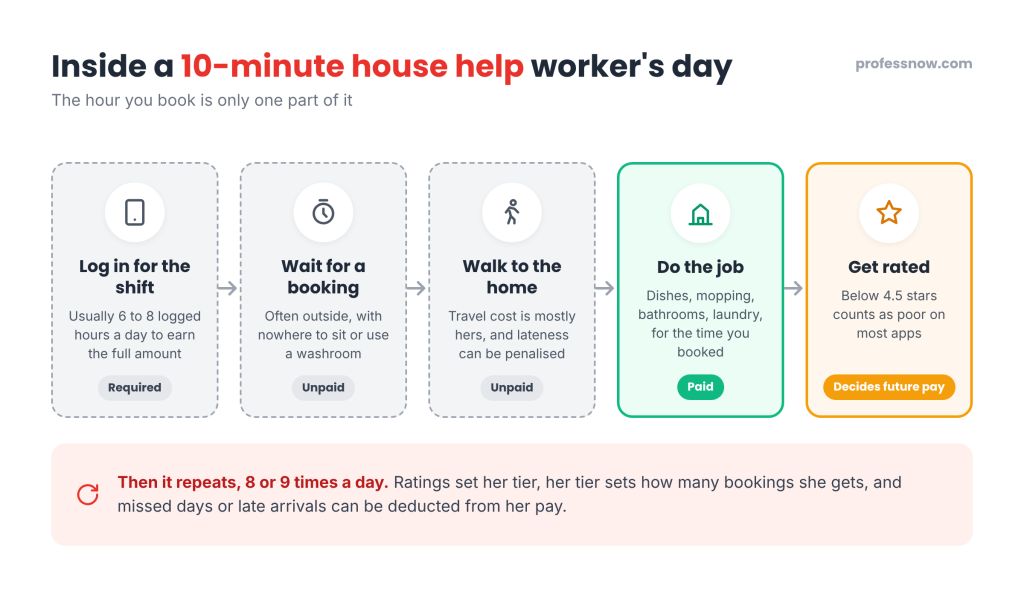
When InstaHelp launched in March 2025, Urban Company promised a minimum of ₹20,000 a month for 132 logged hours. Over time, workers say pay moved to the same model the whole industry now uses: tied to logged hours and ratings. Some InstaHelp workers told Decode in April 2026 that they were taking home ₹10,000 to ₹12,000 after deductions. Pronto, for its part, says plainly that it has no fixed minimum monthly salary, and workers told Scroll that pay for new recruits dropped from ₹28,000 to ₹24,000 last year.
Ratings decide almost everything
On all three apps, workers say anything below 4.5 stars counts as a poor rating. Most customers don’t know this. They give four stars for a good job, thinking it’s a decent score, and the worker pays for it later.
Ratings feed into tiers (Urban Company uses diamond, gold and silver), and tiers decide how many bookings a worker gets. Workers on InstaHelp told Decode that three low ratings in a row can get their ID blocked without explanation. That pressure also makes it harder to say no when a customer asks for extra work, like scrubbing fans or deep-cleaning a bathroom that wasn’t part of the booking.
Leave that isn’t really leave
Taking a day off usually means earning nothing that day, and weekends are often off-limits altogether. Workers on different apps described losing around ₹1,000 for a missed day, though Snabbit’s CEO has denied that his company has such a policy. InstaHelp workers surveyed in March 2026 said that logging out mid-shift for an emergency could cost them the full day’s pay.
Unpaid waiting and walking
The 10-minute house help promise is partly made possible by women waiting nearby with nothing to do. Pronto’s own CEO told Inc42 that waiting takes up 13 to 20 percent of a worker’s day, and that time is unpaid. Travel between homes is mostly on the worker too. Many walk. Between bookings, there’s often nowhere to sit, and in busy areas no washroom either.
Safety inside strangers’ homes
Workers go through background checks. Customers don’t. Anyone with the app can book a woman to come to their home, and she can’t always turn down a booking without losing money.
The companies have added some protections. All three apps have an SOS button. Pronto offers self-defence training, and Urban Company runs a women-only safety helpline. Still, the Indian Federation of App-Based Transport Workers says it has received harassment complaints, including alleged sexual harassment, and that the fear of a bad rating can push women to put up with behaviour they shouldn’t have to. Workers have also described being refused water, kept away from the washroom, or given separate utensils, sometimes because of caste.
In April 2026, more than 50 women gathered outside an Urban Company hub in Noida to protest falling pay and penalties. Police dispersed the gathering and detained at least 15 of them, according to Decode.
Is anything changing?
Slowly, yes. The Code on Social Security, 2020 came into force on 21 November 2025. It’s the first central law that formally recognises gig and platform workers, and it makes them eligible for government schemes such as accident insurance, health and maternity benefits. Workers register through the e-Shram portal, and platforms are supposed to contribute 1 to 2 percent of their turnover to a social security fund. The catch: as of September 2026, the government still hadn’t notified the actual contribution rate or when it starts.
Some states have moved faster. Karnataka’s gig workers law, passed in 2025, specifically covers home services booked through apps. It makes platforms pay a welfare fee on worker payouts and gives workers a welfare board and a way to raise disputes. Rajasthan, Bihar, Jharkhand and Telangana have similar efforts.
There’s also the “10 minutes” question itself. In January 2026, after talks with the Labour Ministry, Blinkit, Zepto, Swiggy and Zomato agreed to drop their “10-minute delivery” branding because of concerns about rider safety. Yet 10-minute house help is still sold on exactly that promise. House-help workers mostly walk, so the road risk is different, but the time pressure is the same: arrive late and it can show up in your rating or your pay. Whether the same thinking will reach this sector is an open question.
What you can do as a customer
You don’t have to stop using these apps. But a few small habits make a real difference to the person who shows up.
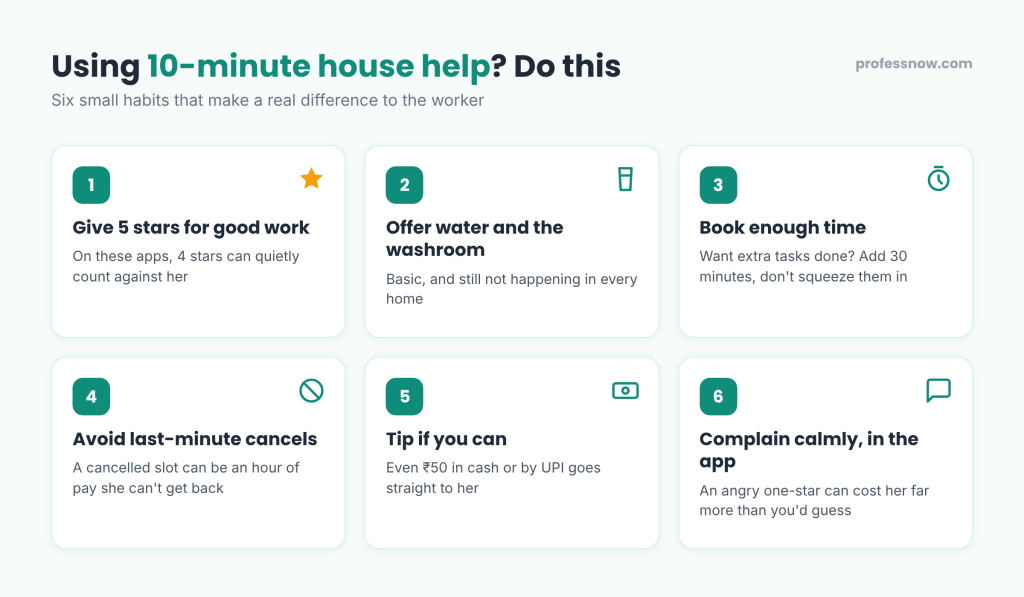
- Rate honestly, and know what the stars mean. If she did a good job, give five stars. On these apps, four stars can quietly count against her.
- Offer water and let her use the washroom. It sounds basic, and it still isn’t always happening.
- Book enough time. If you want the fans and the balcony done too, add another 30 minutes instead of squeezing it into the slot.
- Don’t cancel at the last minute. A cancelled booking can mean a lost hour she can’t get back.
- Tip if you can. Even ₹50 in cash or by UPI goes straight to her.
- Raise problems through the app, calmly. A one-star rating out of irritation can cost her far more than you’d guess.
A different way to hire
Instant apps work by making the worker interchangeable. Whoever is closest gets sent. That’s what makes 10 minutes possible, and it’s also why a worker has so little control over her day.
There’s another model. On ProfessNow, home cleaners and housekeepers create their own profiles, list their own services and fees, and confirm the bookings that come in. Customers who like someone’s work can book the same person again, so a good worker builds regular clients and a reputation instead of starting from zero with every tap. If you’re a cleaner or housekeeper looking for work on your own terms, you can join ProfessNow as a professional. If you’re hiring, you can find home cleaners in your city.
Still deciding between an app and a regular helper? Our guide on instant house help vs a regular maid compares the cost, reliability and convenience side by side.
Frequently asked questions
How much do 10-minute house help workers earn?
Workers interviewed in Mumbai in early 2026 reported roughly ₹21,000 to ₹24,000 a month for eight-hour days, and up to ₹32,000 to ₹40,000 for 12-hour days. Actual take-home varies a lot with ratings, penalties, leave and how many bookings come in.
Do instant house help workers get any benefits?
Some platforms say they provide health insurance and accident cover. Under the Code on Social Security, workers can also register on e-Shram for government schemes. Leave, though, is mostly unpaid.
Is 10-minute house help safe for women workers?
Workers are background-checked and the apps have SOS features, but customers aren’t vetted. Worker groups have reported harassment complaints, so safety is still a real concern.
Should I tip a 10-minute house help worker?
If you can, yes. A tip goes straight to the worker, and in a model where pay depends on ratings and logged hours, it’s one of the few things that adds to her earnings without conditions.