
Introduction
In the rapidly evolving landscape of modern IT operations, managing the sheer volume of data generated by distributed systems has moved beyond human scale. The Certified AIOps Professional certification is designed to bridge the gap between traditional monitoring and intelligent, automated operations. Whether you are a seasoned SRE or a rising DevOps engineer, this aiopsschool program provides a structured approach to integrating machine learning and data analytics into your incident management lifecycle. This guide helps you navigate the complexities of modern observability and automation, ensuring you can make informed decisions about your professional development. By focusing on practical application rather than mere theory, you will learn how to reduce noise, improve mean time to resolution, and build resilient infrastructure.
What is the Certified AIOps Professional?
The Certified AIOps Professional certification represents a comprehensive framework for implementing artificial intelligence in IT operations. It exists to standardize the way organizations handle event correlation, anomaly detection, and automated remediation in complex cloud environments. Unlike traditional certifications that focus on single-tool mastery, this program emphasizes architectural understanding and the ability to apply intelligence across the entire stack. It aligns perfectly with modern engineering workflows that prioritize proactive issue detection over reactive troubleshooting. By focusing on production-focused outcomes, the certification ensures that professionals are prepared to manage the high-velocity data challenges inherent in modern enterprise systems.
Who Should Pursue Certified AIOps Professional?
This certification is intended for a broad spectrum of IT professionals who manage or operate complex production environments. Software engineers, Site Reliability Engineers, and cloud platform specialists will find immediate value in the automation methodologies taught. Security and data professionals who need to correlate security signals with operational data will also benefit from the cross-functional nature of the curriculum. For engineering managers and technical leaders, the program provides the necessary knowledge to evaluate and implement AIOps strategies within their teams. Whether you are based in India or working in a global remote environment, this certification provides a universal language for modern operational intelligence.
Why Certified AIOps Professional
The demand for professionals who can bridge the gap between data science and operational reliability is growing exponentially. As enterprises move toward autonomous operations, the ability to interpret and act on algorithmic insights is becoming a non-negotiable skill for high-level engineers. This certification ensures that you remain relevant in an industry where traditional manual monitoring is being rapidly replaced by automated, intelligent systems. By investing in this skill set, you secure a competitive advantage in the job market, demonstrating that you can drive down operational costs while significantly increasing system uptime. The return on investment is measured in both career advancement and the ability to deliver more stable, reliable software products.
Certified AIOps Professional Certification Overview
The program is delivered via the Official URL and hosted on [aiopsschool]. It offers a tiered approach to certification, ensuring that candidates can progress from foundational knowledge to specialized professional mastery. The assessment approach is designed to test your ability to apply concepts to real-world scenarios rather than simply recalling definitions. Ownership of the certification rests with the industry-standard bodies that govern the curriculum, ensuring that the content remains aligned with the latest technological shifts. Each certification level is structured to validate specific competencies, making it easy for employers to identify candidates with the right level of practical expertise.
Certified AIOps Professional Certification Tracks & Levels
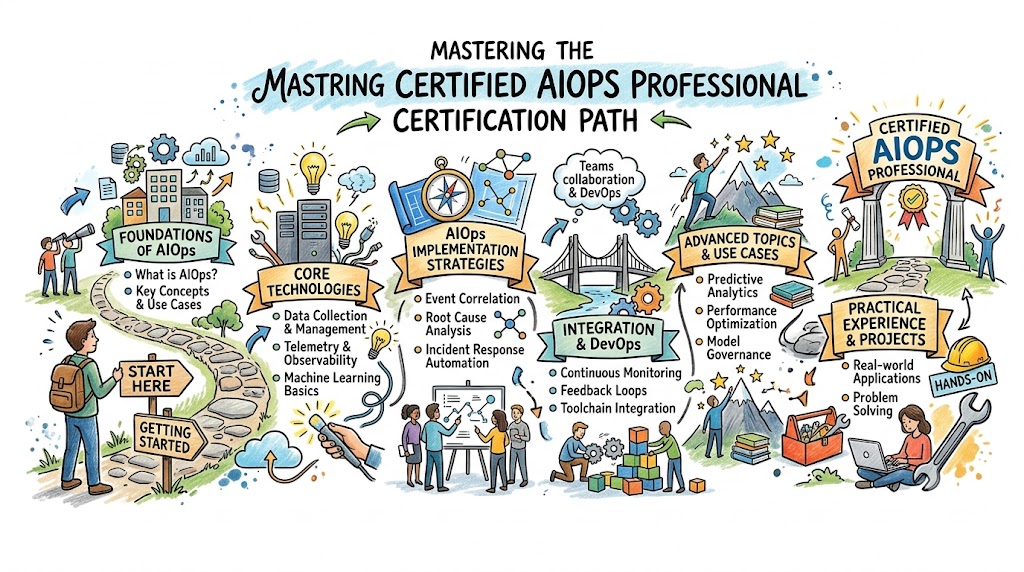
The certification framework is divided into distinct levels: Foundation, Professional, and Advanced. Foundation levels focus on the core principles of observability and data ingestion, which are essential for any engineer starting their AIOps journey. The Professional level dives deeper into the specific machine learning models and automation workflows required to manage large-scale infrastructure. Advanced tracks offer specializations such as predictive analytics, automated incident response, and complex environment modeling. These levels are mapped to your career progression, allowing you to start with basics and build toward an expert-level understanding of intelligent operations as your professional experience grows.
Complete Certified AIOps Professional Certification Table
| Track | Level | Who it’s for | Prerequisites | Skills Covered | Recommended Order |
| Operations | Foundation | Junior Engineers | Basic Monitoring | Data Collection, Noise Reduction | 1 |
| Engineering | Professional | SRE / DevOps | Operational Experience | Anomaly Detection, Modeling | 2 |
| Strategy | Advanced | Managers / Leads | Professional Cert | Predictive Analytics, ROI Analysis | 3 |
Detailed Guide for Each Certified AIOps Professional Certification
Certified AIOps Professional – Foundation Level
What it is
This certification validates a foundational understanding of how AI techniques are applied to operational data. It covers the basics of event correlation and data ingestion methods.
Who should take it
Suitable for junior engineers, IT operators, and developers looking to transition into modern observability roles.
Skills you’ll gain
- Understanding telemetry data patterns
- Basic event correlation techniques
- Setting up automated alert thresholds
- Using log aggregation tools for AI readiness
Real-world projects you should be able to do
- Cleaning and normalizing operational logs for analysis
- Configuring basic anomaly detection on a small cluster
- Reducing alert fatigue by implementing simple suppression rules
Preparation plan
- 7–14 days: Review foundational monitoring concepts and data types.
- 30 days: Complete labs focused on log aggregation and threshold setting.
- 60 days: Conduct a mock analysis of a sample production environment.
Common mistakes
Focusing too much on specific proprietary tools instead of the core logic, and failing to understand the underlying data quality requirements.
Best next certification after this
- Same-track: Certified AIOps Professional – Professional Level
- Cross-track: Certified SRE Professional
- Leadership: IT Operations Management Certification
Choose Your Learning Path
DevOps Path
The DevOps path focuses on integrating AI-driven insights directly into the CI/CD pipeline. You will learn how to automate deployment health checks and use predictive modeling to avoid failed releases. This path is essential for engineers aiming to build self-healing delivery pipelines.
DevSecOps Path
This path emphasizes the intersection of security data and operational stability. You will learn how to use machine learning to identify security threats that mimic operational anomalies. It is a critical focus area for those securing cloud-native infrastructures.
SRE Path
The SRE path is dedicated to achieving high availability through intelligent automation. You will focus on SLO management and the use of AIOps to automate root cause analysis. This path transforms your approach to incident management from manual to automated.
AIOps Path
This path is for those who want to master the intelligence side of operations. You will spend time analyzing complex data sets, fine-tuning ML algorithms for specific environments, and building custom predictive models for system capacity and performance.
MLOps Path
The MLOps path bridges the gap between data science models and production deployment. You will learn how to maintain the health of ML models in production and ensure they provide accurate insights for operational decisions.
DataOps Path
The DataOps path focuses on the lifecycle of operational data. You will learn how to manage data pipelines to ensure the quality, availability, and consistency of data fed into AIOps engines. It is the backbone of any successful AI implementation.
FinOps Path
The FinOps path teaches you to use operational data to drive cost efficiency. You will learn how to use predictive analytics to right-size infrastructure and identify waste before it impacts the budget. This is a vital skill for modern cloud management.
Role → Recommended Certified AIOps Professional Certifications
| Role | Recommended Certifications |
| DevOps Engineer | Professional Level AIOps |
| SRE | Advanced Level AIOps |
| Platform Engineer | Professional Level AIOps |
| Cloud Engineer | Foundation Level AIOps |
| Security Engineer | DevSecOps Specialization |
| Data Engineer | DataOps Specialization |
| FinOps Practitioner | FinOps Specialization |
| Engineering Manager | Advanced Strategy AIOps |
Next Certifications to Take After Certified AIOps Professional
Same Track Progression
Once you have mastered the Professional level, the next logical step is the Advanced level. This involves taking on complex architecture design tasks and leading organizational-wide AIOps transformations. You will move from being a user of tools to an architect of solutions.
Cross-Track Expansion
Expand your expertise by pursuing certifications in DataOps or FinOps. These tracks complement your AIOps knowledge by adding layers of data pipeline integrity and cost-optimization strategies, making you a more versatile engineer.
Leadership & Management Track
For those transitioning to management, focus on certifications that emphasize organizational strategy, ROI measurement, and team transformation. This helps you translate technical AI initiatives into business value for executive stakeholders.
Training & Certification Support Providers for Certified AIOps Professional
DevOpsSchool is a premier provider offering deep-dive training, hands-on labs, and expert mentorship to help candidates master the complexities of AIOps.
Cotocus specializes in enterprise-grade curriculum delivery, focusing on the practical application of intelligent operations within large-scale distributed systems.
Scmgalaxy provides a robust learning environment with a focus on version control and automation integration, essential for any AIOps professional.
BestDevOps offers curated content designed to keep practitioners updated with the latest industry standards and certification requirements.
devsecopsschool focuses on the critical security aspects of AIOps, ensuring professionals understand how to protect intelligent operational infrastructure.
sreschool provides targeted training for site reliability engineers who want to integrate AI into their existing incident management and uptime strategies.
aiopsschool serves as the primary hub for all certifications related to AIOps, providing comprehensive learning paths and resources for all skill levels.
dataopsschool offers specialized modules on managing operational data streams, a key prerequisite for effective artificial intelligence implementation.
finopsschool focuses on the financial implications of operations, teaching engineers how to utilize AI for cloud cost optimization and resource planning.
Frequently Asked Questions (General)
- How difficult is it to obtain the certification?The difficulty level is calibrated for working professionals, requiring a mix of theoretical knowledge and hands-on laboratory work.
- How much time should I allocate for study?Most professionals find that 4 to 8 weeks of consistent study is sufficient to master the material and pass the assessment.
- What are the prerequisites for the Foundation level?Basic familiarity with cloud operations, standard monitoring tools, and general data concepts is highly recommended.
- Is this certification recognized globally?Yes, the curriculum is built on industry-standard practices, ensuring your skills are transferable across borders and sectors.
- Does the certification expire?Certifications typically require periodic renewal or continuing education credits to ensure your knowledge stays current with evolving AI technologies.
- Can I manage this with a full-time job?The curriculum is designed for flexibility, allowing you to learn at your own pace through self-paced modules and weekend labs.
- How does this certification improve my salary potential?By validating high-demand skills in AI and automation, you position yourself for specialized roles that command a premium in the market.
- Is there a lab component to the exam?Yes, the assessment includes practical scenarios that require you to apply your knowledge to real-world configuration tasks.
- What if I have no background in machine learning?The program starts with core concepts that bridge the gap, making it accessible to those with a strong operations background.
- Are there any group discounts for teams?Many of the training providers offer bulk enrollment options for engineering teams looking to upskill simultaneously.
- How does this differ from traditional monitoring certifications?Traditional certifications focus on static dashboards, while this emphasizes dynamic, machine-learning-driven insights and automated remediation.
- Where can I find the official curriculum syllabus?The most up-to-date syllabus is available directly on the official certification page for each respective track.
FAQs on Certified AIOps Professional
- What specific AI models are covered in the training?The training covers anomaly detection, trend forecasting, and clustering models tailored for log and metric data analysis.
- How do I ensure data quality before using these AIOps tools?The curriculum teaches strategies for data cleansing, normalization, and observability pipeline management as a foundation.
- Can this help in reducing false positives in alerts?Yes, event correlation and suppression are core topics specifically designed to tackle alert fatigue and noise reduction.
- Is coding required for the certification assessments?Basic scripting skills are necessary for configuring automation scripts and data processing pipelines during the labs.
- How does this help in incident response?You will learn to automate the discovery of root causes by correlating disparate data sources during an incident.
- Is there a focus on specific cloud providers?The principles are cloud-agnostic, though labs often use popular cloud environments to demonstrate real-world implementation.
- Can I apply these skills to on-premise systems?Absolutely, the principles of AIOps are designed to work across hybrid environments, including legacy on-premise infrastructure.
- What is the primary role of an AIOps professional?To design, implement, and maintain intelligent systems that automate operational tasks and provide actionable insights.
Final Thoughts: Is Certified AIOps Professional Worth It?
Investing in the Certified AIOps Professional program is a strategic move for any engineer serious about the future of IT operations. It is not about chasing the latest trend, but about building a fundamental understanding of how to manage the complexity of modern systems. The curriculum forces you to move beyond manual intervention, pushing you to design resilient, self-correcting environments. If you are committed to long-term career growth, this certification provides the practical expertise that distinguishes top-tier engineers from the rest. It is a rigorous path, but one that yields significant returns in both technical capability and career trajectory.
Informative and well-structured post! The certification path is explained clearly, making it easier for professionals to understand the skills and opportunities in AIOps.