
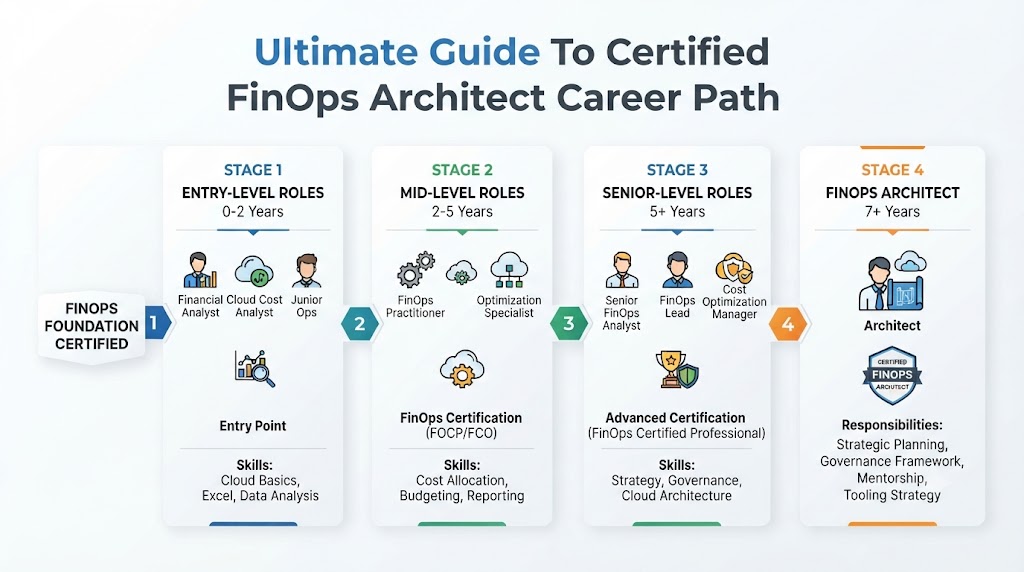
Introduction
Cloud computing costs have become one of the most critical challenges for modern enterprises, requiring a strategic bridge between engineering, finance, and business operations. Obtaining the Certified FinOps Architect designation is a decisive step for professionals aiming to solve these complex cloud financial challenges at scale. This comprehensive guide is designed for working software engineers, managers, and platform leaders who wish to understand the value of the training provided by FinOpsSchool. We will explore how mastering cost optimization positions you at the forefront of modern cloud-native and platform engineering careers. By following this detailed breakdown, you will gain the clarity required to make highly informed career decisions and accelerate your professional trajectory in a competitive global market.
What is the Certified FinOps Architect?
The Certified FinOps Architect represents a specialized validation of an engineer’s ability to design, implement, and manage highly cost-efficient cloud architectures. It exists because modern organizations desperately need technical leaders who can control cloud expenditure without sacrificing system performance, security, or reliability. This path emphasizes real-world, production-focused learning over abstract financial theory, ensuring candidates can tackle actual billing complexities and resource allocation challenges. It aligns perfectly with modern engineering workflows by bringing financial accountability directly into the continuous integration and continuous deployment pipelines. Ultimately, it transforms cost management from a reactive accounting task into a proactive engineering discipline embedded in the system’s core design.
Who Should Pursue Certified FinOps Architect?
This career path is exceptionally beneficial for current cloud professionals, DevOps engineers, and Site Reliability Engineers who want to elevate their strategic impact beyond basic infrastructure provisioning. Engineering managers and technical leaders will find it invaluable for managing large departmental budgets, negotiating with cloud vendors, and driving a culture of cost optimization across multiple teams. Security and data professionals also benefit significantly, as massive data processing workloads and extensive security logging often generate hidden and explosive cloud costs. Whether you are an experienced architect looking to define a niche or a mid-level engineer bridging the gap with finance teams, this path offers immense practical value. Furthermore, this knowledge is highly sought after across global enterprise markets and the rapidly expanding technology ecosystem in India.
Why Certified FinOps Architect
The industry demand for technical professionals who can actively control cloud expenditure has skyrocketed as enterprise adoption of multi-cloud and hybrid-cloud strategies deepens. Companies are quickly realizing that technical excellence must go hand-in-hand with financial viability, ensuring long-term longevity and security for this specific career path. This certification helps professionals stay highly relevant despite constant changes in underlying cloud provider tools, as the fundamental principles of financial operations and unit economics remain constant. It provides an exceptional return on your time and career investment by positioning you directly for senior architectural and leadership roles within the organization. Mastering these specialized skills makes you an indispensable corporate asset capable of protecting the company’s bottom line in any economic climate.
Certified FinOps Architect Certification Overview
The official training and rigorous assessment program is delivered via the designated course page and securely hosted on the primary provider website. The certification levels are meticulously designed to take candidates from fundamental financial awareness to the advanced implementation of cost-aware architectural designs. The assessment approach focuses heavily on practical, scenario-based evaluations, ensuring candidates can analyze real cloud billing data, enforce strict tagging governance, and recommend architectural shifts. The ownership and evolution of this domain rest with senior industry professionals who deeply understand the delicate balance between technical constraints and aggressive business profitability goals. The entire curriculum structure is logically organized to mirror the actual phases of the continuous lifecycle: inform, optimize, and safely operate.
Certified FinOps Architect Certification Tracks & Levels
The educational journey typically begins with a foundation level, which establishes the core vocabulary and crucial concepts needed for engineers to collaborate effectively with finance and procurement teams. Moving forward, the professional level dives deeply into technical implementation, teaching engineers how to build custom cost dashboards, automate tagging compliance, and optimize idle resources. The advanced architectural level focuses heavily on high-level system design, multi-cloud strategy, and leading organizational change management for senior practitioners. Specialization tracks often branch into critical areas like DevOps pipeline integration, SRE reliability cost balancing, and data processing efficiency optimization. These progressively demanding technical levels ensure a clear, well-structured, and highly logical alignment with your long-term career progression and corporate leadership aspirations.
Complete Certified FinOps Architect Certification Table
| Track | Level | Who it’s for | Prerequisites | Skills Covered | Recommended Order |
| Core Strategy | Foundation | Cloud Engineers, Finance | Basic Cloud Knowledge | Terminology, Billing, Visibility | 1 |
| Implementation | Professional | DevOps, SRE, Platform | Foundation Cert, CI/CD | Tagging, Automation, Dashboards | 2 |
| Architecture | Advanced | Principal Engineers, Leads | Professional Cert, Architecture | Multi-cloud strategy, Unit Economics | 3 |
| SRE Integration | Specialization | Site Reliability Engineers | Professional Cert | Reliability vs Cost Tradeoffs | 4 |
| Data Systems | Specialization | Data Engineers, DataOps | Foundation Cert, Big Data | Query optimization, Storage tiers | 5 |
Detailed Guide for Each Certified FinOps Architect Certification
Certified FinOps Architect – Foundation
What it is
This entry-level certification validates a candidate’s basic understanding of cloud financial management principles and core vocabulary. It establishes the groundwork for aligning technical decisions with corporate business objectives.
Who should take it
This is ideal for junior to mid-level cloud engineers, system administrators, and even non-technical finance professionals looking to understand cloud economics. It serves as the perfect entry point for anyone transitioning into a dedicated platform or cost-optimization role.
Skills you’ll gain
- Understanding cloud billing models and pricing structures.
- Identifying basic cost anomalies and reporting them.
- Bridging communication gaps between engineering and finance.
- Implementing basic resource tagging strategies.
Real-world projects you should be able to do
- Generate a comprehensive monthly cloud spend report for department heads.
- Identify unattached storage volumes and idle compute instances.
- Create a standardized tagging policy document for engineering teams.
- Map cloud usage back to specific business units or products.
Preparation plan
For a 7 to 14-day timeline, focus entirely on understanding core terminology and reviewing sample cloud bills. Over 30 days, practice mapping basic cloud resources to billing line items in a free-tier environment. A 60-day plan allows for deep exploration of cost visibility tools and cross-departmental communication strategies.
Common mistakes
- Focusing too much on technical tools rather than business concepts.
- Ignoring the cultural aspect of bringing teams together.
- Failing to understand the difference between Capex and Opex in cloud contexts.
- Overlooking the importance of consistent resource tagging from day one.
Best next certification after this
- Same-track option: Certified FinOps Architect – Professional
- Cross-track option: Cloud Provider Foundation Certification (AWS/Azure/GCP)
- Leadership option: Agile Project Management Foundations
Certified FinOps Architect – Professional
What it is
This mid-level certification validates the ability to actively implement cost optimization strategies and automate financial guardrails. It proves you can translate financial goals into concrete engineering tasks and CI/CD pipeline checks.
Who should take it
Targeted at active DevOps engineers, SREs, and platform engineers who build and maintain enterprise cloud environments. Candidates should have hands-on experience provisioning infrastructure and managing deployment automation.
Skills you’ll gain
- Automating resource scheduling and rightsizing recommendations.
- Implementing infrastructure-as-code (IaC) cost estimation tools.
- Managing reserved instances and savings plan portfolios.
- Building automated alerting for unexpected spending spikes.
Real-world projects you should be able to do
- Integrate cost estimation tools like Infracost into GitHub Actions.
- Write scripts to automatically terminate non-production resources at night.
- Analyze performance metrics to right-size oversized database instances.
- Centralize organizational billing data into a unified analytics dashboard.
Preparation plan
A 7 to 14-day sprint should focus on mastering infrastructure-as-code integration and automation scripts. The 30-day approach should involve building actual cost dashboards and writing automated alerting rules in a lab. For a 60-day plan, simulate a complete enterprise environment and implement a full suite of automated financial guardrails.
Common mistakes
- Implementing aggressive cost-cutting that negatively impacts application performance.
- Creating alert fatigue by setting budget thresholds too low or too frequently.
- Failing to collaborate with application teams before modifying their resources.
- Relying entirely on manual interventions instead of building automated guardrails.
Best next certification after this
- Same-track option: Certified FinOps Architect – Advanced
- Cross-track option: Certified Kubernetes Administrator (CKA)
- Leadership option: Cloud Security Management Certification
Certified FinOps Architect – Advanced
What it is
This top-tier certification proves mastery in designing massive, highly efficient cloud ecosystems and driving organizational culture shifts. It signifies that the holder can balance multi-million dollar budgets with elite engineering performance.
Who should take it
Designed for principal engineers, chief architects, and senior engineering managers responsible for global infrastructure. Candidates should have deep experience in system architecture and a strong understanding of corporate finance strategy.
Skills you’ll gain
- Designing multi-cloud and hybrid-cloud cost arbitration systems.
- Establishing unit economics (cost per transaction/user).
- Leading widespread cultural shifts toward engineering accountability.
- Negotiating enterprise discount programs and custom cloud contracts.
Real-world projects you should be able to do
- Redesign a monolithic application architecture to leverage serverless computing for cost efficiency.
- Calculate and track the exact cloud infrastructure cost required to serve a single customer.
- Establish a cloud center of excellence governing thousands of developers.
- Evaluate and implement a cross-cloud workload migration strategy based on pricing arbitrage.
Preparation plan
In 7 to 14 days, concentrate on advanced unit economics and enterprise contract negotiation principles. Over 30 days, analyze complex architectural case studies and redesign them for maximum financial efficiency. A 60-day preparation requires building a comprehensive, organization-wide financial operations rollout strategy for a massive enterprise.
Common mistakes
- Designing overly complex architectures that save money but are impossible to maintain.
- Ignoring the developer experience when imposing strict cost governance rules.
- Treating financial operations as an IT problem rather than a core business strategy.
- Failing to establish clear unit economics before attempting to measure optimization success.
Best next certification after this
- Same-track option: Specialized tracks (Data Systems, SRE Integration)
- Cross-track option: Certified Enterprise Architect (TOGAF)
- Leadership option: Executive MBA or Technology Management Certification
Choose Your Learning Path
DevOps Path
The DevOps path focuses on integrating cost visibility directly into the software delivery lifecycle and continuous integration pipelines. Professionals taking this route will learn to catch expensive infrastructure misconfigurations before they are deployed to production. It emphasizes the use of infrastructure-as-code testing and automated policy enforcement tools. This path transforms traditional release engineering by ensuring every deployment is both technically sound and financially efficient.
DevSecOps Path
Professionals on the DevSecOps path will balance the intricate demands of strict security compliance with aggressive cost management. Security tools, extensive logging, and continuous threat monitoring often consume vast amounts of expensive cloud resources. This route teaches engineers how to optimize data retention policies, streamline security telemetry, and right-size security appliances. The goal is to build impenetrable systems that do not needlessly inflate the monthly cloud billing statement.
SRE Path
The Site Reliability Engineering path tackles the natural friction between maintaining high system availability and controlling infrastructure expenses. SREs will learn to accurately price the cost of high availability, multi-region redundancy, and disaster recovery setups. This track heavily involves analyzing service level objectives (SLOs) to determine if an application is being over-provisioned for unnecessary reliability. It ensures that engineering teams only pay for the exact level of uptime the business truly requires.
AIOps Path
Engineers following the AIOps path will leverage artificial intelligence and machine learning to predict and manage cloud spending. This route focuses on building intelligent systems that can automatically detect billing anomalies and suggest architectural improvements. Professionals will learn to utilize predictive analytics to forecast future capacity needs and optimize reserved instance purchases dynamically. It represents the cutting edge of cost management, relying on data science rather than manual spreadsheet analysis.
MLOps Path
The MLOps path is dedicated to managing the notoriously high costs associated with training and serving machine learning models. Professionals will learn how to optimize expensive GPU instance usage, manage massive training datasets efficiently, and utilize spot instances safely. This track ensures that AI initiatives remain financially viable by closely monitoring the unit economics of model inference. It is critical for organizations heavily invested in generative AI and deep learning research.
DataOps Path
DataOps professionals will focus on optimizing the storage, processing, and querying of massive enterprise datasets across various cloud platforms. This path teaches engineers how to architect efficient data lakes, utilize appropriate storage tiers, and optimize complex SQL queries to minimize processing costs. Data pipelines are frequent sources of unchecked spending, making this knowledge absolutely vital for enterprise data teams. The objective is to deliver rapid data insights without incurring exponential infrastructure charges.
FinOps Path
The pure FinOps path is designed for those who want to specialize entirely in cloud financial management and organizational culture. These professionals act as the ultimate bridge between the CFO’s office and the Chief Technology Officer’s engineering teams. They focus heavily on reporting, contract negotiation, vendor management, and driving cost-accountability across all engineering pods. This path leads directly to specialized leadership roles such as Director of Cloud Economics or Head of Cloud Financial Management.
Role → Recommended Certified FinOps Architect Certifications
| Role | Recommended Certifications |
| DevOps Engineer | Foundation, Professional, CI/CD Specialization |
| SRE | Foundation, Professional, SRE Integration Track |
| Platform Engineer | Foundation, Professional, Advanced Architecture |
| Cloud Engineer | Foundation, Professional, Advanced Architecture |
| Security Engineer | Foundation, DevSecOps Optimization Track |
| Data Engineer | Foundation, Data Systems Specialization Track |
| FinOps Practitioner | Foundation, Professional, Advanced Architecture |
| Engineering Manager | Foundation, Advanced Architecture, Leadership Track |
Next Certifications to Take After Certified FinOps Architect
Same Track Progression
Continuing on the same track involves pursuing highly specialized micro-certifications that target specific cloud providers or architectural niches. Professionals can deepen their expertise by focusing exclusively on container cost optimization, serverless economics, or edge computing financial models. This progression ensures you remain the absolute technical authority on cost management within your specific engineering domain. Deep specialization leads to highly coveted consulting roles and principal architectural positions within massive enterprise organizations.
Cross-Track Expansion
Expanding across tracks means acquiring complementary skills that broaden your overall understanding of the software development lifecycle. By pursuing credentials in advanced Kubernetes administration, multi-cloud networking, or applied data engineering, you enhance your architectural vision. Understanding how other technical disciplines operate allows you to design cost-optimization strategies that respect their unique constraints. This cross-pollination of skills creates well-rounded platform engineers capable of solving complex, multi-disciplinary enterprise challenges.
Leadership & Management Track
The leadership track shifts the focus away from technical implementation and heavily toward organizational design, strategy, and business management. Professionals should pursue enterprise architecture frameworks, agile leadership certifications, or advanced technology management programs. This path prepares you to lead entire engineering departments, manage multi-million dollar vendor contracts, and communicate effectively with board members. It is the definitive route for transforming from a senior individual contributor into an executive technology leader.
Training & Certification Support Providers for Certified FinOps Architect
DevOpsSchool
DevOpsSchool is a globally recognized training organization that has been instrumental in shaping the careers of thousands of IT professionals. Their approach to training focuses heavily on real-world scenarios, ensuring that learners are not just memorizing theory but actually applying concepts to production-grade environments. When it comes to financial operations and cloud cost management, they provide excellent foundational knowledge that pairs perfectly with architectural design. Their trainers are experienced industry veterans who bring a wealth of practical insights into the classroom. The platform offers diverse learning formats, including self-paced courses, live online sessions, and corporate training bootcamps. This makes it a highly versatile choice for engineers and managers looking to upskill systematically while managing their daily work commitments effectively.
Cotocus
Cotocus stands out as a premier consulting and training provider with a strong emphasis on automation, continuous delivery, and cloud-native practices. They have built a solid reputation for helping enterprises streamline their software development lifecycles while optimizing underlying infrastructure costs. Their training methodology is deeply rooted in practical implementation, offering labs and hands-on projects that reflect the complexities of modern corporate environments. By choosing Cotocus, professionals gain access to a curriculum that bridges the gap between software engineering and financial accountability. They focus extensively on building resilient systems that do not break the bank, which is essential for any modern architecture. Their mentorship programs are particularly valuable for those aiming to transition into senior architectural or leadership roles smoothly.
Scmgalaxy
Scmgalaxy operates as a massive community-driven learning platform dedicated to software configuration management, deployment automation, and modern operational practices. They provide an extensive repository of community knowledge, tutorials, and structured training programs tailored for working technology professionals. Their certification support focuses on giving candidates exposure to a wide variety of tools and methodologies used in enterprise environments today. Learners benefit immensely from peer-to-peer discussions, shared real-world troubleshooting scenarios, and expertly curated curriculum paths. Their dedication to open-source tools and cost-effective operational strategies makes them an excellent resource for aspiring cloud architects. Engaging with Scmgalaxy ensures that your theoretical knowledge is constantly validated against practical challenges faced by engineers globally on a daily basis.
BestDevOps
BestDevOps focuses exclusively on delivering high-impact, concentrated training for professionals aiming to master modern software delivery and infrastructure management. They pride themselves on keeping their curriculum aggressively updated to match the rapid evolution of cloud platforms and automation technologies. Their financial operations training modules help engineers understand the direct correlation between poorly written automation scripts and inflated monthly cloud bills. BestDevOps provides highly structured certification paths that guide candidates step-by-step from fundamental concepts to advanced architectural design principles. They emphasize strict governance, continuous monitoring, and automated remediation techniques in their technical labs. This provider is highly recommended for teams looking to establish a robust cloud center of excellence within their corporate structure.
devsecopsschool.com
devsecopsschool.com is a specialized institution dedicated to embedding security seamlessly into the automated software delivery lifecycle. While their primary focus is on secure coding and infrastructure protection, they uniquely address the immense costs associated with enterprise security logging. Their training helps professionals understand how to maintain strict regulatory compliance without unnecessarily hoarding expensive cloud storage or compute resources. They teach advanced techniques for right-sizing security appliances, optimizing threat detection algorithms, and automating compliance reporting efficiently. This ensures that security architects can protect their organizations without destroying the department’s operational budget. Their courses are vital for anyone looking to balance the non-negotiable requirements of enterprise security with the realities of cloud financial management.
sreschool.com
sreschool.com provides elite-level training focused entirely on the principles of Site Reliability Engineering and highly resilient system design. They expertly address the critical intersection where system uptime guarantees collide with infrastructure budgeting and capacity planning. Their curriculum forces engineers to calculate the actual financial cost of achieving an extra nine of availability for any given enterprise application. Learners are taught how to design dynamic, auto-scaling architectures that expand gracefully under load and contract aggressively to save money. By training here, professionals learn to use service level objectives as financial guardrails rather than just technical performance targets. It is the premier destination for operations professionals who need to quantify the financial impact of their reliability engineering decisions.
aiopsschool.com
aiopsschool.com represents the cutting edge of IT operations training, focusing on the integration of artificial intelligence into infrastructure management. They teach engineers how to leverage advanced machine learning models to predict capacity requirements and detect costly billing anomalies autonomously. Their specialized courses guide candidates through the process of building intelligent operational systems that replace manual dashboard monitoring and spreadsheet analysis. By understanding predictive analytics, learners can optimize enterprise discount programs and reserve instances with mathematical precision rather than guesswork. This provider is highly suited for forward-thinking architects who want to completely automate cloud financial management using modern data science techniques. It prepares professionals to lead the next generation of highly autonomous, self-optimizing cloud computing environments safely.
dataopsschool.com
dataopsschool.com is dedicated to the complex discipline of managing massive data pipelines and analytical workloads in cloud environments. Their training emphasizes the critical need to control the notoriously unpredictable costs associated with big data processing and enterprise data warehousing. Professionals learn specific architectural patterns designed to optimize data ingestion, minimize expensive data egress charges, and utilize cost-effective tiered storage. They focus heavily on tuning complex analytical queries to consume fewer compute resources, directly impacting the bottom line of data-driven organizations. Choosing this provider ensures that data engineers understand the financial consequences of their architectural choices in real-time. It is an indispensable resource for teams operating large-scale distributed data systems and machine learning training environments.
finopsschool.com
finopsschool.com is the definitive, authoritative source for comprehensive education regarding cloud financial management and enterprise cost optimization strategies. They provide the most deeply aligned curriculum designed specifically to bridge the severe communication gap between engineering, finance, and procurement departments. Their training covers everything from basic billing visibility to highly advanced multi-cloud rate negotiations and cultural change management. Learners gain access to meticulously crafted case studies detailing how massive global enterprises successfully brought their spiraling cloud costs under strict control. As the premier destination for this specific discipline, they set the industry standard for what a qualified financial operations practitioner must know. Completing their rigorous programs signals to employers that you possess elite mastery over the economics of modern computing.
Frequently Asked Questions (General – 12 questions )
1. What exactly does a professional in this field do on a daily basis?
Professionals spend their days analyzing complex cloud usage data, reviewing architectural designs for cost efficiency, and automating financial guardrails. They collaborate heavily with engineering teams to optimize application performance while working with finance to forecast future infrastructure budgets. It is a highly dynamic role balancing technical engineering with strategic business planning.
2. Is coding experience absolutely necessary to succeed?
While deep software development experience is not strictly required, a strong understanding of scripting and automation is highly beneficial. You must be comfortable reading infrastructure-as-code templates and understanding how CI/CD pipelines deploy resources. Basic proficiency in Python or Bash will significantly enhance your ability to automate optimization tasks.
3. How long does it realistically take to master these skills?
Gaining foundational knowledge typically takes a few weeks of dedicated study and lab practice. However, mastering the advanced architectural concepts and cultural management strategies can take several months to a year of real-world application. Consistent practice in a live cloud environment is the key to accelerated mastery.
4. Will artificial intelligence replace the need for this role?
AI will automate the detection of basic billing anomalies and suggest routine rightsizing, but it will not replace strategic architectural decision-making. Human professionals are still required to align cloud spending with complex, shifting business objectives and manage cross-departmental culture. AI simply serves as a powerful tool that makes the professional far more effective.
5. How do I practice these skills without a massive enterprise budget?
You can gain significant experience by utilizing the free tiers offered by major cloud providers and building small, automated projects. Focus on setting up billing alerts, writing automated shutdown scripts for idle resources, and analyzing the resulting billing exports. Open-source cost estimation tools can also be run locally to simulate financial checks.
6. Do I need to be an expert in all major cloud providers?
No, it is generally better to possess deep expertise in one primary cloud provider while maintaining a high-level understanding of the others. The core principles of cost optimization and unit economics apply universally across AWS, Azure, and Google Cloud. Once you master the concepts on one platform, adapting to another becomes significantly easier.
7. Does this career path require strong communication skills?
Yes, excellent communication skills are arguably as important as technical proficiency in this specific role. You must be able to explain complex technical constraints to finance directors while simultaneously explaining financial realities to backend engineers. Success relies heavily on your ability to influence and educate others.
8. What is the typical career progression for someone starting here?
Professionals usually start as technical cloud engineers or junior analysts before moving into dedicated optimization or platform engineering roles. From there, they progress into senior architectural positions, guiding the design of massive distributed systems. The ultimate career destination is often a Director or VP-level role overseeing enterprise cloud strategy.
9. How important is an understanding of traditional corporate finance?
A basic understanding of capital expenses (Capex) versus operational expenses (Opex) is critical for communicating with business leaders. You do not need to be an accountant, but you must understand how cloud spending impacts corporate margins and profitability. Knowing financial terminology helps you build stronger business cases for engineering projects.
10. Can this certification help me transition from a non-technical role?
Yes, it serves as an excellent bridge for project managers, scrum masters, or financial analysts looking to enter the technology sector. The foundational levels provide the necessary technical vocabulary without requiring immediate deep engineering expertise. It allows non-technical professionals to add immediate value to engineering departments.
11. How frequently does the core technology in this field change?
While specific cloud provider tools and pricing models change constantly, the fundamental methodologies of visibility, optimization, and operation remain highly stable. Your primary focus will be adapting the core principles to new technologies, such as the shift from virtual machines to serverless computing. Continuous learning is expected, but your foundational knowledge will not become obsolete.
12. Is it better to learn this before or after learning basic cloud administration?
It is highly recommended to have a basic understanding of cloud administration and infrastructure provisioning before diving deep into financial operations. You must understand how resources are built and networked before you can effectively optimize their costs. However, learning cost principles early prevents bad architectural habits from forming.
FAQs on Certified FinOps Architect (8 Focused Q&A in 100 words)
1. How does the Certified FinOps Architect differ from standard cloud certifications?
Standard cloud certifications focus heavily on how to provision, configure, and secure infrastructure to make applications function correctly. They rarely prioritize the long-term financial impact of those technical decisions. The Certified FinOps Architect, however, specifically targets the economic viability of cloud environments. It teaches you how to balance peak technical performance with strict budgetary constraints, ensuring architectures are both robust and financially sustainable. It shifts the mindset from simply building systems to building highly efficient, cost-aware businesses.
2. What are the core prerequisites before attempting the advanced levels?
Before tackling the advanced architectural level, candidates must possess a solid foundation in modern cloud provisioning, networking, and deployment automation. You should have practical experience utilizing infrastructure-as-code tools and a clear understanding of continuous integration pipelines. Furthermore, candidates must have completed the foundational and professional level certifications to ensure they grasp the standard vocabulary and implementation techniques. Strong analytical skills and a basic understanding of enterprise business models are also crucial for success at the highest level.
3. How does this certification address multi-cloud environments?
Modern enterprises rarely rely on a single cloud provider, creating massive complexity in tracking and optimizing expenditures. This certification specifically addresses the challenges of normalizing billing data across AWS, Azure, and Google Cloud to create unified visibility. It teaches architects how to evaluate pricing arbitrage, deciding strategically where to place specific workloads based on distinct provider cost advantages. You will learn to establish consistent tagging and governance policies that function seamlessly regardless of the underlying infrastructure provider.
4. Will this certification teach me how to negotiate with cloud vendors?
Yes, the advanced tracks cover the strategic elements of enterprise cloud contract negotiation and managing vendor relationships. It provides insights into how cloud providers structure enterprise discount programs, committed use contracts, and custom pricing tiers. You will learn how to accurately forecast your organization’s long-term capacity needs to negotiate from a position of data-backed strength. This knowledge ensures your organization does not over-commit financially while still securing the best possible rates for critical infrastructure.
5. How much emphasis is placed on organizational culture?
A significant portion of the curriculum is dedicated to organizational culture and change management, recognizing that tools alone cannot solve financial issues. The certification emphasizes strategies for establishing a blameless culture where engineering teams willingly take ownership of their specific cloud costs. It teaches you how to gamify cost savings, present data effectively to different stakeholders, and build a centralized center of excellence. Changing developer behavior is often the hardest part of the job, and this program prepares you for it.
6. Does the curriculum cover containerized and serverless environments?
Absolutely, as modern architectures rely heavily on Kubernetes and serverless functions, the curriculum dives deeply into optimizing these specific technologies. You will learn how to allocate shared cluster costs accurately back to individual engineering teams or microservices, which is notoriously difficult. The training covers the exact financial tradeoffs between running persistent container nodes versus utilizing event-driven serverless architectures. It ensures you can confidently manage costs on the cutting edge of cloud-native application development.
7. How quickly can an organization see a return on investment from this training?
Organizations typically see an immediate return on investment as soon as the professional begins applying the foundational concepts of visibility and tagging. Simply identifying unattached storage volumes, legacy idle instances, and over-provisioned databases can instantly recover thousands of dollars monthly. As the professional advances to architectural redesigns and automated guardrails, the savings compound exponentially. The financial benefit of having a certified architect on staff significantly outweighs the initial cost and time of the training program itself.
8. Is this certification recognized by major enterprise employers?
Yes, this specialized certification is increasingly recognized and specifically requested by major global enterprises, financial institutions, and massive technology companies. As cloud bills become top-tier boardroom concerns, executives actively seek out verified professionals who can bring mathematical discipline to engineering operations. Holding this credential signals to hiring managers that you possess a rare, highly valuable blend of elite technical architecture skills and sharp business acumen. It provides a massive competitive advantage in the modern technology job market.
Final Thoughts: Is Certified FinOps Architect Worth It?
Investing your time and energy into mastering cloud financial architecture is one of the most strategic career moves an engineer can make today. It elevates you from a pure technical implementer to a crucial business strategist who directly protects the company’s profitability. The skills validated by this path guarantee you will remain highly relevant and deeply valued regardless of which specific technical tools dominate the future market. If you are serious about accelerating your trajectory toward principal engineering or executive leadership, this certification provides the exact framework needed to succeed.