
Introduction
Artificial Intelligence is no longer just an emerging experiment confined to research labs; it has become the core driver of modern enterprise innovation and operational efficiency. Across industries—ranging from finance and healthcare to manufacturing and retail—organizations are racing to integrate machine learning models, generative applications, and automated workflows into their daily operations. However, this sudden surge in adoption brings significant practical challenges. Businesses frequently struggle with a widening technical skill gap, disjointed implementation strategies, data privacy concerns, and operational bottlenecks. For individual professionals, navigating the vast array of new tools, frameworks, and specialized disciplines can feel overwhelming.
To bridge these gaps, organizations and individuals require clear guidance, structured learning pathways, and reliable strategies. True enterprise AI transformation demands more than basic coding knowledge—it requires an understanding of infrastructure orchestration, model lifecycle management, prompt engineering, and strategic deployment. Having a centralized resource for education, training, and strategic implementation is essential for long-term success. Platforms like AIUniverse provide structured educational pathways, practical tools, and enterprise training solutions to help learners and organizations successfully navigate this evolving technological landscape.
What is AIUniverse?
AIUniverse is designed as an all-encompassing AI learning platform and strategic knowledge hub. Built to address the challenges of modern digital transformation, it serves as a bridge between complex theoretical concepts and real-world business implementation. The platform caters to a broad audience, offering resources for beginners exploring machine learning fundamentals as well as enterprise leaders seeking to scale intelligent systems across global teams.
At its core, AIUniverse simplifies the complexities of Artificial Intelligence, Generative AI, Agentic AI, and Machine Learning Operations (MLOps). Rather than focusing solely on academic theory, the platform emphasizes practical, hands-on application. Learners gain direct exposure to real-world deployment scenarios, prompt management strategies, and system orchestration techniques used by top engineering teams today.
By combining structured online courses, hands-on learning resources, enterprise consulting insights, and specialized tools, AIUniverse equips both individuals and business teams with the practical skills needed to thrive in an AI-driven economy.
Why AI Skills Matter Today
The modern professional landscape is undergoing a massive structural shift. Automation and intelligent systems are changing how software is developed, business decisions are made, and operational workflows are executed. Acquiring structured AI skills is no longer optional for technical teams—it is essential for long-term career resilience and business growth.
The Growing Demand Across Industries
Virtually every modern industry is actively deploying machine learning models to optimize operations and improve customer experiences:
- Finance: Algorithms analyze millions of transactions in real time to detect fraud, evaluate risk, and automate algorithmic trading.
- Healthcare: Computer vision and natural language processing (NLP) assist in medical imaging analysis, clinical documentation, and drug discovery.
- Retail and E-Commerce: Recommendation engines personalize shopping experiences, while predictive analytics optimize global supply chains.
- Software Engineering: Generative AI tools assist developers in writing code, automated testing, and infrastructure management.
The Transition from Theory to Execution
Knowing how a neural network works theoretically is fundamentally different from building, deploying, and maintaining a production model. Modern enterprise environments require engineers who understand model monitoring, automated pipelines, prompt optimization, data security, and ethics.
Bridge-building skills—those that connect theoretical data science with software engineering and IT operations—are currently in high demand. Professionals who master these applied skills position themselves as indispensable assets within their organizations.
AI Certification Courses Available
As the field expands, general technical knowledge is being replaced by hyper-specialized disciplines. Generic programming skills are often insufficient when managing dynamic, autonomous systems or enterprise-grade ML pipelines. Structured certification pathways ensure that learners master the exact toolsets and frameworks required by modern industries.
Through comprehensive AI certification courses online, learners build verified expertise across cutting-edge domains, moving beyond foundational programming into advanced system design, operational automation, and autonomous agency.
Agentic AI Certification Course
Autonomous AI agents represent the next major evolution beyond basic chatbot interactions. While traditional generative systems simply respond to single prompts, autonomous agents can independently plan, execute multi-step tasks, use external APIs, and make decisions based on changing environmental feedback.
Key Learning Modules
An Agentic AI certification course covers the full stack of modern agent architecture:
- Agent Orchestration Frameworks: Hands-on experience with frameworks such as LangChain, AutoGen, and CrewAI to design multi-agent workflows.
- Tool Usage and API Integration: Teaching agents to search web databases, run code in isolated sandboxes, and interact with enterprise software.
- Memory Systems: Implementing short-term, long-term, and vector-based memory mechanisms for sustained context retention.
- Planning and Reasoning: Utilizing techniques like ReAct (Reasoning and Acting), Chain-of-Thought, and Tree-of-Thoughts to guide agent decision-making.
Real-World Application
Imagine a customer support workflow where an incoming user request involves checking order status, issuing a refund in a database, and sending a confirmation email. Instead of a human manually handling these steps across three tools, an autonomous agent reads the request, queries the database, executes the refund policy rule, updates the CRM, and drafts a personalized reply—evaluating its own work for correctness before final submission.
MLOps Certification Course
Deploying a machine learning model to a production server is only the first step in a model’s lifecycle. Over time, real-world data distribution changes, causing performance degradation—a phenomenon known as data drift. Machine Learning Operations (MLOps) combines software engineering, DevOps, and data science to standardize and automate the entire ML lifecycle.
Core Architecture and Curriculum
An MLOps certification course focuses on building scalable, reliable, and reproducible production pipelines:
- Automated Data Pipelines: Building robust ingestion, validation, and feature store pipelines using tools like Feast or Great Expectations.
- Model Tracking and Versioning: Managing experiment runs, hyperparameters, and artifacts using MLflow and DVC (Data Version Control).
- Continuous Integration and Deployment (CI/CD for ML): Automating testing, model training, and continuous deployment workflows.
- Monitoring and Observability: Detecting data drift, model drift, and system latency using monitoring stacks like Prometheus, Grafana, or Evidently AI.
Why MLOps Skills are Essential
Without structured MLOps practices, data science teams spend massive amounts of time manually retraining models, troubleshooting broken scripts, and dealing with system failures in production. An MLOps specialist ensures that models automatically update, self-heal, and scale alongside business demand without manual intervention.
AIOps Certification Course
While MLOps focuses on managing machine learning models, Artificial Intelligence for IT Operations (AIOps) applies machine learning and big data analytics directly to enterprise IT infrastructure. Modern IT environments generate terabytes of logs, metrics, and traces every single day, making manual system monitoring impossible.
Key Skills Acquired
An AIOps certification course trains IT professionals, system administrators, and DevOps engineers to automate IT operations:
- Log Analytics and Pattern Recognition: Using NLP and unsupervised learning to cluster millions of system logs and detect anomalies.
- Predictive Incident Management: Training models to forecast server downtime, resource exhaustion, or network bottlenecks before they affect end-users.
- Root Cause Analysis (RCA): Automatically correlating telemetry data across distributed cloud microservices to pinpoint failure points.
- Automated Remediation (Self-Healing Systems): Writing event-driven scripts that allow systems to automatically restart services, re-route traffic, or allocate cloud resources during an incident.
Business Value
By replacing reactive IT troubleshooting with proactive, AI-driven automation, enterprise organizations experience significantly lower Mean Time to Resolution (MTTR), reduced operational expenditure, and higher application uptime.
Traditional Learning vs. AIUniverse
Choosing the right educational and implementation partner is critical for both individual career development and business transformation. Below is a detailed comparison between traditional learning methods and the practical approach provided by AIUniverse.
| Metric / Dimension | Traditional Learning Methods | The AIUniverse Approach |
| Learning Method | Theoretical, textbook-heavy, lecture-driven. | Practical, scenario-based, and project-focused. |
| Practical Skills | Focuses on basic scripts and isolated code snippets. | Focuses on end-to-end production pipelines and agent orchestration. |
| AI Certifications | Generic completion certificates with broad topics. | Specialized certifications in Agentic AI, MLOps, and AIOps. |
| Business Readiness | Low emphasis on real-world business constraints. | Designed for immediate enterprise implementation and scaling. |
| Corporate Training | One-size-fits-all video packages. | Customized workforce training aligned with company goals. |
| AI Consulting | Theory-focused strategic reports without execution. | Hands-on strategic guidance, technical validation, and implementation. |
| Industry Relevance | Content often lags behind rapid technological shifts. | Frequently updated to reflect modern enterprise tools and frameworks. |
Corporate AI Training Programs
For business organizations, upskilling an existing workforce is far more cost-effective and efficient than hiring entirely new technical departments. Modern workforce transformation requires strategic alignment, clear learning paths, and practical application directly tied to business objectives.
Effective corporate AI training transforms teams from passive tool consumers into active power users and developers who can automate internal workflows, build internal solutions, and maintain security standards.
Tailored Learning Paths
Different departments require different skill sets:
- Software & Engineering Teams: Deep-dive technical tracks covering MLOps pipelines, custom API integration, vector database architecture, and Agentic AI frameworks.
- Product Managers & Analysts: Applied learning focusing on feature design, model evaluation metrics, user experience for non-deterministic software, and vendor selection.
- Operations & Business Units: Practical training centered on workflow automation, prompt engineering, and internal process optimization.
- Executive Leadership: High-level strategic modules covering AI governance, risk management, data privacy compliance, cost management, and ROI measurement.
Driving Real Business ROI
When enterprise teams undergo structured training, organizations experience immediate operational gains. Engineering teams ship features faster, customer support teams handle higher volumes with automated workflows, and data teams eliminate repetitive operational tasks.
AI Consulting Services
Adopting enterprise artificial intelligence involves navigating dynamic software ecosystems, evaluating complex cloud services, managing data security risks, and controlling infrastructure costs. Many enterprises struggle not from a lack of interest, but from a lack of clear technical strategy.
Through strategic AI consulting services, organizations receive tailored guidance to navigate every stage of their adoption journey—from initial feasibility assessments to full-scale infrastructure production.
Strategic Feasibility and Architectural Design
Not every business problem requires a massive neural network or custom model training. Strategic consulting helps businesses evaluate whether a problem is best solved using a simple heuristic rule, an off-the-shelf fine-tuned model, or a custom-built agentic workflow. This prevents organizations from over-engineering solutions and burning cloud infrastructure budgets unnecessarily.
Governance, Privacy, and Security
Deploying artificial intelligence at scale requires robust data governance policies. AI consulting assists companies in implementing data masking techniques, preventing sensitive corporate IP from leaking into public training datasets, ensuring compliance with global regulations (such as GDPR and HIPAA), and protecting systems against prompt injection attacks.
AIUniverse Services and Benefits
To help professionals and business leaders quickly evaluate how AIUniverse supports their journey, the following table details core platform offerings alongside their key operational benefits.
| Service | Primary Benefit |
| AI Certification Courses | Build verified technical expertise in high-demand domains like Agentic AI, MLOps, and AIOps. |
| Corporate AI Training | Upskill enterprise workforces with tailored programs that drive operational productivity. |
| AI Consulting Services | Receive strategic roadmap guidance, governance planning, and cost-effective system design. |
| Prompt Management | Standardize enterprise prompt workflows, improve response reliability, and secure API keys. |
| MLOps Learning | Master continuous integration, model monitoring, and automated deployment pipelines. |
| AIOps Learning | Learn to automate IT operations, reduce system downtime, and accelerate incident response. |
| Enterprise AI Guidance | Gain practical strategies to safely transition projects from early concepts to production. |
Best Prompt Management Tools
As generative technologies become deeply integrated into software products and corporate workflows, prompt engineering has evolved from a simple casual habit into a serious discipline. Managing prompts directly inside application source code leads to security risks, difficult debugging, and poor collaboration between technical and non-technical team members.
Using dedicated, top-tier prompt management tools allows developers and prompt engineers to version-control, test, evaluate, and deploy prompts without redeploying underlying application software.
Essential Features of Production-Grade Tools
- Version Control: Track changes to prompt templates over time, allowing teams to roll back instantly if a prompt tweak causes unexpected model behavior.
- Collaborative Management: Allow non-technical domain experts (like product managers or legal teams) to edit and refine prompt text in a clean web UI without touching code.
- A/B Testing and Evaluation: Test multiple prompt variations against a gold-standard dataset to measure accuracy, hallucination rates, token usage, and response latency.
- Centralized Security: Store and manage system prompts securely, protecting dynamic variables and preventing sensitive internal instructions from being exposed.
Impact on Enterprise Productivity
By centralizing prompt management, organizations decouple application code from prompt iterations. This reduces production deployment cycles from days to minutes, allowing teams to continuously optimize model outputs while maintaining security standards.
Federated Learning Platforms
Data privacy regulations, proprietary trade secrets, and strict sovereignty rules often prevent organizations from centralizing data into a single cloud repository. In industries such as banking, healthcare, and defense, sharing raw data is frequently impossible due to regulatory constraints. Federated learning resolves this fundamental challenge.
How Federated Learning Works
Instead of bringing patient or customer data to a central cloud server to train a model, federated learning brings the machine learning model to the edge device or local data center.
- A base model is sent from a central server to multiple decentralized nodes (e.g., local hospital servers or smartphones).
- Each local node trains the model on its local, private data.
- Only the mathematical model updates (gradients/weights)—never the raw underlying data—are sent back to the central server.
- The central server aggregates these updates (using algorithms like Federated Averaging) to refine the shared global model.
Strategic Industry Applications
- Healthcare Collectives: Multiple hospitals collaborate to build high-precision cancer detection models without ever sharing sensitive patient records across institutional boundaries.
- Cross-Border Banking: Multi-national financial institutions collaborate on global money laundering detection while fully complying with regional data residency laws.
Best MLOps Tools
Building a modern machine learning operations ecosystem requires selecting the right tools for data pipelines, experiment management, model registries, and production observability. Modern enterprises rely on standard, high-performing MLOps tools to ensure infrastructure reliability.
Core Tool Categories and Industry Standards
- Experiment Tracking and Model Registries: Tools like MLflow and Weights & Biases allow data scientists to track dynamic parameters, loss curves, and model artifacts, ensuring full reproducibility.
- Data and Pipeline Versioning: Tools like DVC (Data Version Control) track large dataset variations alongside Git commit histories, while Feast serves as a centralized feature store for real-time inference.
- Model Deployment and Serving: Systems like Triton Inference Server, KServe, and Ray Serve manage scalable containerized model deployments with optimized GPU memory utilization.
- Observability and Drift Detection: Platforms such as Evidently AI and Arize AI continuously monitor real-world inference traffic for distribution drift and performance drops.
Best AI Tools for Business
Beyond deep custom model engineering, adopting modern commercial and open-source applications allows enterprise teams to streamline immediate daily tasks. Utilizing versatile, industry-leading AI tools for business dramatically enhances team productivity across multiple operational functions.
Productivity Tools by Category
- Code & Software Development: Tools like GitHub Copilot and Cursor IDE act as real-time pair programmers, accelerating feature delivery and code refactoring.
- Data Analytics & Business Intelligence: Platforms like Julius AI and ThoughtSpot enable users to query complex corporate databases using natural language, auto-generating analytical charts and insights.
- Workflow Automation: Automation engines such as Zapier Central and Make.com combine API integrations with language models to automate complex cross-platform administrative workflows.
- Document Analysis & Knowledge Management: Tools powered by Retrieval-Augmented Generation (RAG) allow enterprise teams to interact conversationally with thousands of internal PDF documents, contracts, and technical manuals instantly.
Real-World AI Business Use Cases
To truly understand the value of modern intelligent systems, let us examine practical business implementation scenarios across traditional enterprise environments.
Case Scenario 1: Predictive Maintenance in Manufacturing
A global manufacturing enterprise faced high operating costs due to unexpected machinery failure along its assembly lines.
- The Solution: The company implemented an AIOps and IoT sensor network combined with edge-based machine learning models.
- The Result: The system monitors acoustic readings, temperature spikes, and vibration metrics in real time. When an anomaly is detected, the automated system schedules maintenance during off-peak hours before mechanical breakdown occurs. This operational shift reduced unplanned downtime by over 35% and saved millions in emergency repair costs.
Case Scenario 2: Automated Claims Processing in Insurance
An insurance organization spent weeks manually reviewing complex property damage claims.
- The Solution: The firm built an Agentic AI workflow utilizing computer vision models and RAG-driven policy engines.
- The Result: Claimants submit photos via a mobile app. Computer vision models automatically assess damage severity, compare images with policy terms stored in a vector database, calculate estimated repair costs, and route approved claims directly for payout authorization. Processing time fell from 14 days to under 10 minutes for standard cases.
Enterprise AI Adoption
Adopting dynamic technology across a large corporate enterprise is rarely just a technical challenge—it is primarily an organizational, operational, and cultural challenge. Without a structured roadmap, projects frequently stall during early pilot stages.
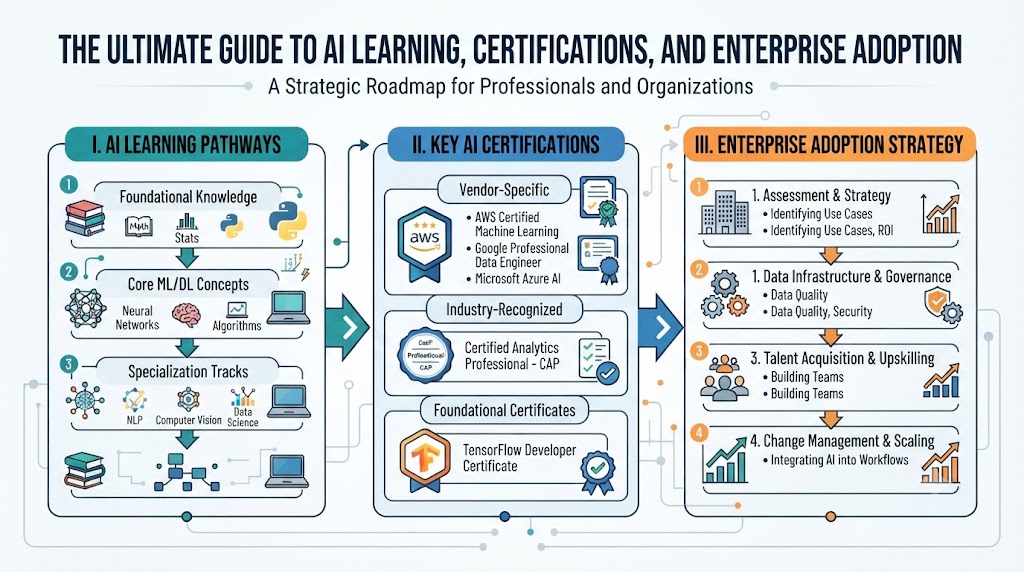
The 4-Stage Enterprise Adoption Framework
- Assessment and Strategy: Identify high-value business use cases, define key performance indicators (KPIs), evaluate internal data readiness, and establish compliance policies.
- Infrastructure and Tooling Setup: Establish secure cloud environments, deploy centralized feature stores, implement prompt management infrastructure, and configure monitoring tools.
- Pilot Programs and Validation: Launch focused, small-scale Proof of Concepts (PoCs) in high-impact departments to validate ROI, gather user feedback, and refine system design.
- Scale, Upskill, and Govern: Roll out verified systems across all business divisions, launch mandatory employee upskilling programs, and enforce enterprise governance.
Common AI Learning Mistakes
Both individuals learning artificial intelligence and businesses building enterprise solutions frequently fall into common technical and strategic traps. Recognizing these mistakes early saves significant time and financial resources.
Critical Mistakes to Avoid
- Focusing Exclusively on Theory: Spending months studying deep mathematical derivations without building end-to-end software deployments.
- Ignoring MLOps and Lifecycle Maintenance: Treating model deployment as a one-time project rather than an ongoing maintenance process that requires continuous monitoring and retraining.
- Underestimating Data Quality: Attempting to train complex models or build RAG systems using messy, unstructured, or unvalidated source data (“garbage in, garbage out”).
- Over-Engineering Simple Problems: Forcing expensive large language models or complex multi-agent orchestrations onto simple business problems that could easily be solved with standard database queries or basic logic.
- Neglecting Enterprise Security: Allowing development teams to test external public APIs using sensitive company data without implementing private proxies, access controls, or prompt logging.
Best Practices for AI Learning
To build a sustainable, successful career or lead an effective enterprise team, adopt these proven practices:
- Prioritize Hands-On Implementation: Always pair theoretical learning with practical execution. Build complete end-to-end projects, deploy them via APIs, containerize them with Docker, and host them on cloud servers.
- Master Pipeline Operations Early: Do not isolate yourself in local notebooks. Learn version control, automated testing pipelines, experiment tracking, and deployment tools from day one.
- Invest Heavily in Data Hygiene: Spend time mastering data cleaning, feature engineering, vector indexing, and pipeline orchestration. High-quality data consistently outperforms complex algorithms trained on noisy data.
- Focus on Security and Compliance: Learn how to implement role-based access control (RBAC), data encryption, model evaluation, and safety guardrails across all software applications.
Future of AI Skills
As natural language interfaces and generative coding tools continue to mature, the specific skills required by developers, data scientists, and business leaders will continue to evolve.
The Shift Toward System Orchestration
Writing raw code syntax is rapidly becoming automated. Future technical professionals will focus less on typing line-by-line functions and more on high-level system architecture, agent orchestration, data management, and problem definition.
Key future focus areas include:
- Agentic Safety and Alignment: Designing systems that prevent autonomous agents from performing unintended actions in production environments.
- Synthetic Data Generation: Creating high-fidelity, privacy-compliant synthetic datasets to train specialized models when real-world data is scarce.
- Edge Computing Optimization: Quantizing and pruning complex models to run efficiently on local edge hardware with low latency and minimal energy usage.
Frequently Asked Questions
1. What is AIUniverse and who is it designed for?
AIUniverse is a comprehensive educational platform and strategic resource hub designed for students, software developers, data scientists, DevOps engineers, and enterprise leaders seeking to master artificial intelligence, MLOps, AIOps, and enterprise integration.
2. What are the key benefits of taking an Agentic AI certification course?
An Agentic AI course teaches you how to build autonomous systems capable of dynamic planning, multi-step execution, tool integration, and context management using modern frameworks like LangChain, AutoGen, and CrewAI.
3. How does MLOps differ from traditional DevOps?
While DevOps focuses on continuous integration and deployment of traditional code, MLOps extends these principles to manage data pipelines, experiment tracking, model registries, continuous retraining, and real-world model drift monitoring.
4. What is AIOps and how does it help enterprise IT teams?
AIOps applies machine learning and big data analytics to enterprise IT operations. It helps teams automate log analysis, predict server downtime, perform root-cause analysis, and execute self-healing remediation routines to maintain system uptime.
5. Why should businesses invest in corporate AI training?
Corporate training upskills existing employees, turning them into efficient users and developers who can automate internal tasks, build proprietary tools, enforce security policies, and maximize returns on technology investments.
6. What services are included in professional AI consulting?
AI consulting services include feasibility studies, architectural system design, data governance strategies, security compliance checks, cost optimization, and technical guidance for scaling projects into production.
7. Why are prompt management tools necessary for developers?
Prompt management tools decouple prompts from application source code. They allow teams to version-control, collaborate on, test, and evaluate prompt variations securely without needing to redeploy software codebase packages.
8. What is federated learning and why is it important for privacy?
Federated learning allows machine learning models to be trained across decentralized devices or servers containing local data samples without exchanging the raw data itself, making it ideal for privacy-sensitive industries like healthcare and finance.
9. Which MLOps tools are most widely used in the industry today?
Industry-standard MLOps tools include MLflow and Weights & Biases for experiment tracking, DVC and Feast for data versioning and feature storage, Triton and KServe for serving, and Evidently AI for drift monitoring.
10. How can non-technical business professionals start learning AI?
Non-technical professionals should start by learning practical workflow automation tools, fundamental prompt engineering, and business use-case evaluation before diving into specialized courses or high-level strategic frameworks.
11. What are the most common causes of model drift in production?
Model drift is typically caused by changes in real-world consumer behavior, seasonal shifts, evolving economic conditions, or changes in upstream data collection hardware and APIs.
12. How does AIUniverse support complete beginners?
AIUniverse offers clear foundational learning paths, easy-to-understand explanations, practical real-world examples, and step-by-step guidance to ensure learners of all experience levels can progress effectively.
13. What is the difference between Generative AI and Agentic AI?
Generative AI focuses primarily on producing content (text, images, code) based on a given user prompt. Agentic AI goes further by autonomously setting goals, planning sub-tasks, executing code, using external software tools, and correcting its own errors.
14. How can small businesses afford enterprise AI adoption?
Small businesses can start by leveraging affordable open-source models, modular API integrations, and low-code workflow automation platforms before committing to custom hardware infrastructure or extensive fine-tuning projects.
15. Is coding required to work with modern AI platforms?
While basic coding (such as Python) is beneficial for custom model development and MLOps engineering, many modern business productivity applications, prompt management suites, and analytics tools operate using clean visual interfaces and natural language.
Conclusion
Artificial Intelligence is fundamentally reshaping how individuals manage their careers and how enterprises build modern software infrastructure. Navigating this rapidly evolving landscape requires moving beyond generic theoretical concepts and embracing practical, hands-on execution. Whether you are an engineer seeking specialized skills in Agentic architecture, an IT professional looking to master AIOps, or an enterprise executive driving business transformation, structured education and clear operational strategies are essential for success.
Platforms like AIUniverse provide the certified learning tracks, specialized insights, prompt management strategies, and consulting frameworks needed to bridge the gap between technical complexity and real-world results. By focusing on practical application, sound MLOps principles, continuous workforce upskilling, and robust data governance, both individuals and organizations can confidently build, scale, and manage intelligent systems for long-term operational success.