
Introduction
Managing cloud expenditures has shifted from an administrative accounting chore to a critical engineering discipline. The Certified FinOps Professional designation represents the industry benchmark for practitioners who bridge the divide between technology teams, engineering workflows, finance departments, and executive leadership. This comprehensive guide provides an objective breakdown for software engineers, platform architects, engineering leaders, and operations specialists aiming to master the operational mechanics of financial engineering. Supported by educational initiatives from FinOpsSchool, this blueprint details the core competencies, examination pathways, operational challenges, and practical return on investment associated with becoming a certified authority in modern cloud cost optimization.
What is the Certified FinOps Professional?
The Certified FinOps Professional is an advanced, production-oriented validation program created to evaluate an engineer or manager’s ability to implement fiscal accountability within distributed systems. Rather than focusing merely on billing dashboards or static reports, it emphasizes real-world cost allocation, architectural unit economics, resource elasticity, and rate optimization strategies.
Modern cloud-native systems running on Kubernetes, multi-cloud platforms, and serverless architectures scale dynamically, making static budgeting models obsolete. This certification proves that an engineer understands how to weave financial visibility into continuous integration and continuous deployment pipelines, automated provisioning templates, and infrastructure monitoring stacks. It shifts cloud financial management from a reactive, end-of-month scramble to an automated, continuous operational discipline.
Who Should Pursue Certified FinOps Professional?
This credential is engineered for professionals across the software delivery lifecycle who directly influence cloud infrastructure utilization and organizational spending. DevOps and Site Reliability Engineers benefit substantially by learning how to evaluate deployment choices, cluster sizing, and resilience architectures through a cost-efficiency lens without compromising service-level objectives.
Enterprise platform engineers, solutions architects, technical project managers, and finance professionals embedded in engineering units will find immediate applicability in their daily workflows. The program caters effectively to technical practitioners in both mature cloud environments and developing tech hubs, including the rapidly expanding engineering ecosystems across India, North America, Europe, and the Asia-Pacific region, where enterprise cloud migrations require rigorous governance.
Why Certified FinOps Professional
Cloud infrastructure spending represents one of the largest operating expenses for modern software enterprises. As organizations scale, unmanaged compute instances, over-provisioned storage tiers, and abandoned development clusters rapidly degrade operational margins. Professionals holding the Certified FinOps Professional credential are equipped to eliminate this waste methodically, making them invaluable assets to modern engineering organizations.
Beyond immediate waste reduction, this credential establishes enduring career stability by decoupling professional expertise from transient tools. While specific cloud interfaces and billing APIs evolve, the underlying principles of rate optimization, workload right-sizing, anomaly detection, shared cost allocation, and collaborative governance remain constant. Investing time into this discipline yields sustained professional dividends, establishing technical practitioners as high-impact leaders capable of driving measurable business efficiency.
Certified FinOps Professional Certification Overview
The Certified FinOps Professional program provides an exhaustive assessment framework designed to test an individual’s practical mastery of modern cloud financial lifecycle stages: Inform, Optimize, and Operate. Candidates are evaluated on their ability to ingest complex billing data, establish granular tagging policies, build automated remediation workflows, and guide organizational culture toward decentralized cost ownership.
Assessment involves analyzing complex enterprise case studies, solving rate and capacity scenarios, designing showback and chargeback systems, and balancing architectural reliability against operational spend. The evaluation guarantees that certified individuals possess actionable, engineering-grade competency rather than superficial theoretical awareness, qualifying them to manage multi-million-dollar cloud footprints with confidence.
Certified FinOps Professional Certification Tracks & Levels
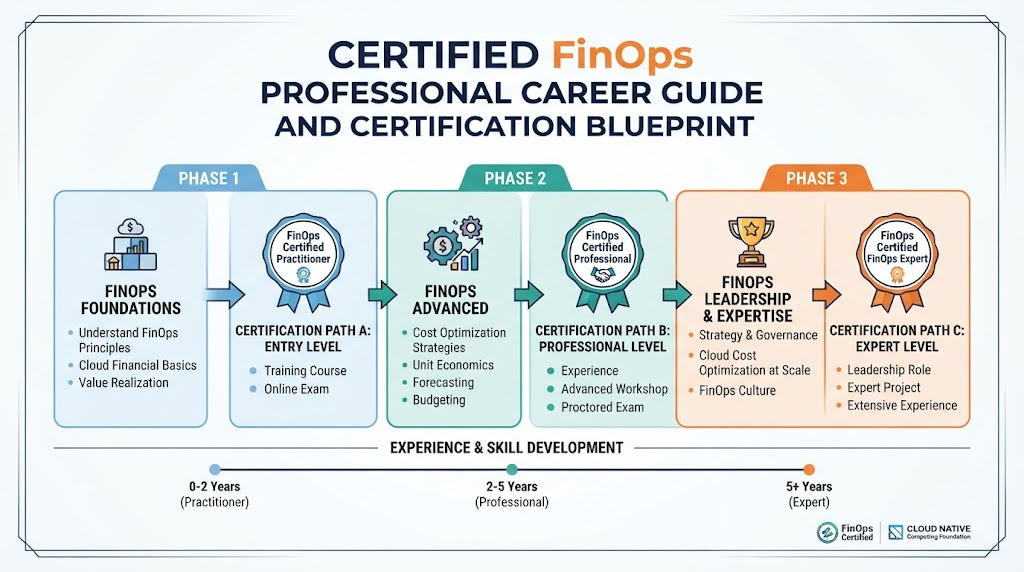
Professional development within this domain follows a structured tier of capability, progressing from foundational principles to advanced governance and organizational execution.
- Foundation Level: Focuses on establishing fluency in core terminology, the cloud billing model, visibility mechanics, and the shared responsibility model between engineering and finance.
- Professional Level: Delves into hands-on architectural optimization, unit economics calculation, anomaly detection engines, commitment portfolio planning, and automated governance.
- Advanced / Architect Level: Targets enterprise-scale organizational transformation, multi-cloud financial federation, cross-functional organizational design, custom metric development, and executive policy integration.
Complete Certified FinOps Professional Certification Table
| Track | Level | Who it’s for | Prerequisites | Skills Covered | Recommended Order |
| Cloud Financial Operations | Foundation | Junior Engineers, Financial Analysts, Operations Associates | Basic Cloud Concepts | Cloud billing basics, tagging, resource identification, cost visibility | 1 |
| Engineering Cost Architecture | Professional | DevOps, SREs, Cloud Architects, Platform Leads | 2+ Years Cloud Operations | Workload rightsizing, commitment discounts, container cost allocation, anomaly detection | 2 |
| Enterprise Governance | Advanced | Principal Architects, Engineering Directors, FinOps Leads | Professional Certification | Unit economics, organizational change, multi-cloud chargeback, executive KPI reporting | 3 |
Detailed Guide for Each Certified FinOps Professional Certification
Certified FinOps Professional – Foundation Level
What it is
Validates foundational comprehension of cloud billing constructs, resource visibility mechanisms, and standard lifecycle phases. It ensures individuals can effectively interpret cloud invoices, establish baseline monitoring, and communicate across technical and financial boundaries.
Who should take it
Early-career cloud engineers, technical project coordinators, financial analysts working alongside engineering teams, and systems administrators transitioning toward cloud-native financial management.
Skills you’ll gain
- Understanding cloud variable spend models versus traditional fixed capital expenditures.
- Implementing basic tagging standards for comprehensive resource metadata tracking.
- Interpreting raw billing data exports and basic cost management console reporting.
- Establishing visibility thresholds and foundational budget alerting metrics.
Real-world projects you should be able to do
- Build an automated dashboard tracking daily cost trends across distinct engineering environments.
- Conduct an audit to identify untagged resources across multi-account development environments.
- Configure automated threshold-based billing alerts using native cloud notification services.
Preparation plan
- 7–14 Days: Read foundational framework documentation, review cloud pricing calculator models, and master basic billing nomenclature.
- 30 Days: Set up test billing accounts, configure cost allocation tags, and build basic budget alerts in a sandbox environment.
- 60 Days: Deeply analyze real enterprise sample billing datasets, map cost centers to infrastructure components, and take practice assessment tests.
Common mistakes
- Treating cloud spend solely as an accounting problem rather than a shared engineering operational responsibility.
- Ignoring the importance of consistent metadata and taxonomy standards across development environments.
- Focusing purely on cost cutting rather than aligning infrastructure cost with business value generation.
Best next certification after this
- Same-track option: Certified FinOps Professional – Professional Level
- Cross-track option: Cloud Associate Solutions Architect
- Leadership option: Certified Engineering Management Professional
Certified FinOps Professional – Professional Level
What it is
Validates advanced technical capabilities required to architect, optimize, and govern production cloud footprints. It proves the holder can systematically implement automated workload optimization, commitment portfolio purchases, and container-level attribution.
Who should take it
Senior DevOps Engineers, Site Reliability Engineers, Cloud Infrastructure Architects, and dedicated technical practitioners responsible for enterprise cloud efficiency.
Skills you’ll gain
- Calculating and tracking complex unit economics metrics tied to production software output.
- Structuring commitment strategies spanning Reserved Instances, Savings Plans, and Spot allocations.
- Allocating shared infrastructure costs, idle capacity, and container workloads in Kubernetes clusters.
- Developing automated CI/CD guardrails and infrastructure-as-code linting for cost control.
Real-world projects you should be able to do
- Deploy an open-source container cost allocation tool into a Kubernetes cluster to track namespace-level spend.
- Design a mixed compute strategy incorporating Spot instances and savings commitments for a microservices cluster.
- Implement automated remediation scripts to shut down ephemeral test environments outside core operational hours.
Preparation plan
- 7–14 Days: Focus on mathematical formulas for commitment break-even analysis, container resource metrics, and rate optimization algorithms.
- 30 Days: Execute hands-on rightsizing experiments, parse deep CUR (Cost and Usage Report) files using SQL queries, and construct unit metrics.
- 60 Days: Implement complete cost observability stacks across multiple staging environments, simulate production anomaly incidents, and draft full mitigation plans.
Common mistakes
- Over-committing to long-term discount plans without factoring in planned architectural migrations.
- Rightsizing compute workloads without monitoring latency, throughput, and error rates in APM tools.
- Failing to account for shared service overhead like cross-zone data transfer and centralized log storage.
Best next certification after this
- Same-track option: Certified FinOps Professional – Enterprise Architect Track
- Cross-track option: Kubernetes Certified Administrator (CKA)
- Leadership option: Director of Platform Engineering / Enterprise Architect
Certified FinOps Professional – Advanced / Enterprise Level
What it is
Validates expertise in driving large-scale organizational transformations, designing multi-cloud governance policies, and implementing company-wide showback and chargeback systems aligned with business KPIs.
Who should take it
Principal Engineers, Enterprise Architects, Cloud Directors, and Heads of Infrastructure aiming to build and lead institutional cost-efficiency capabilities.
Skills you’ll gain
- Designing automated chargeback and showback frameworks across diverse multi-cloud environments.
- Establishing organizational KPI metrics connecting infrastructure costs directly to business profitability.
- Leading cross-functional cultural change and integrating cost accountability into development teams.
- Negotiating custom enterprise discount agreements and commercial contracts with cloud vendors.
Real-world projects you should be able to do
- Author an enterprise-wide cloud governance policy standardizing tagging, commitment management, and deprecation.
- Design a real-time unit economic dashboard tracking cost-per-transaction for an enterprise core application.
- Establish a cross-functional governance working group bridging engineering, finance, and procurement leadership.
Preparation plan
- 7–14 Days: Review case studies on enterprise organizational change, executive metric design, and vendor governance frameworks.
- 30 Days: Model enterprise chargeback mechanisms for complex shared network, security, and data platforms.
- 60 Days: Draft end-to-end strategic playbooks covering executive alignment, cultural enablement, tooling evaluation, and incentive engineering.
Common mistakes
- Imposing top-down restrictions that slow developer velocity instead of building guardrails that enable autonomous optimization.
- Relying exclusively on third-party commercial tools without fixing fundamental architectural anti-patterns.
- Measuring success solely by total bill reduction rather than overall business efficiency and margins.
Best next certification after this
- Same-track option: Continuous Executive Mentorship & Practice
- Cross-track option: Chief Technology Officer Certification / Executive Leadership Program
- Leadership option: Enterprise Technology Strategy Certification
Choose Your Learning Path
DevOps Path
The DevOps learning path embeds financial mechanics directly into continuous delivery, automated provisioning, and configuration management workflows. Engineers learn to integrate cost-estimation checks into pull requests, enforce infrastructure-as-code linting standards using tools like Open Policy Agent, and automate lifecycle management for non-production environments. This pathway ensures that financial feedback reaches developers early in the development cycle, preventing expensive misconfigurations from ever deploying to production environments.
DevSecOps Path
The DevSecOps learning path integrates financial optimization with compliance, vulnerability remediation, and governance frameworks. Engineers explore how security scanning, compliance logging, and encryption mechanisms impact storage tiers, networking egress, and computational overhead. This pathway equips professionals to optimize security tool sprawl, eliminate unused security agents, and design defensive architectures that meet enterprise compliance requirements without generating unmanaged infrastructure spend.
SRE Path
The Site Reliability Engineering path focuses on balancing reliability, service-level objectives, and operational expenditure. Practitioners evaluate how high-availability configurations, multi-region failovers, disaster recovery systems, and observability platforms contribute to infrastructure costs. This track teaches SREs to design fault-tolerant systems that respect economic boundaries, ensuring that excess redundancy does not drain company resources while defending critical availability metrics.
AIOps Path
The AIOps learning path focuses on applying machine learning algorithms to operational telemetry and financial data. Engineers learn to deploy automated anomaly detection models to identify infrastructure cost spikes in real time before they impact monthly balance sheets. This pathway emphasizes automated pattern recognition, intelligent capacity forecasting, and automated remediation systems that adjust resource allocations dynamically based on predicted traffic patterns.
MLOps Path
The MLOps pathway is tailored specifically for the intensive computational demands of artificial intelligence and machine learning pipelines. Engineers study the costs associated with GPU clusters, model training runs, distributed dataset storage, and real-time inference endpoints. This track teaches practitioners how to implement spot instance orchestration for batch training jobs, manage model registry storage costs, and scale inference fleets efficiently against actual user demand.
DataOps Path
The DataOps learning path addresses the distinct financial challenges found in data engineering, data warehousing, and modern analytics stacks. Professionals learn to optimize large-scale compute engines, manage automated query performance, and design storage lifecycle rules across massive data lakes. This track focuses on partitioning strategies, query cost attribution, and managing modern data warehouse spend across distributed analytics teams.
FinOps Path
The dedicated FinOps path is the primary route for professionals aiming to specialize completely in technical financial management and governance. This track covers the entire operational lifecycle, progressing deeply through cost allocation architectures, commitment discounts, organizational unit economics, and cultural enablement. It prepares individuals to build dedicated internal cost management practices that operate across engineering, finance, and executive leadership teams.
Role → Recommended Certified FinOps Professional Certifications
| Role | Recommended Certifications |
| DevOps Engineer | Certified FinOps Professional (Professional Level) |
| SRE | Certified FinOps Professional (Professional Level) |
| Platform Engineer | Certified FinOps Professional (Professional Level) |
| Cloud Engineer | Certified FinOps Professional (Foundation Level) |
| Security Engineer | Certified FinOps Professional (Foundation Level) |
| Data Engineer | Certified FinOps Professional (Professional Level) |
| FinOps Practitioner | Certified FinOps Professional (Advanced Level) |
| Engineering Manager | Certified FinOps Professional (Advanced Level) |
Next Certifications to Take After Certified FinOps Professional
Same Track Progression
Once you achieve the core Certified FinOps Professional credential, continuing within the same track involves expanding into specialized enterprise governance and architectural maturity models. Progression here means focusing on deep analytical techniques, advanced data modeling of cloud usage reports, and building custom internal platforms that automate rate optimization across multi-cloud environments. This keeps you at the bleeding edge of the discipline.
Cross-Track Expansion
Deepening your credibility requires validating skills in adjacent engineering domains that directly influence cloud consumption. Pursuing advanced cloud architect certifications, Kubernetes administration credentials, and infrastructure-as-code accreditations builds a powerful hybrid skill profile. An engineer who possesses deep FinOps knowledge alongside hands-on orchestration and platform engineering expertise holds a commanding advantage in modern technical leadership discussions.
Leadership & Management Track
For senior professionals looking to transition from technical implementation to organizational strategy, pursuing leadership and engineering management certifications is the logical next step. These programs emphasize organizational design, executive stakeholder management, strategic procurement, and budget accountability. Pairing deep technical cost engineering with executive leadership capabilities equips you for roles such as Director of Cloud Operations, VP of Platform Engineering, or Chief Technology Officer.
Training & Certification Support Providers for Certified FinOps Professional
DevOpsSchool
DevOpsSchool provides comprehensive, instructor-led training programs designed by industry veterans with extensive enterprise experience. Their curriculum places a heavy emphasis on real-world implementation, guiding students through practical labs, infrastructure-as-code cost automation, and deep architectural analysis. The platform supports learners with extensive study resources, recorded sessions, and guided mentoring that helps bridge theoretical concepts with production-grade engineering requirements.
Cotocus
Cotocus delivers enterprise-focused consulting and specialized technical upskilling for modern engineering organizations. Their training methodologies focus heavily on production infrastructure transformation, container economics, and multi-cloud optimization strategies. By integrating hands-on scenario training with real-world infrastructure blueprints, Cotocus enables working professionals and enterprise teams to rapidly acquire practical, job-ready skills that immediately impact organizational performance.
Scmgalaxy
Scmgalaxy is a dedicated knowledge base and community platform offering extensive tutorials, reference architectures, and training programs across the software delivery lifecycle. Their educational resources focus on source code management, continuous integration, and infrastructure cost transparency. The platform serves as a reliable technical reference for engineers seeking practical guides, community discussions, and specialized certification preparation content.
BestDevOps
BestDevOps focuses on curating high-quality technical roadmaps, learning resources, and practical tool assessments for modern infrastructure practitioners. Their content offers clear, unbiased comparisons of cloud platforms, observability stacks, and cost governance utilities. By breaking down complex technical subjects into digestible, actionable guides, BestDevOps helps software engineers and platform specialists make informed decisions regarding their professional upskilling paths.
devsecopsschool.com
devsecopsschool.com specializes in the intersection of security automation, continuous compliance, and infrastructure architecture. Their training programs teach engineers how to secure cloud-native environments without incurring unsustainable infrastructure costs. By highlighting efficient scanning pipelines, optimized logging architectures, and secure baseline configurations, the platform prepares professionals to defend enterprise infrastructure both securely and economically.
sreschool.com
sreschool.com is an educational platform dedicated to the principles of Site Reliability Engineering, distributed systems resilience, and performance management. Their coursework guides engineers through balancing service availability targets, incident response protocols, and economic infrastructure constraints. Students gain hands-on experience designing architectures that provide high reliability and minimal downtime while maintaining clean, predictable cloud operating expenditures.
aiopsschool.com
aiopsschool.com focuses on the operational application of machine learning, automated telemetry analysis, and algorithmic infrastructure management. Their specialized programs teach engineers how to build automated detection pipelines that flag operational and financial anomalies before they cause service degradation or cost overruns. The platform is ideal for practitioners seeking to master intelligent, data-driven automation within complex cloud environments.
dataopsschool.com
dataopsschool.com provides targeted technical education for data engineers, analytics architects, and database administrators managing large-scale data workflows. Their courses focus on optimizing data pipelines, managing compute-intensive query engines, and implementing tiered storage governance. Through practical labs, students learn how to extract maximum value from enterprise data infrastructure without exceeding operational data platform budgets.
finopsschool.com
finopsschool.com is a dedicated educational authority focused entirely on cloud financial management, cost architecture, and technical governance. The institution offers specialized, career-oriented certification preparation programs that cover the entire financial engineering lifecycle. With a faculty of seasoned industry practitioners, the platform provides deep technical training, practical case studies, and mentorship for individuals and enterprise teams worldwide.
Frequently Asked Questions
1. What is the fundamental goal of the Certified FinOps Professional program?
The primary objective is to validate an engineer or manager’s ability to drive cloud financial accountability, eliminate wasted expenditure, and align technical architectures with measurable business value.
2. How mathematically complex is this certification?
The mathematical requirements involve practical financial calculations such as unit costs, amortization, percentage-based commitment discount models, and break-even timelines rather than advanced calculus or theoretical mathematics.
3. Is prior software development experience required?
While coding experience is beneficial, it is not mandatory; however, candidates should have a solid conceptual understanding of cloud infrastructure, networking, storage tiers, and deployment lifecycles.
4. How much time is typically required to prepare for the examination?
Most working engineers dedicate between 30 and 60 days of consistent study, focusing on practical billing analysis, commitment planning, and architectural optimization strategies.
5. How does this credential differ from standard cloud architect certifications?
Standard cloud architect certifications validate system design, security, and operational resilience, whereas this program focuses specifically on the economic efficiency, financial attribution, and governance of those systems.
6. Does this certification hold value for non-engineering finance professionals?
Yes, financial analysts and procurement specialists embedded within technology teams benefit significantly by learning the operational mechanics, architecture patterns, and nomenclature used by cloud engineering departments.
7. How does this program address container and Kubernetes costs?
The curriculum covers container economics extensively, including resource request and limit configuration, namespace cost attribution, shared cluster overhead distribution, and idle capacity management.
8. What is the recommended balance between theoretical study and hands-on practice?
Candidates should balance their time equally between understanding operational frameworks and working directly with cloud billing consoles, cost usage reports, and infrastructure automation tools.
9. Will this certification remain relevant as artificial intelligence tools automate cost tracking?
Yes, because while automated tools can detect anomalies, human expertise remains essential for setting organizational policy, negotiating vendor contracts, and making nuanced architectural trade-offs.
10. How does this certification support career progression toward leadership roles?
Demonstrating mastery over both technical infrastructure and business margins positions technical professionals as valuable strategic leaders capable of managing engineering budgets effectively.
11. Is this certification recognized globally across enterprise employers?
Yes, enterprises worldwide actively seek certified professionals to manage their growing multi-cloud budgets, control infrastructure waste, and establish structured financial governance.
12. What are the common prerequisites before attempting this assessment?
A minimum of one to two years of hands-on experience working within public cloud environments, coupled with a solid understanding of cloud billing concepts, is strongly recommended.
FAQs on Certified FinOps Professional
1. What specific cloud platforms are covered in the Certified FinOps Professional assessment?
The assessment is designed around vendor-neutral principles, ensuring the skills apply universally across major public clouds such as Amazon Web Services, Microsoft Azure, and Google Cloud Platform. While core concepts like commitments, storage lifecycle policies, and egress costs apply everywhere, candidates learn the corresponding terminology for each major platform. This broad perspective enables professionals to manage multi-cloud footprints without being locked into a single provider’s proprietary billing ecosystem.
2. How does the Certified FinOps Professional certification address multi-cloud environments?
The program provides frameworks for consolidating divergent billing formats into unified data pipelines for comprehensive analysis. Candidates learn how to normalize cost allocation tags, build centralized showback dashboards across multiple providers, and evaluate cross-cloud data transfer costs. This multi-cloud capability is essential for large enterprises that maintain workloads across diverse vendors to avoid single-supplier dependence while maintaining consolidated executive financial visibility.
3. What practical hands-on exercises best prepare candidates for this certification?
Effective preparation involves writing SQL queries against deep Cost and Usage Reports (CUR), building automated dashboard visualizations, and configuring container-level monitoring tools. Candidates should practice calculating effective savings rates across mixed reservation portfolios, simulating right-sizing outcomes for compute clusters, and developing automated scripts that eliminate unattached storage volumes. Working through realistic production scenarios solidifies the analytical instincts tested during the assessment.
4. How does holding this certification impact an engineer’s day-to-day workflow?
Certified practitioners approach infrastructure decisions with a balanced view of operational capability and financial impact. Instead of over-provisioning resources to guarantee stability, they use data-driven insights to right-size instances, optimize storage classes, and configure autoscaling policies. They also spend less time manually justifying monthly bills because they establish automated tagging and reporting systems that provide continuous visibility to finance and leadership teams.
5. How does this certification help engineering managers and technical leads?
For engineering leaders, the credential provides structured methodologies to build a culture of financial accountability without slowing down product delivery. Managers learn how to establish realistic cloud budget targets, design incentives for engineering teams to optimize workloads, and defend infrastructure investments using unit economic business metrics. This capability bridges the communication gap between technical leadership and the executive suite.
6. What role does automation play in the Certified FinOps Professional curriculum?
Automation is a central focus of the curriculum, emphasizing that manual cost tracking is unsustainable in modern dynamic environments. Candidates learn how to integrate cost linting into continuous deployment pipelines, automate policy enforcement via infrastructure-as-code scanners, and trigger automated shutdown of non-production environments. The curriculum trains professionals to deploy programmatic guardrails that actively prevent overspending before resources are provisioned.
7. How frequently should a certified professional update their knowledge base?
Given the continuous evolution of cloud service offerings, pricing structures, and commitment discount models, professionals should review their skills continuously. Engaging with practitioner communities, reviewing case studies, and monitoring vendor billing updates ensures your optimization strategies stay current. Maintaining alignment with the latest container cost allocation tools and architectural patterns ensures long-term operational effectiveness across modern cloud environments.
8. Can small organizations benefit from employing a Certified FinOps Professional?
Smaller organizations and fast-growing startups benefit substantially because early cost management prevents architectural debt from compounding as infrastructure scales. A certified professional helps young companies maximize startup cloud credits, select flexible commitment models, and implement clean tagging architectures from day one. This foundational discipline prevents runaway cloud spend from depleting venture capital runway during critical growth periods.
Final Thoughts: Is Certified FinOps Professional Worth It?
Investing time and energy into mastering cloud financial engineering represents a pragmatic, high-impact career move for technical professionals. Modern software engineering has evolved past the era where infrastructure was treated as an infinite, unmetered resource. Companies demand clear financial visibility and efficiency from their technical teams, and those who can deliver robust, highly available architectures at optimal cost hold a distinct professional advantage.
Pursuing the Certified FinOps Professional credential requires moving past the superficial layer of cost dashboards into the technical core of infrastructure utilization, data egress economics, and organizational governance. If your career goal is to become an indispensable bridge between complex systems engineering and executive business strategy, mastering this discipline offers exceptional long-term professional value.